![[2026 Update] After WhatsApp’s risk control becomes stricter, what should be done to screen numbers so that they are not easily blocked?](/_nuxt/img/android-chrome-192x192.deac7789b80c.png)
Recently, many teams working on acquiring customers for WhatsApp have had a clear feeling: the same operation method that worked before is now more likely to trigger restrictions or even account closures. The change is not just the sending behavior itself, but a larger part comes from the quality of the data.
As risk control becomes stricter, screen numbers are no longer just a tool to improve conversions, but are directly related to the stability of the account.
After risk control is tightened, the problem usually lies in the data layer
In actual use, many restricted accounts do not have abnormal sending frequency, but have problems with reaching objects.
For example:
- Frequent access to unregistered numbers
- Send bulk messages to low active or silent users
- Abnormal account numbers or invalid numbers are mixed into the data
These behaviors will be judged by the system as low-quality contacts, thereby increasing risks.
Which data is more likely to trigger risks
Before screening, raw data often contains multiple high-risk types.
If the WhatsApp number is not registered, this type of data cannot be reached, but it will increase the failure rate.
Accounts with abnormal status can easily be judged as abnormal behavior
Users who have been inactive for a long time have no interaction after being contacted, which affects the judgment of account behavior.
If the proportion of these data is too high, the limit may be triggered even if the sending rhythm is normal.
The role of screen number in risk control
The core of screening is not only to filter out usable data, but also to filter out high-risk data.
By filtering, you can:
- Reduce delivery failure rate
- Improve reach efficiency
- Make account behavior closer to normal use
After this layer of processing, the overall performance of the account will be more stable and less likely to be judged as abnormal.
How to create a more stable screening method
In the current environment, the screening process needs to be clearer, rather than simply judging the registration status.
A more stable way is:
- Do number detection first and filter out unavailable data
- Screen the registration status again to ensure that the account exists
- Re-screen activity and only retain users with usage behavior
The combination of these three steps can filter out most high-risk data in advance.
Data structure will directly affect account security
If the proportion of high-quality users in the data is high, the sending behavior is more likely to be recognized by the system as normal communication.
On the contrary, if a large number of invalid or low-active users are reached, even if the sending volume is not large, it may be judged as abnormal.
Therefore, the data structure itself is a part of risk control, rather than a mere preliminary step.
Batch screening can reduce unstable factors
When the amount of data is large, manual filtering is not only inefficient, but also difficult to ensure uniform standards.
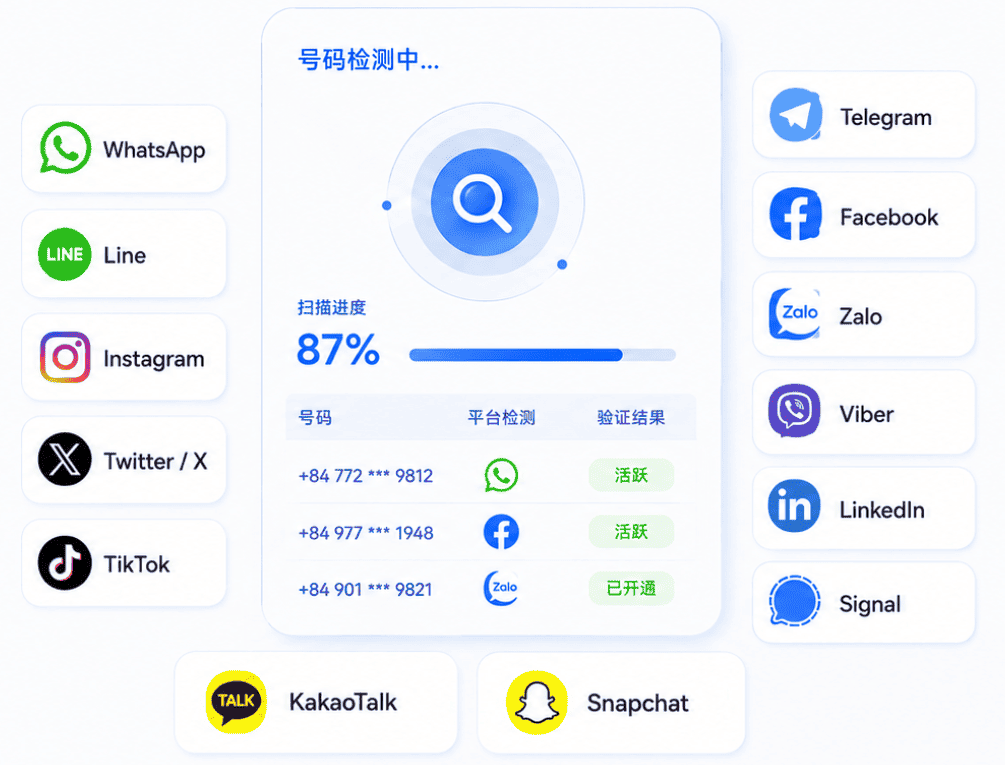
Through Amman, number detection, registration status identification and activity screening can be directly completed in the number screening stage, and high-risk data can be filtered out in advance. It supports batch processing and can also be connected to the API so that the data can be filtered before being used.
In a risk control environment, it is more important to reduce ineffective actions
In the current environment, stability is more important than scale. It's not that the more you send, the better, but the more precise the contact, the safer it is.
When the screening process is stable, the account behavior will be closer to normal usage, and the overall risk will be reduced.
Amman is the world's leading number screening platform, providing global customers with batch number screening and testing services covering 236 countries. The platform currently supports more than 40 mainstream social networking and applications, including WhatsApp, Line, Twitter, Facebook, Instagram, LinkedIn, Viber, Zalo, Binance, Signal, etc., adapting to the needs of multiple scenarios.
The main core functions cover multi-dimensional precise screening such as activation, activity, interaction, gender, avatar, age, online, accuracy, empty account, mobile phone device, etc., and can flexibly meet the needs of different users. Its core advantage is to integrate global mainstream social and application resources to provide users with one-stop, real-time and efficient number precision screening services, helping customers achieve global digital layout.
It is a common choice for all professional teams to complete rational screening before actually reaching users.
Editor abcheck has a lot of experience, welcome to communicate with me, click to contact @Tg8189