
When doing WhatsApp customer development, many teams will focus on a certain link, such as constantly optimizing speaking skills, or blindly expanding the data scale. But the actual effect is often unstable. Sometimes a lot of data is sent but there is no response, and sometimes the effect is completely different when changing a batch of data.
The problem is not that a certain link is not done well, but that the process is not smoothed out. Customer development is not a single point of optimization, but a complete combination from data to reach. If these three steps of number detection, active screening and speech preparation are done in the wrong order, it will be difficult to improve the effect no matter how you optimize it later.
Why customer development can’t just do one thing
In actual operation, the most common misunderstanding is to only focus on one point.
- Only optimize words and ignore data quality
- Only expand the data size without filtering
- Only look at the number of messages sent, not the effective reach
These practices may seem to improve efficiency, but they actually amplify the problem. If the data is not clean, no matter how many contacts are made, it will only increase costs.
Number detection is the first step
In all processes, number detection is the most basic step.
It solves the most direct problem:
- Which numbers have been activated for WhatsApp?
- What data is simply inaccessible?
If this step is not done, a large number of invalid numbers will be mixed in subsequent transmissions, which will directly reduce the overall effect.
In actual operation, number detection should be the first step in the data entry process, rather than a subsequent supplementary action.
Active screening determines follow-up efficiency
Number activation is only a basic condition, what really affects the results is whether the user is using it.
Common situations are:
- Some users have registered but have not logged in for a long time
- Some accounts are used occasionally and the response is unstable.
- Only some users have continuous usage behavior
Without active screening, these differences will directly affect the reach effect.
Screening out users with usage behavior can significantly increase the probability of messages being seen, making subsequent communication more basic.
Preparation of speaking skills should be used in conjunction with data
Many teams will prepare a large number of words, but there is no obvious difference in actual use. The reason is that the words do not correspond to the user layers.
A more efficient way is:
- For highly active users, directly use conversion-oriented words
- For moderately active users, adopt a testing and onboarding approach
- For low-active users, reduce investment or delay reaching them
There is nothing wrong with the words themselves, the key lies in whether they are used on the right people.
The correct sequence of the three links
In actual implementation, these three steps should be in a fixed sequence rather than a random combination.
It can be understood as:
- Do number detection first and filter out unavailable data
- Then do active filtering to filter out available users.
- Finally, match the words to reach the audience
Once this sequence is determined, the overall process will become more stable and easier to optimize.
Use Amman to make front-end screening easier
When the amount of data is large, it is difficult to complete detection and filtering at the same time if you rely on manual operations. A more practical approach would be to have tools process the data as it comes in.
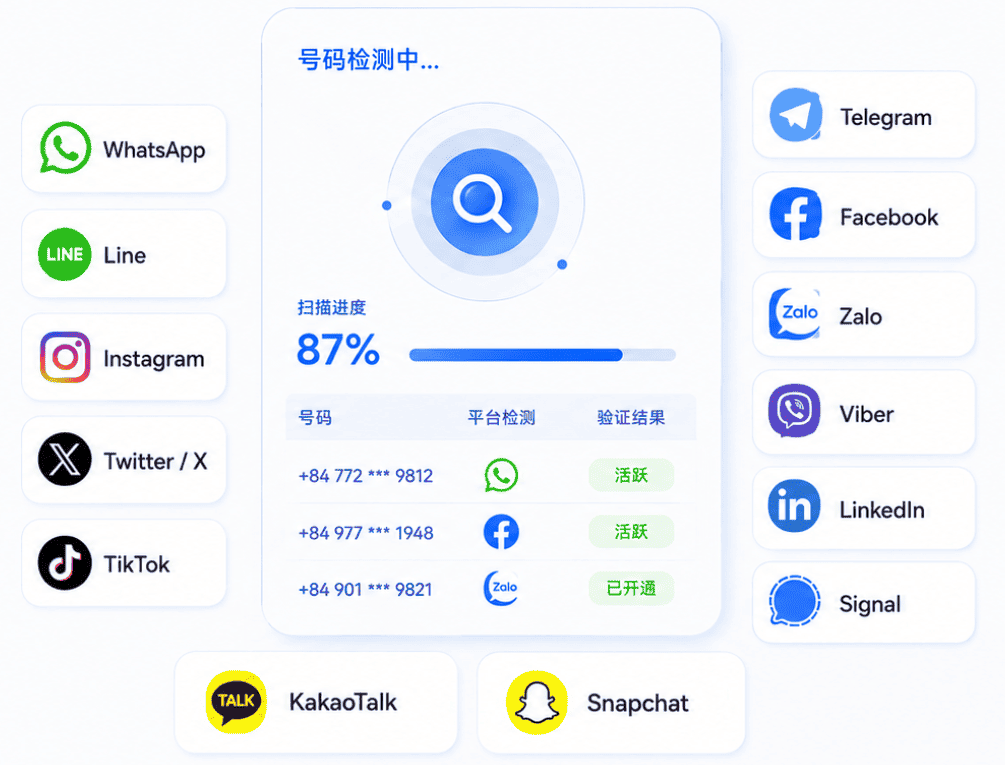
Through Amman, you can perform batch detection on numbers, identify WhatsApp activation status, and filter based on activity levels. In this way, the data can be organized from the original state into usable users in one round of processing, and then enter the reach phase.
For teams that need to continuously develop customers, this approach makes it easier to form a stable process.
The key to customer development is sequence, not single-point optimization
In WhatsApp customer acquisition, number detection, activity screening and conversation preparation are all important, but what is more important is the order between them.
If you talk first and then filter the data, the problem will be magnified; if you clean the data first and then optimize the reach, every step will be clearer.
Amman is the world's leading number screening platform, providing global customers with batch number screening and testing services covering 236 countries. The platform currently supports more than 40 mainstream social networking and applications, including WhatsApp, Line, Twitter, Facebook, Instagram, LinkedIn, Viber, Zalo, Binance, Signal, etc., adapting to the needs of multiple scenarios.
The main core functions cover multi-dimensional precise screening such as activation, activity, interaction, gender, avatar, age, online, accuracy, empty account, mobile phone device, etc., and can flexibly meet the needs of different users. Its core advantage is to integrate global mainstream social and application resources to provide users with one-stop, real-time and efficient number precision screening services, helping customers achieve global digital layout.
It is a common choice for all professional teams to complete rational screening before actually reaching users.
Editor abcheck has a lot of experience, welcome to communicate with me, click to contact @Tg8189