
When dealing with Telegram data, duplicate users are almost inevitable. Importing from different channels, crossing multiple group members, and overlaying historical data will all cause the same user to appear multiple times in the data. If duplication is not removed, subsequent reach, statistics, and conversions will be affected.
Deduplication is not a simple data sorting, but a basic step to ensure that subsequent operations are effective.
Why Telegram data is prone to duplication
Telegram data sources are usually scattered, and data obtained through different paths are constantly superimposed.
Common situations include:
- Cross-export data of multiple group members
- Acquire the same batch of users through different channels
- Repeated import of historical data
These situations will cause the same user to appear in the data in different forms, making subsequent processing more difficult.
What problems will duplicate data cause?
If you do not remove duplicates, the problem will not break out immediately, but will gradually accumulate.
Reached repeatedly, the same user is sent multiple messages
Data statistics are distorted and the effect cannot be accurately judged.
User experience declines, and repeated contacts affect interaction
At larger scales, these issues can significantly impact overall operational efficiency.
Comparison of common deduplication methods
In actual operation, deduplication methods are roughly divided into several categories.
Manual deduplication is suitable for small-scale data, but is inefficient
Table tool processing can handle data of a certain scale, but the operation is complicated
System batch deduplication, suitable for large-scale data processing
As the amount of data increases, systematic deduplication is a more stable approach.
A more efficient deduplication process
In order to ensure that the data structure is clear, deduplication can be placed in the preliminary stage of data processing.
This can be done in the following order:
Import all data uniformly to avoid scattered processing
Perform batch deduplication and eliminate duplicate users
Output unique user data
Then enter the subsequent screening process
In this way, it can be ensured that subsequent screening and reaching are based on unique users.
It is more reasonable to filter after removing duplicates.
The order of deduplication and filtering is also critical.
If you filter first and then remove duplicates, the following will appear:
Duplicate data is filtered multiple times
Filter results are double counted
Decreased overall efficiency
A more reasonable way is:
Remove duplicates first, then filter
This can reduce repeated processing and make the screening results more accurate.
The role of Amman in data processing
In large-scale Telegram data processing, deduplication usually needs to be combined with other filtering actions rather than done alone.
When passing through Amman, this can be done during processing:
Batch deduplication
Account status detection
Activity filter
Data label output
In this way, the basic organization of the data has been completed before it is used, instead of being processed later.
It also supports API access, which allows data to be automatically deduplicated and filtered when imported, reducing manual operations.
The value of deduplication lies in making data controllable
When duplicate data is cleaned up, several direct changes will occur:
The reach is more concentrated and resources are no longer consumed repeatedly.
Statistics are more accurate
Subsequent optimization will make it easier to determine the direction
These changes will transform overall operations from chaos to structure.
If the data is not deduplicated, all subsequent actions will be amplified.
In Telegram operations, many problems seem to be reach or conversion problems, but the root cause is often data.
If there are duplicates in the data itself, the results will be skewed no matter how many times it is sent. Although deduplication is a basic action, it determines the effectiveness of every subsequent step.
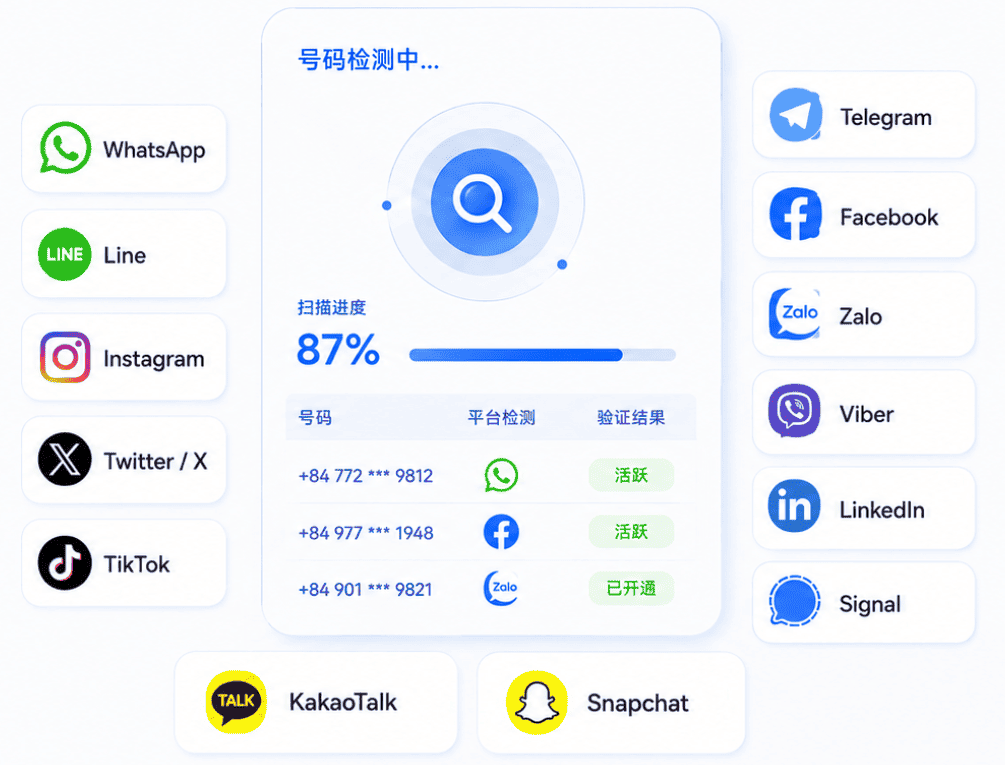
Amman is the world's leading number screening platform, providing global customers with batch number screening and testing services covering 236 countries. The platform currently supports more than 40 mainstream social networking and applications, including WhatsApp, Line, Twitter, Facebook, Instagram, LinkedIn, Viber, Zalo, Binance, Signal, etc., adapting to the needs of multiple scenarios.
The main core functions cover multi-dimensional precise screening such as activation, activity, interaction, gender, avatar, age, online, accuracy, empty account, mobile phone device, etc., and can flexibly meet the needs of different users. Its core advantage is to integrate global mainstream social and application resources to provide users with one-stop, real-time and efficient number precision screening services, helping customers achieve global digital layout.
It is a common choice for all professional teams to complete rational screening before actually reaching users.
Editor abcheck has a lot of experience, welcome to communicate with me, click to contact @Tg8189