
When doing overseas business, many teams will encounter a practical problem: customers are located in different countries and different time zones. Some people consult during the day, while others send messages in the middle of the night. If you rely entirely on manual customer service, it will be difficult to achieve continuous response. Either the opportunity will be missed, or the communication rhythm will be interrupted.
This is why more and more teams are beginning to connect to AI customer service, hoping to solve the problem of "can't handle". However, after actual implementation, you will find that simply accessing AI is not enough. If the front-end data is not processed well, customer service efficiency will still not improve.
Why communicating across time zones can be a problem
One characteristic of cross-border business is that customers’ time is highly dispersed. Even if a team arranges multiple shifts, it is difficult to cover all time periods.
Common situations include:
- No one responds when customers send inquiries
- Response is delayed and the customer has lost interest
- Communication gaps in different time zones affect trust
The sum of these problems will directly affect the conversion efficiency.
The role of AI customer service in WhatsApp
The core value of AI customer service is to provide basic response capabilities during periods of time that cannot be covered manually.
Problems that can be solved include:
- Respond to customer inquiries immediately
- Solve common problems and reduce manual pressure
- Maintain communication continuity and never let conversations break down
In cross-time zone scenarios, this “instant response” is critical to avoid massive churn.
Why AI alone is not enough
After many teams connect to AI, they still find that the results are unstable because the data itself is not filtered.
If the users entering the consultation process themselves are of low quality:
- A large number of invalid consultations occupy resources
- AI replies fail to translate into effective communication
- Subsequent manual undertaking efficiency decreases
This shows that the problem is not only the reception method, but also the source of users.
How should a more complete reception process be designed?
For AI customer service to truly work, the entire process needs to be linked together, rather than just optimizing the intermediate links.
It can be understood as three steps:
- Screen users on the front end to ensure data quality
- AI customer service undertakes consultation and completes preliminary communication
- Manual customer service follows up on high-value users to drive conversions
This allows different links to function independently rather than interfering with each other.
How to improve overall reception efficiency
The key to improving efficiency is not to increase the number of customer services, but to reduce ineffective communication.
You can start from two directions:
- Screen users in advance to reduce low-quality inquiries
- Stratify users and allow high-value customers to enter the manual process first
This allows customer service resources to be focused on users who are more likely to convert.
Optimize front-end data quality with Amman
In actual operation, if the front-end data is not filtered, it is difficult to control the quality of users entering the consultation process. A more effective way is to complete filtering before the data enters the system.
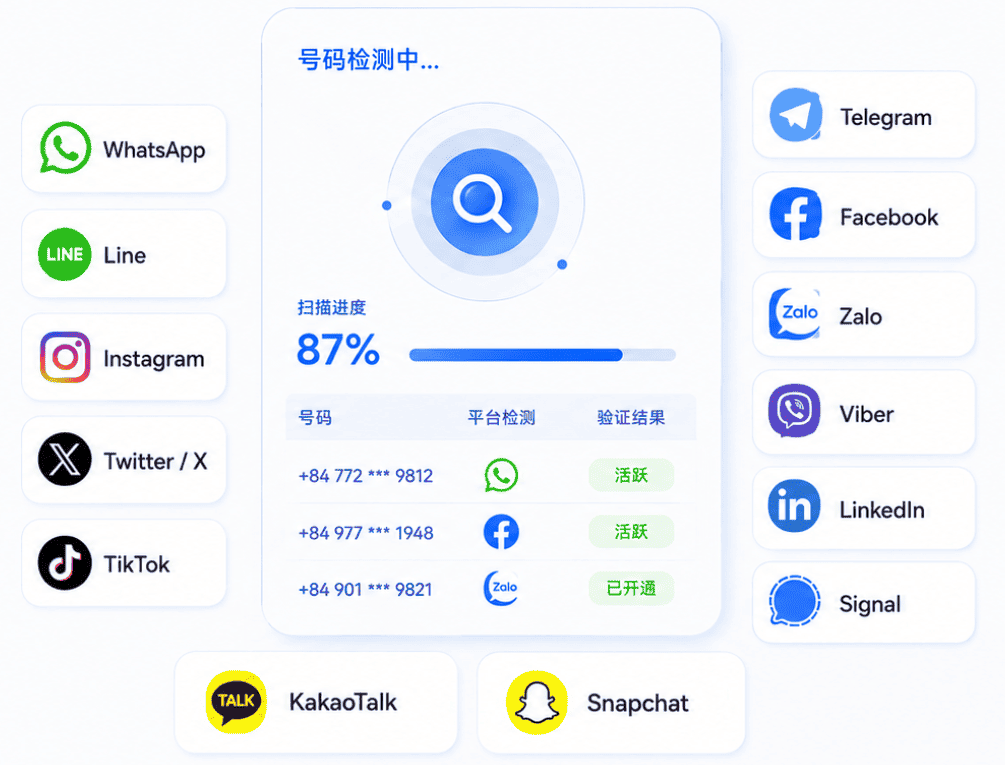
Through Amman, you can perform batch detection on numbers, identify WhatsApp activation status, and filter based on activity levels. This can make users entering the AI customer service process closer to the real user population instead of mixed data.
After this step is completed, the efficiency of AI customer service will be significantly improved.
Able to handle, not only quick to reply
In a cross-time zone scenario, "acceptability" means not only being able to reply, but also being able to continuously communicate and transform.
If you just quickly reply to low-quality users, it won't make much sense; only when the users entering the process themselves have value, the cooperation of AI and artificial intelligence will be effective.
Putting screening first and then using AI to take over can truly turn cross-time zone communication into an advantage rather than a burden.
Amman is the world's leading number screening platform, providing global customers with batch number screening and testing services covering 236 countries. The platform currently supports more than 40 mainstream social networking and applications, including WhatsApp, Line, Twitter, Facebook, Instagram, LinkedIn, Viber, Zalo, Binance, Signal, etc., adapting to the needs of multiple scenarios.
The main core functions cover multi-dimensional precise screening such as activation, activity, interaction, gender, avatar, age, online, accuracy, empty account, mobile phone device, etc., and can flexibly meet the needs of different users. Its core advantage is to integrate global mainstream social and application resources to provide users with one-stop, real-time and efficient number precision screening services, helping customers achieve global digital layout.
It is a common choice for all professional teams to complete rational screening before actually reaching users.
Editor abcheck has a lot of experience, welcome to communicate with me, click to contact @Tg8189