
In the past two years, the Korean market has attracted significant attention in cross-border, e-commerce, games, SaaS and other fields. Following this, the demand for "Korean email data" has grown rapidly. When many teams are looking for data, they will give priority to generation tools because of their fast speed, low cost, and controllable scale.
But a very practical question is: can the generated mailbox be used?
If it is just used as "quantity", there is no problem in generating it; but if it is used for marketing reach, customer development, and long-term private domain, data quality is the key.
Common ways to obtain Korean email data
In practice, Korean email data usually comes from several different paths, each with different structures and problems.
- Batch generation tool
By splicing mailboxes according to rules, the scale can be quickly enlarged, but the actual effective ratio is unstable.
- Enterprise information collection
Obtain the email address through the company's official website and industry directory, which is closer to B-end users, but verification is required.
- Data platform or third-party resources
The acquisition speed is fast, but the data is mixed and requires focused screening.
- Historical customer accumulation
From past business or user registration, best quality, but limited quantity
Generating tools are often used as "supplementary sources" rather than as data sources for direct use.
Why the generated email cannot be used directly
The logic of generating a mailbox is essentially "possible existence" rather than "real existence".
In a batch of generated data, usually:
- Email address does not exist
- The mailbox server cannot receive mail
- Mailbox that has not been used for a long time or has been abandoned
- High-risk mailboxes (easy to get into the trash)
If sent directly without detection, the result is usually:
- Bounce rate is very high
- Mail goes into trash
- Almost no reply
This type of problem will not be fully exposed in the first batch, but will become more and more obvious as the number of sendings increases.
The core logic of email validity detection
To make your mailbox truly usable, you need to do more than just "detect" but process it in layers.
Basic detection can be divided into several steps:
- Format check
Filter obvious error mailboxes
- Existence detection
Determine whether the email address actually exists
- Server response detection
Determine whether emails can be received normally
- Risk identification
Flag high-risk mailboxes
Through Amman, these tests can be completed in batches rather than verified one by one. The system will directly return the mailbox status so that the data has been filtered before being used.
Email data is not only “sendable” but also “worthy of sending”
Many teams will stay at the "email available" level, but in the Korean market, this is far from enough.
because:
- Users make more rational decisions
- Competition for email content is fiercer
- Longer conversion cycle
This means that in addition to testing effectiveness, user quality must also be judged.
Through Amman, you can further filter the data, for example:
- Distinguish between business email and ordinary email
- Flag active or stable users
- Output hierarchical labels
This allows you to know which parts of this batch of data are worth focusing on before sending them.
A more complete set of email processing processes
In actual operations, it is recommended to make mailbox processing a fixed process rather than a temporary operation.
It can be executed in this order:
Import raw mailbox data
Amman will do batch inspection when passing through (format + existence + risk)
Filter available mailboxes
Further stratification of users
Then enter the email sending system
This ensures that all subsequent sending actions are based on the filtered data.
Why Amman is more important in mailbox data processing
Compared with number data, mailboxes are more likely to "look normal but are actually invalid", so they rely more on batch detection capabilities.
When passing through Amman, you can:
- Check email validity in batches
- Quickly identify unavailable data
- Flag high-risk mailboxes
- Output structured tags
Especially in markets like South Korea, which require high data accuracy, early screening can significantly reduce invalid sending.
It also supports API access, which allows each batch of newly acquired email data to be automatically detected when entering the system instead of being processed later.
Korean email data is more suitable for refined use
Compared with the general market, Korean users are more sensitive to email content and frequency.
If you use unfiltered data, this will appear:
- Email ignored
- Low open rate
- Response rate is unstable
The data filtered by Amman can be used stratified by quality:
- High-quality mailboxes are used for key development
- Medium data for testing
- Low quality data is sent less
This method is more in line with the usage habits of the Korean market.
Generation is just the entrance, filtering is the core
In mailbox data, generation is only one of the ways to obtain it, but it is the subsequent processing that determines the result.
Only after the data has been inspected and stratified by Amman can it truly have marketing value. Otherwise, no matter how many mailboxes are generated, they will end up "looking like a lot" but not converting.
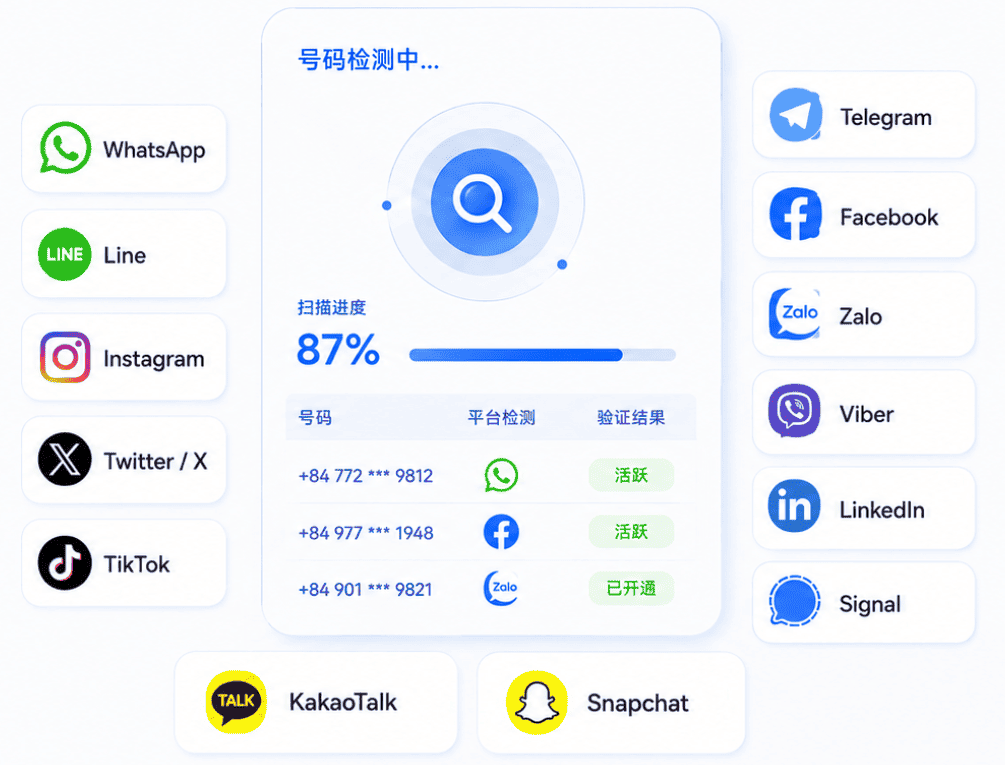
Amman is the world's leading number screening platform, providing global customers with batch number screening and testing services covering 236 countries. The platform currently supports more than 40 mainstream social networking and applications, including WhatsApp, Line, Twitter, Facebook, Instagram, LinkedIn, Viber, Zalo, Binance, Signal, etc., adapting to the needs of multiple scenarios.
The main core functions cover multi-dimensional precise screening such as activation, activity, interaction, gender, avatar, age, online, accuracy, empty account, mobile phone device, etc., and can flexibly meet the needs of different users. Its core advantage is to integrate global mainstream social and application resources to provide users with one-stop, real-time and efficient number precision screening services, helping customers achieve global digital layout.
It is a common choice for all professional teams to complete rational screening before actually reaching users.
Editor abcheck has a lot of experience, welcome to communicate with me, click to contact @Tg8189