
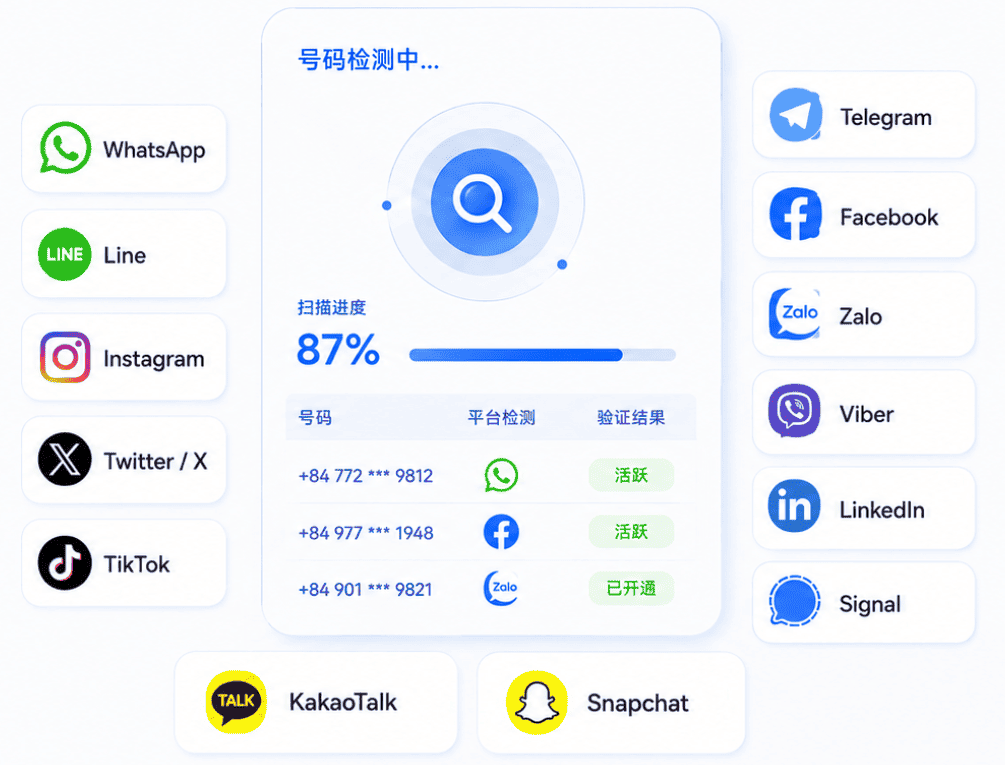
In enterprise-level customer acquisition scenarios, once the amount of data increases, the first problem encountered is not how to reach users, but how to process the data clearly . Especially in channels that rely on numbers such as WhatsApp, if it is not possible to quickly determine whether the number is registered and available, all subsequent operations will become inefficient.
Manual verification one by one is no longer suitable for large-scale data. What enterprises need more is a batch query method that can run stably.
Why do companies need to query registration status in batches?
Compared with personal use, enterprises face larger scale data and more complex data sources. Numbers obtained from different channels are mixed together. If no screening is done, several obvious problems will arise.
First, the sending failure rate is high, and a large number of numbers are unregistered or unavailable.
Second, the data structure is confusing and it is difficult to judge which numbers are worthy of priority.
Third, the test results are unstable and vary significantly from batch to batch.
These problems essentially point to the same point: the data is not uniformly tested before being used.
Why common practices don’t scale
Many teams will use some simple methods to verify numbers in the early stage, such as manual import, detection one by one, or processing with scattered tools. These methods can handle it on a small scale, but once the amount of data increases, problems will be exposed.
The processing speed cannot keep up, affecting the overall rhythm.
The screening criteria are not uniform, and different people process the results differently.
Data needs to be imported and exported repeatedly, increasing operating costs.
When these problems are superimposed, it is difficult to form a stable process.
What is the core logic of batch query
Batch query does not simply enlarge the number, but standardizes the filtering step.
A more reasonable process should be:
Import a batch of number data
One-time detection of registration status through interface
The system returns results and categorizes the data
After the screening is completed, registered users and unavailable numbers can be directly distinguished without the need for secondary processing.
Why the API method is more suitable for enterprise use
In enterprise scenarios, data processing needs to be ongoing rather than a one-time operation. The API method can embed the query process into the system, so that the data can be detected when it enters the process.
The advantages of this approach are:
New data can be processed automatically without manual intervention
Unified screening criteria and more stable results
Can be linked with other systems to reduce intermediate steps
This approach makes it easier to scale as data volumes continue to grow.
How query results can be directly used in subsequent processes
After the batch query is completed, the data does not need to stay at the "test results" level, but can directly enter the use process.
For example:
Registered and normal numbers can be used for contact with priority
Unregistered or abnormal numbers can be eliminated directly
Data of different qualities can be used in layers
This can reduce subsequent repeated screening and make each step of operation based on the data that has been sorted.
Use Amman to achieve more efficient batch queries
In actual operation, Amman can conduct batch detection of numbers, quickly return to WhatsApp registration status, and support activity recognition. In one round of processing, basic filtering and data classification can be accomplished simultaneously.
At the same time, API access is supported, and the query layer can be directly embedded into the enterprise system, so that the data has been detected when it enters the process, without additional operations.
Putting screening in front will make the whole process stable.
In enterprise-level use, stability is more important than single-shot efficiency. The significance of batch querying registration status is not only to increase the speed, but also to make data processing a standard process. When numbers are screened when they enter the system, subsequent reach and conversion will be smoother, and it will be easier to continuously optimize.
Amman is the world's leading number screening platform, providing global customers with batch number screening and testing services covering 236 countries. The platform currently supports more than 40 mainstream social networking and applications, including WhatsApp, Line, Twitter, Facebook, Instagram, LinkedIn, Viber, Zalo, Binance, Signal, etc., adapting to the needs of multiple scenarios.
The main core functions cover multi-dimensional precise screening such as activation, activity, interaction, gender, avatar, age, online, accuracy, empty account, mobile phone device, etc., and can flexibly meet the needs of different users. Its core advantage is to integrate global mainstream social and application resources to provide users with one-stop, real-time and efficient number precision screening services, helping customers achieve global digital layout.
It is a common choice for all professional teams to complete rational screening before actually reaching users.
Editor abcheck has a lot of experience, welcome to communicate with me, click to contact @Tg8189