
When working on a private domain in the currency circle, many teams will pursue “data volume” at the beginning, hoping to obtain as many user contact information as possible. However, after actual operation, you will find that the more numbers you have, the more unstable the effect will be. The active period is short and the loss is fast. It will be difficult to precipitate truly valuable users later.
The problem is not the source of the data, but whether the data was organized. Users in the currency circle themselves are highly volatile. Without filtering and stratification, data will be difficult to reuse, let alone long-term private domain.
A characteristic of currency circle data: short active period
There are obvious differences between Binance related users and ordinary e-commerce users.
This type of user usually has several characteristics:
- Actively concentrated in the market fluctuation stage
- Usage behavior is obviously cyclical
- Many accounts are active for a short period of time and then become silent later.
If you use raw data directly, it is easy for a situation to occur: a group of users will give feedback at the beginning, but soon lose their activity, and the subsequent contact effect will be significantly reduced.
This is why the private sector of the currency circle relies more on "data sorting" rather than simple expansion.
Basic standards for precise numbers
In the currency circle scene, whether a number is worthy of precipitation requires at least several basic conditions to be met:
- Already activated WhatsApp or Telegram
- There is actual usage behavior
- The account status is stable and not a short-term abnormality.
These three conditions are indispensable. If they are only satisfied with activation but have no active behavior, it will be difficult for such users to continue to communicate.
Through Amman, these three levels of screening can be completed before the data enters the private domain, instead of repeated trial and error during the operation process.
A set of number arrangement processes suitable for the currency circle
Compared with other industries, currency circle data is more suitable for "screening first and then settling", rather than screening while using.
It can be executed in this order:
The first step is to import the original number data
The second step is to check the activation status and filter out unavailable numbers.
The third step is to screen active users and target those who are currently using them.
Step 4: Filter abnormal or unstable accounts
The fifth step is to simply stratify the remaining data
Through this process, the original data can be compressed into a batch of numbers that are closer to real users.
Through Amman, these steps can be integrated into one round of inspection to avoid repeated operations.
Data after stratification is easier to precipitate
After the organization is completed, the key is not to use it immediately, but to manage it in layers.
It can be simply divided into:
Highly active users, used for key reach and conversion
Medium active users, used for continuous cultivation
Low active users, reduce contact frequency or delay use
This layered approach allows data to be used at different stages instead of being consumed all at once.
When Amman outputs results, it can directly add labels, so that the data has a natural hierarchical structure to facilitate subsequent private domain operations.
Why organized data is more suitable for long-term private domain
The core of the private domain of the currency circle is not one conversion, but repeated exposure.
If the data is not sorted, the following will appear:
- The reach effect decreases with each round
- It’s getting harder and harder for users to wake up
- Data cannot be reused
Filtered and stratified data can achieve:
- Highly active users communicate continuously
- Medium users gradually convert
- Data can be used in multiple rounds
This is the basis for a long-term private domain.
Use Amman to transform data from disposable to reusable
In actual operation, Shi Amman's role is not just to filter numbers, but to make data "reusable".
Can be done with:
- Batch detection of activation status
- Activity recognition
- Abnormal account filtering
- Data label output
It also supports API access, which allows each batch of new data to be sorted when it enters the system, instead of being processed later.
In this way, your private domain data is no longer a one-time consumption, but is continuously available.
The core of the private domain in the currency circle is not scale, but structure
Many teams will pursue data scale in the early stages, but in the currency circle scenario, what is more important is whether the data structure is stable.
When numbers are filtered and stratified, the overall effect will be more controllable, even if the amount of data is reduced. Reaching, conversion, and reuse will gradually stabilize instead of starting over every round.
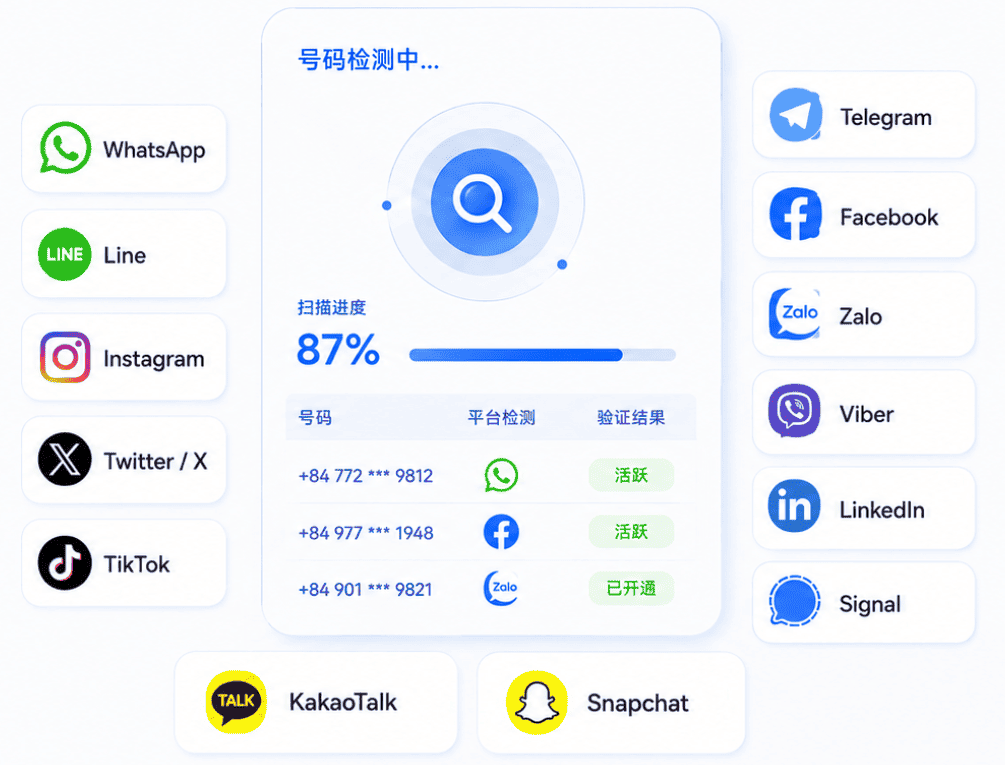
Amman is the world's leading number screening platform, providing global customers with batch number screening and testing services covering 236 countries. The platform currently supports more than 40 mainstream social networking and applications, including WhatsApp, Line, Twitter, Facebook, Instagram, LinkedIn, Viber, Zalo, Binance, Signal, etc., adapting to the needs of multiple scenarios.
The main core functions cover multi-dimensional precise screening such as activation, activity, interaction, gender, avatar, age, online, accuracy, empty account, mobile phone device, etc., and can flexibly meet the needs of different users. Its core advantage is to integrate global mainstream social and application resources to provide users with one-stop, real-time and efficient number precision screening services, helping customers achieve global digital layout.
It is a common choice for all professional teams to complete rational screening before actually reaching users.
Editor abcheck has a lot of experience, welcome to communicate with me, click to contact @Tg8189