
Let’s make the conclusion clear first: Grab users’ mobile phone numbers cannot be obtained or exported directly . The platform itself will not open this kind of data, and there is no "grab interface" to directly obtain the user's mobile phone number.
But in actual customer acquisition, this does not mean that it cannot be done. Most teams use another approach - obtaining numbers from external data sources, and then using a screening system to restore the group of real available people who are "close to Grab users".
The key is not to "get Grab data", but to "screen out the real active users in Southeast Asia".
Data is not brought, it is screened out
Many people will get stuck on the "data source" step at the beginning. In fact, the more core issue is: whether the data obtained can be used .
Commonly available data sources include:
- Local data providers in Southeast Asia (Malaysia, Indonesia, Thailand, etc.)
- Third-party aggregated number library
- Historical business precipitation data (delivery, community, fission, etc.)
The data itself will not identify "Grab users", but it will definitely include some users who actually use Grab or similar applications.
The real key is the next step - screening.
Once you get the number, never use it directly
This is the most common mistake many teams make:
Get a batch of numbers → Import them directly → Start group sending or adding friends
The result is usually:
- The sending success rate is unstable
- Very low reply
- Data fluctuates greatly
The reason is simple: the data is mixed and not filtered in any way.
The correct approach is: screen first and then use .
A set of screening processes that can be executed directly
If your goal is to screen out active Southeast Asian people "similar to Grab users", you can follow this process:
Step 1: Empty number filtering
Filter out non-existent or wrong numbers
→ This step can directly reduce 20%–40% of invalid data
Step 2: Activation status detection
Determine whether to activate WhatsApp/Telegram
→ Those that are not activated will be directly eliminated.
Step Three: Activity Screening (Key)
distinguish:
- Recently active users
- Low active users
- Long-term silent users
→ Only keep people with usage behavior
Step 4: Regional Screening (Focus on Southeast Asia)
Target: Malaysia, Indonesia, Philippines and other target areas
Step 5: Simply layer and reuse
- High activity: priority access
- Medium active: test use
- Low activity: reduce investment
With this set of features, what you get is not "Grab users", but very close to the real active consumer groups in Southeast Asia .
The role of API interface in the entire process
When the amount of data increases, manual filtering is almost impossible. At this time, API is not a "plus point", but a basic capability.
API mainly solves three problems:
- Batch detection: tens of thousands to hundreds of thousands of numbers processed at one time
- Automation: Data enters the system and is automatically filtered
- System docking: direct access to CRM, delivery system, group control system
In other words, screening is no longer an action, but becomes a "default process."
When used, Amman turns screening numbers into a standard process
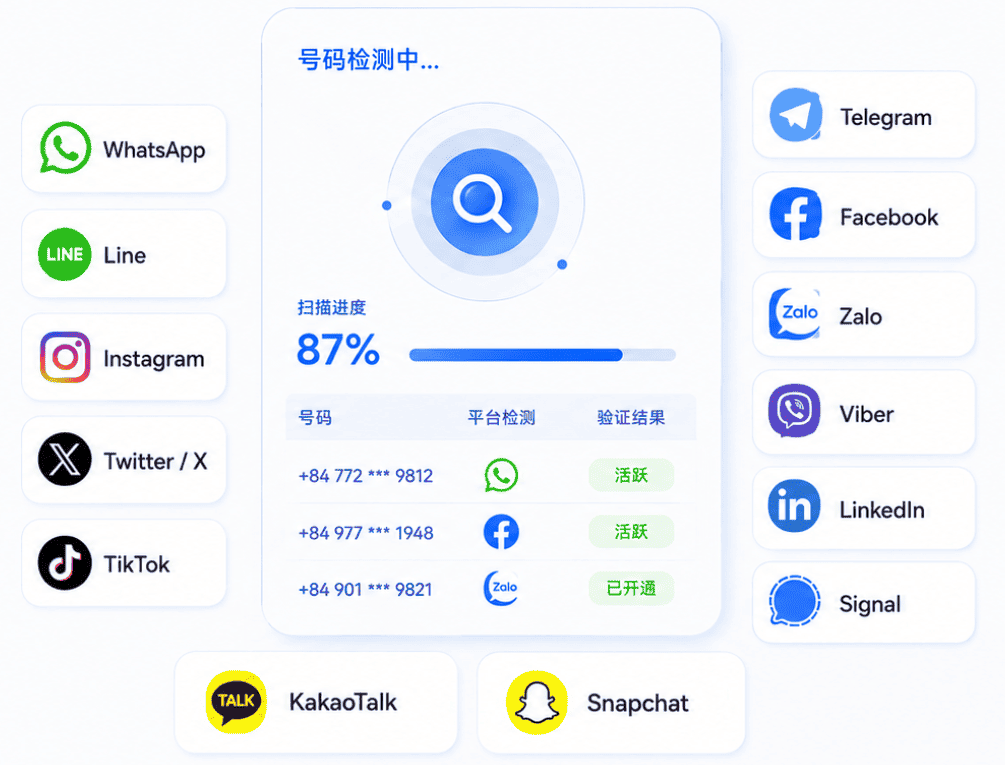
In actual implementation, Amman can complete the above process at once instead of doing it step by step.
It can be done:
- Check whether the number actually exists in batches (empty number filtering)
- Determine the activation status of platforms such as WhatsApp and Telegram
- Identify activity and distinguish whether it is in use
- Support regional filtering to target Southeast Asian users
- Output structured tag data to facilitate subsequent layering
More importantly, it supports API access.
You can directly connect Shi'anman to your data system to achieve:
- New data import → automatic filtering
- Filter results → automatically tag
- Different data → automatically enter different pools
In this way, it is not "screening one batch at a time", but all data is screened by default .
Why do so many people fail to achieve results?
Not because there is no data, but because:
- No filtering
- Filter is incomplete
- No process is formed
As long as data are mixed, the results are bound to be unstable.
Don’t focus on “Grab users”, focus on “real active people”
Many people’s initial thinking is: I want Grab users.
But after actually doing it, you will find that this goal itself has problems.
What you really want is:
- in Southeast Asia
- using mobile phone
- Have spending power
- It is possible to communicate
These people are the ones who can transform.
And this is not achieved by "grabbing platform data", but by filter number + layering + filtering logic .
Amman is the world's leading number screening platform, providing global customers with batch number screening and testing services covering 236 countries. The platform currently supports more than 40 mainstream social networking and applications, including WhatsApp, Line, Twitter, Facebook, Instagram, LinkedIn, Viber, Zalo, Binance, Signal, etc., adapting to the needs of multiple scenarios.
The main core functions cover multi-dimensional precise screening such as activation, activity, interaction, gender, avatar, age, online, accuracy, empty account, mobile phone device, etc., and can flexibly meet the needs of different users. Its core advantage is to integrate global mainstream social and application resources to provide users with one-stop, real-time and efficient number precision screening services, helping customers achieve global digital layout.
It is a common choice for all professional teams to complete rational screening before actually reaching users.
Editor abcheck has a lot of experience, welcome to communicate with me, click to contact @Tg8189