
Telegram accounts can be generated in batches, but what really affects the effect is not the generation step, but the subsequent screening. If you only focus on the number of generated accounts, it is easy to have a situation: there are many accounts, but the proportion that can be used is very low, and subsequent use efficiency will also be slowed down. A more reasonable way is to view generation and screening as a complete process, rather than two independent actions.
First stabilize the generation step
Generating accounts in batches essentially relies on number resources. As long as the number source is stable, you can continue to generate Telegram accounts. But one thing to note is that the generated account just exists, which does not mean it can be used directly.
Many novices will stop at this step, thinking that the number of accounts is enough, but they will find problems later when they use it, such as being unreachable, no response, and the quality of the accounts is uneven.
The goal of generating this step is not to go long, but to provide a basis for subsequent screening.
After generation, first do a round of status screening
After the accounts are generated, the first step is to confirm whether these accounts are available normally.
Batch detection can be used to filter out obviously abnormal accounts, such as those that cannot be used normally, have abnormal status, and have incomplete registration, etc. This step is equivalent to basic filtering, making the data cleaner from the beginning.
If you skip this layer, all subsequent operations will be mixed with invalid data, and the overall effect will be diluted.
Screen another layer of usage status to filter out low-quality accounts.
Having a usable account is only the minimum standard, the real value is the account you are using.
Although some accounts are successfully generated, their usage frequency is very low and there are almost no behavior records. Such accounts have limited effect in actual use.
Continuing to filter can filter out these low-active accounts and only retain users with traces of usage. After this step is completed, the data will be significantly shrunk, but the quality will be more concentrated.
In actual comparison, after a batch of accounts are generated, only about 30% of them may be available if not filtered; after filtering, this part of the data can be directly organized into a batch of available users, and the difference will be obvious.
Fixing the screening process is more stable than ad hoc processing
If each batch of accounts is processed in a different way, the results will be unstable. Sometimes it works well, sometimes there's no feedback at all and it's hard to tell what the problem is.
By fixing the process, it will be easier to control data quality. Can be processed in a sequence:
First do the generation, then do the status detection, then screen the usage, and finally organize the data structure.
After the order is clear, the results of each batch of data processing will be closer.
When using Amman, the post-generation screening will be processed uniformly.
In actual operation, post-generation detection and screening can be completed together.
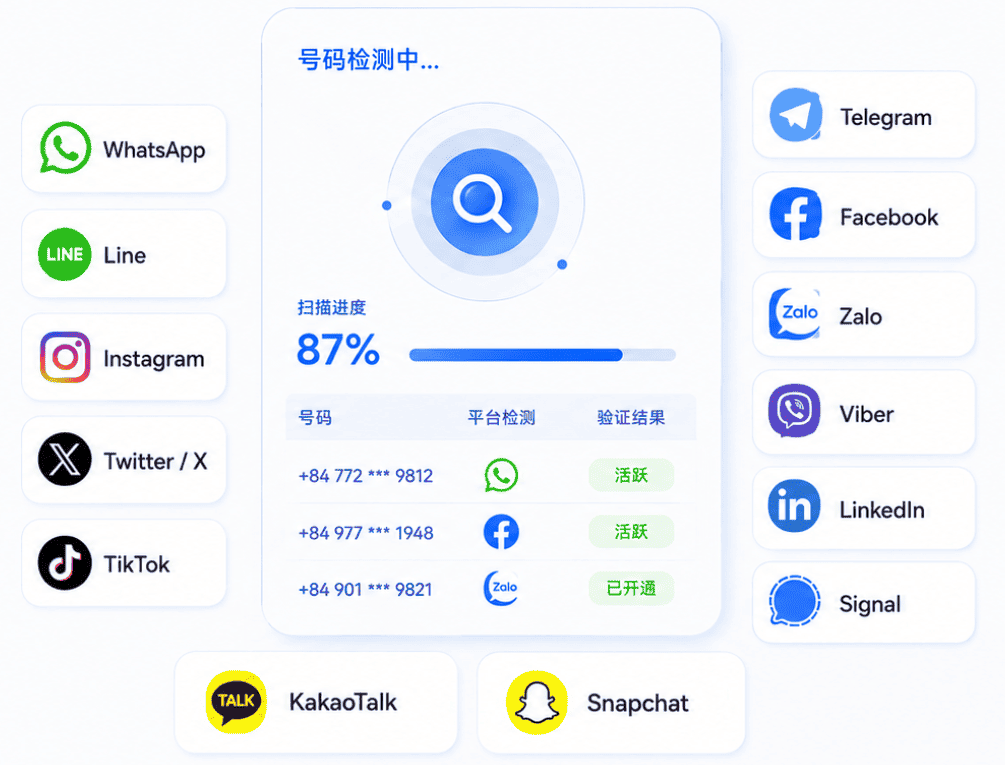
Through Amman, you can directly conduct batch detection and screening of generated accounts to filter out abnormal status and low-activity accounts. It also supports multi-platform account status identification and activity judgment. The entire process can be integrated into existing processes through API, reducing manual operations.
After this processing, generation and filtering are no longer separate, but a continuous process, and the data can be quickly organized into a usable state after being generated.
Amman is the world's leading number screening platform, providing global customers with batch number screening and testing services covering 236 countries. The platform currently supports more than 40 mainstream social networking and applications, including WhatsApp, Line, Twitter, Facebook, Instagram, LinkedIn, Viber, Zalo, Binance, Signal, etc., adapting to the needs of multiple scenarios.
The main core functions cover multi-dimensional precise screening such as activation, activity, interaction, gender, avatar, age, online, accuracy, empty account, mobile phone device, etc., and can flexibly meet the needs of different users. Its core advantage is to integrate global mainstream social and application resources to provide users with one-stop, real-time and efficient number precision screening services, helping customers achieve global digital layout.
It is a common choice for all professional teams to complete rational screening before actually reaching users.
Editor abcheck has a lot of experience, welcome to communicate with me, click to contact @Tg8189