
When doing cross-border Facebook advertising and Messenger private message marketing, have you ever encountered such a dilemma: carefully polished content and high investment budget, but only a few replies and a dismal conversion rate? In fact, it's not that your content is unattractive, but that it reaches a large number of "sleeping" cold accounts - such accounts have basically no response potential, and reaching them is a waste of cost.
For brand operators, independent website pitchers, and cross-border advertising traders, checking the hot and cold status of Facebook accounts before launching is a key prerequisite for accurately targeting high-value users and improving advertising efficiency. This article will use down-to-earth practical logic to break down the hot and cold judgment methods, detection dimensions, batch tools and follow-up operation plans of Facebook accounts to help you avoid invalid contacts from the source and make Facebook marketing more effective.
There is a big difference between hot and cold accounts. Please distinguish between “effective users” before placing them.
The hot or cold status of a Facebook account is essentially the account's activity level and business response willingness, which directly determines the final effect of marketing reach. The core characteristics of the two are significantly different, and there is no need for fuzzy judgment:
1. Cold accounts: those who have not logged into the Facebook platform for more than 3 months and have no interactive behaviors such as likes, comments, or sharing. They have not read or replied to Messenger private messages for a long time. Some of them are even logged out and dormant. There is almost no possibility of commercial conversion.
2. Hot account: Log in frequently in the past 7 days, often participate in platform content interactions (like/comment/share/click ads), can respond to private messages within 24 hours, and have high activity in friend circles/watch lists, with clear content consumption and business decision-making potential.
According to statistics from cross-border industry practice data, about 35%-45% of Facebook advertising budget without hot and cold testing will be consumed on cold accounts; after precise screening, the advertising response rate can be increased by more than 2.5 times, and the conversion cost can be directly reduced by 50%. At a time when Facebook's traffic costs continue to rise, account hot and cold detection is no longer an "optional operation" but a "must-do step."
For these 4 key nodes, account hot and cold testing must be done.
Account hot and cold detection does not need to cover the entire process. You only need to focus on the core aspects of Facebook operations and complete the screening before investing resources to maximize efficiency. The following four scenarios are the "golden opportunities" for detection:
1. Before advertising targeting testing: Detect the activity of accounts in the crowd package, eliminate "sleeping users", avoid distortion of test data, and make targeting strategies more in line with real user needs.
2. Before reaching Messenger in batches: Screen recently active accounts, improve the response rate of automatic messages and manual customer service, and reduce the ineffective operations of "send and then disappear".
3. Before creating popular content: Use popular accounts as seed users for content distribution, and use their high interactivity to drive the initial diffusion of content, increase the weight of platform recommendations, and quickly create popular content.
4. Before the refined operation of the fan page: identify the real active fans and zombie fans in the fan page, brush accounts, adjust the new recruitment and retention strategies in a targeted manner, and let the fan operation focus on effective users.
6 core dimensions to accurately determine whether an account is hot or cold
Determining whether a Facebook account is hot or hot cannot rely on a single indicator. It needs to be combined with a comprehensive analysis of the actual behavior data of the account. The following 6 dimensions are the most accurate basis for judgment in practice, covering the entire behavior link of the account:
1. Recent login frequency: active basic indicator
The core characteristics of hot accounts are that the login frequency is ≥ 3 times in the past 7 days, and the login period is relatively stable; cold accounts usually have no login records for more than 3 months, and only retain account registration information without any platform behavior.
2. Depth of interactive behavior: not only look at “whether there is any”, but also look at “how much”
Focus on whether the account has in-depth interactive behaviors: in addition to likes, whether there are comments, sharing, clicks on ads, collection of content and other actions. The higher the frequency of interaction and the more comprehensive the dimensions, the higher the popularity of the account. Cold accounts have no active interaction and have never even participated in platform content interaction.
3. Private message response speed: directly related to conversion efficiency
After sending a test private message to the account, those that have been read and replied within 24 hours are high-potential hot accounts; those that have not been read for more than 72 hours, or have "delivered unread" displayed for a long time, can basically be judged as cold accounts.
4. Social circle activity: indirectly reflects account value
If most of the account's friends and followers are highly active users and often interact with friends, the response potential of the account will also increase simultaneously; conversely, if the overall social circle is low in activity, even if the account occasionally logs in, there will be no actual conversion value.
5. Content publishing frequency: determine account usage intention
Hot accounts usually publish original content regularly, repost interesting posts, or update personal updates; cold accounts have no content for a long time, and their personal homepages are in a "stagnant state."
6. Login device and location: assist in verifying account authenticity
Hot accounts usually have stable device logins and fixed login locations, and do not exhibit abnormal behaviors such as frequent location switching or simultaneous login from multiple devices; cold accounts often have no device login records for a long time, or login devices and locations frequently change, and some are even registered in batches.
Batch detection strategy: Say goodbye to manual screening and efficiently lock hot accounts
For cross-border enterprises and investment teams, when faced with thousands or even tens of thousands of target accounts, manual detection one by one is extremely inefficient. Based on practical scenarios, 3 batch detection methods are recommended to adapt to different operational needs:
A. Use Facebook backend data to trace back (suitable for teams with a delivery history)
Through the delivery records in the Facebook advertising backend, we extract user account data that have clicked, interacted, and completed conversions, and reversely screen out highly active and hot accounts, and use them as a core group of people for secondary reach to improve conversion efficiency.
B. Query based on user data set (suitable for teams with private domain data)
If you master the target user's FacebookUID, bound mobile phone number, email and other data sets, you can use professional tools to batch query the account's recent login and interaction behaviors, and quickly complete the hot and cold preliminary screening without the need to manually check each one.
C. Access to professional testing platform (suitable for large-scale operation team)
This is currently the most efficient and accurate method: the professional cross-border number screening platform supports batch uploads in multiple formats such as FacebookUID, mobile phone number, and email address, automatically identifies account activity, responsiveness, and behavioral characteristics, and screens out highly active accounts with one click. It can also output detection reports simultaneously, adapting to multiple scenarios such as advertising, Messenger operations, and CRM system access.
3 major operational strategies after detection to maximize account value
After completing the account hot and cold detection, it is not a simple matter of "keeping hot and deleting cold", but to conduct differentiated operations according to the characteristics of the account, so that each type of account can maximize its value. The following three strategies are suitable for different marketing goals:
Focus on reaching pure hot accounts: suitable for short-term high-conversion activities such as big sales and new product promotions. Directly eliminate cold accounts and focus all marketing resources on hot accounts to maximize short-term conversion efficiency and save advertising costs.
Hot and cold hierarchical operations: Suitable for long-term private domain layout, accounts are divided into three categories: "hot/medium/cold": hot accounts are prioritized for refined operations, medium-activity accounts are regularly reached, and cold accounts are activated through low-cost remarketing advertising, welfare guidance, etc., to gradually increase their activity.
Secondary verification of cold accounts: Some accounts may have temporary low activity due to users being busy for a short period of time, going abroad, etc., and are not purely dormant accounts. Low-cost advertising testing and lightweight welfare messages can be used for secondary verification to confirm whether it is a misjudgment and avoid losing potential effective users.
4 common misunderstandings that 90% of pitchers make
In the actual operation of Facebook account hot and cold detection, many practitioners will distort the screening results due to cognitive biases. The following four misunderstandings must be avoided:
Misunderstanding 1: An account is popular if it has been liked. Some users have the habit of "mechanical likes" and just like casually without subsequent in-depth interaction. Such accounts have no actual conversion potential and are not truly popular accounts.
Misunderstanding 2: Fan page fans are all hot accounts. Many fan pages engage in the behavior of brushing likes and buying fans. Most of these fans are zombie accounts without any actual interaction. They are typical cold accounts and should not be directly included in the contact list.
Misunderstanding 3: Active accounts will not be blocked. The hot and cold status only represents the activity level of the account, but does not represent the security of the account. Even if it is a hot account, if there are abnormal device logins, a large number of contacts in a short period of time, or illegal interactive behaviors, Facebook's risk control mechanism may still be triggered and the account will be banned.
Misunderstanding 4: Test once and forget it. Account activity will change over time, and hot accounts may become cold accounts due to changes in user needs. It is recommended to perform a secondary test on the number pool once a month to ensure that the number pool is highly active.
Professional tools support make hot and cold detection more efficient
For teams engaged in large-scale Facebook cross-border operations, manual detection has low efficiency and poor accuracy. Choosing a professional detection platform can make account hot and cold detection more effective with half the effort. A high-quality cross-border number screening platform, with exclusive functions for Facebook account detection, its core advantages are fully demonstrated:
Multi-format compatibility: Supports batch uploading in multiple formats such as FacebookUID, mobile phone number, email, etc. No need for cumbersome format conversion, easy to operate.
Multi-dimensional identification: In addition to hot and cold status, it can also simultaneously detect the gender, age, interaction preferences, interest tags and other characteristics of the account to facilitate accurate targeting.
Customized output: Supports batch export of test results, customizable filter fields, and targeted testing by country and region, adapting to cross-border multi-market operations.
Full-scenario adaptation: Professionally adapted to cross-border advertising, Messenger marketing, private domain operations and other scenarios, it supports multi-language user groups to meet the operational needs of different teams.
Using a professional platform to complete Facebook account hot and cold testing can allow cross-border practitioners to target high-potential customer groups before launching, improve marketing efficiency from the source, and make every budget spent "on the cutting edge".
Suggestion: Try it first before deciding
When many cross-border teams choose Facebook account detection tools, they always worry about "insufficient accuracy and poor adaptability." In fact, the safest way is to try it out first and let real data speak for itself. As a social AI number screening platform covering 244 countries around the world, it supports free trials. You can:
- Screen some Facebook target accounts,
- Do small-scale hot and cold detection tests
- Compare the touch accuracy before and after detection
- Look at the actual operational conversion effects
Real data is far more convincing than any propaganda. If you are looking for a Facebook account hot and cold detection system that is stable, accurate and supports batch detection, you may wish to try it for free first and use the actual test results to judge whether it is suitable for your cross-border business instead of blindly trusting the propaganda. The cross-border Facebook competition in 2026 will focus on refined operations, and the accuracy of account detection is your core competitiveness.
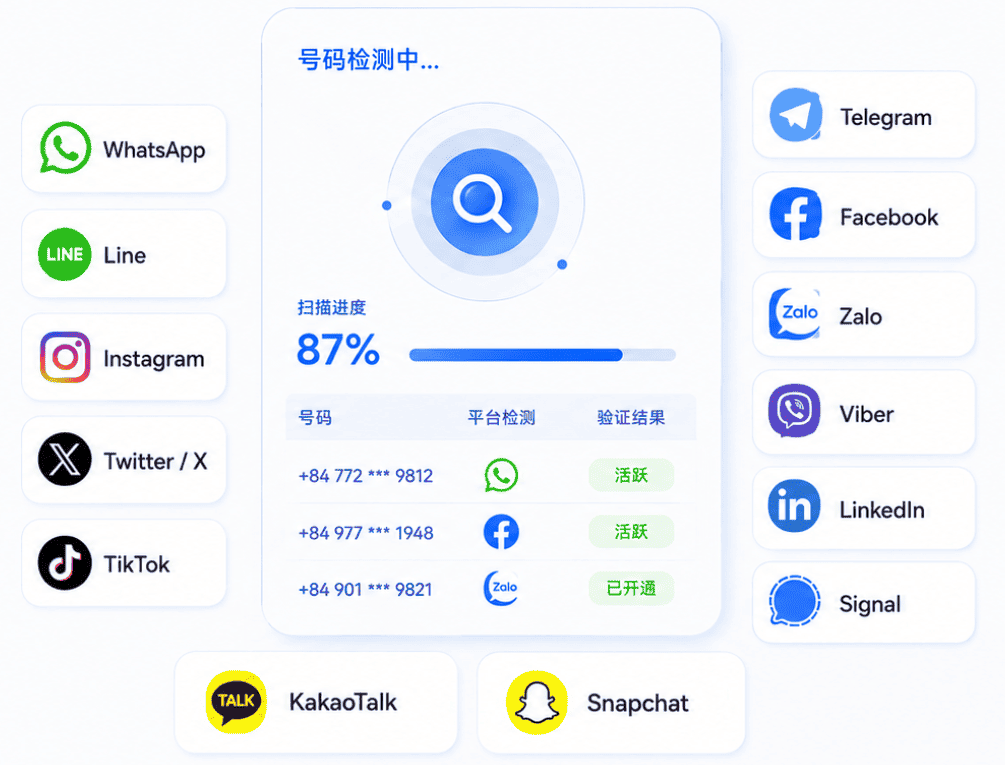
The platform currently supports 130+ comprehensive and diversified platforms, providing global customers with batch number screening and testing services covering 236 countries. The main core functions include activation screening, active screening, interactive screening, gender screening, avatar screening, age screening, online screening, precision screening, duration screening, power-on screening, empty number screening, mobile device screening, etc. It also provides self-screening mode, proxy screening mode, fine screening mode and customized mode, which can flexibly meet the cross-border operation needs of different users.
Its core advantage is that it integrates major social and application resources around the world to provide users with one-stop, real-time and efficient number precision screening services, helping customers achieve global digital layout. Before actually reaching users, completing rational account screening is a common choice for all professional cross-border operations teams.
Editor abcheck has a lot of practical experience in cross-border operations. Welcome to communicate with me. Click to contact the customer service platform.