
Anyone who acquires customers on Facebook will almost always encounter the same problem: there are many accounts, but very few users who can actually interact and convert. Many people think it's because of poor speaking skills and insufficiently attractive content, but the actual problem often lies further ahead - the users you come into contact with are not "active" enough.
The so-called active users are not simply "online users", but a type of people who continue to act on the platform, have interactive habits, and have the ability to receive information. This type of user is the key variable that determines conversion efficiency.
When you start to shift from "collecting accounts" to "screening active users", the entire customer acquisition logic will change significantly.
Why “active users” are the core assets of FB
Under the same exposure, the difference in results brought by different user quality is very obvious.
Typical characteristics of inactive users are:
Rarely post updates, do not participate in interactions, have loose friendships, or even not be online for a long time. Even if such accounts are reached, it is difficult to generate feedback, let alone further conversions.
Active users are completely different:
They have stable browsing habits, like, comment, participate in group discussions, and even take the initiative to communicate via private messages. This means that not only do they “see you,” but they “respond to you.”
This directly affects three core indicators:
- Message response rate
- Content click-through rate
- Conversion completion rate
Judging from the results, screening active users is essentially a "quality filtering" on the front end to keep out invalid traffic.
How to judge FB active users, not just by online status
Many people only look at "whether they are online" or "whether they have logged in recently" to judge whether they are active or not. This is actually a very superficial way of judging.
A more effective judgment dimension should come from the user's behavior trajectory.
The first is content behavior.
Whether there are continuous updates and whether the frequency of releases is stable are the basic indicators for judging whether users are "really using the platform." If an account does not have any content updates for a month, it is most likely low activity.
The second is interactive behavior.
Including likes, comments, reposts, participation in topics, etc. The more frequent this type of behavior is, the higher the user's involvement in the information is and the easier it is to be guided to take further actions.
Let’s look at the social structure.
The number of friends, frequency of friend interaction, and whether you join multiple groups can all reflect the social activity of an account. An "isolated account" with almost no interaction makes it difficult to form effective communication even if it is online.
Finally, there is the time distribution.
Active users usually have a fixed online time, such as appearing frequently at certain times every day, which is also of great reference value for subsequent contact rhythm.
By combining these dimensions, only “valuable active users” can be truly screened out, rather than just superficial online judgments.
Comparison of common screening methods: manual screening vs tool screening
In actual operation, there are roughly two ways to filter active users: manual filtering and batch filtering.
The advantage of manual filtering is that it is intuitive.
By viewing the user's homepage, updates, and interaction records, you can quickly determine the activity level of an account. This method is suitable for small-scale and refined screening. For example, when doing projects with high customer unit prices, higher user quality requirements are required.
But the problem is also obvious: the efficiency is extremely low.
When you need to handle hundreds or thousands of accounts, manual judgment one by one is almost unsustainable, and the standards are easily inconsistent.
Batch screening is more suitable for large-scale scenarios.
By preset filtering conditions, such as recent active behavior, interaction frequency, account status, etc., you can quickly filter out low-quality users and retain highly active people.
However, there is also a key point in batch screening:
The filtering rules must be clear, otherwise it is easy to have a situation where "it looks like a lot, but it is actually inaccurate".
Essentially, the two approaches are not opposed.
A more reasonable approach is to first narrow the scope through batch screening, and then use manual secondary judgment to improve the overall accuracy.
After filtering out, how to manage these users hierarchically?
Screening is only the first step, the more critical thing is how to use these users.
If you treat all active users as the same type of people, it will often lead to a decrease in conversion efficiency. Because different levels of activity have different receptive abilities and transformation paths.
Can be simply divided into three categories:
Highly active users
This type of user interacts frequently and is sensitive to information. They are suitable for directly entering the conversion path, such as product introductions, event invitations, etc. They are more likely to close deals quickly, but they are also more likely to be lost, so they need to control the rhythm.
Medium active users
There is some interaction, but it is unstable. This type of users is more suitable to be continuously reached through content, such as value output and case sharing, to gradually build trust and then promote conversion.
Low active edge users
Although it was screened out, it was not very active. It is not recommended to invest too much effort in this group of users. They can reach low-cost through automated methods and wait for their activity to change.
Through hierarchical management, resource utilization efficiency can be significantly improved and energy can be focused on people with greater potential.
From screening to conversion: avoid the common problem of “volume but no conversion”
Even if many people screen out active users, the conversion effect is still not satisfactory, and the problem often lies in subsequent execution.
A common misunderstanding is: moving too fast.
Directly promoting products to users when they first meet them can easily arouse resentment. Even active users need a trust-building process.
Another problem is: the single way of reaching them.
Relying solely on private messages can be easily ignored. The reach rate can be improved by combining dynamic interaction, comment area communication, group participation and other methods.
Another key point is content matching.
Different users have different concerns. If the content cannot meet the needs, no conversion will occur even if the users are active.
In essence, screening only increases the probability of "reaching effective users", but what really determines the results is still the subsequent communication strategy and content quality.
When you start to focus on “who to screen” instead of “how to say it”, the entire customer acquisition logic will become clearer. Active users are not a quantitative advantage, but a qualitative lever. If used correctly, conversion efficiency will be significantly improved.
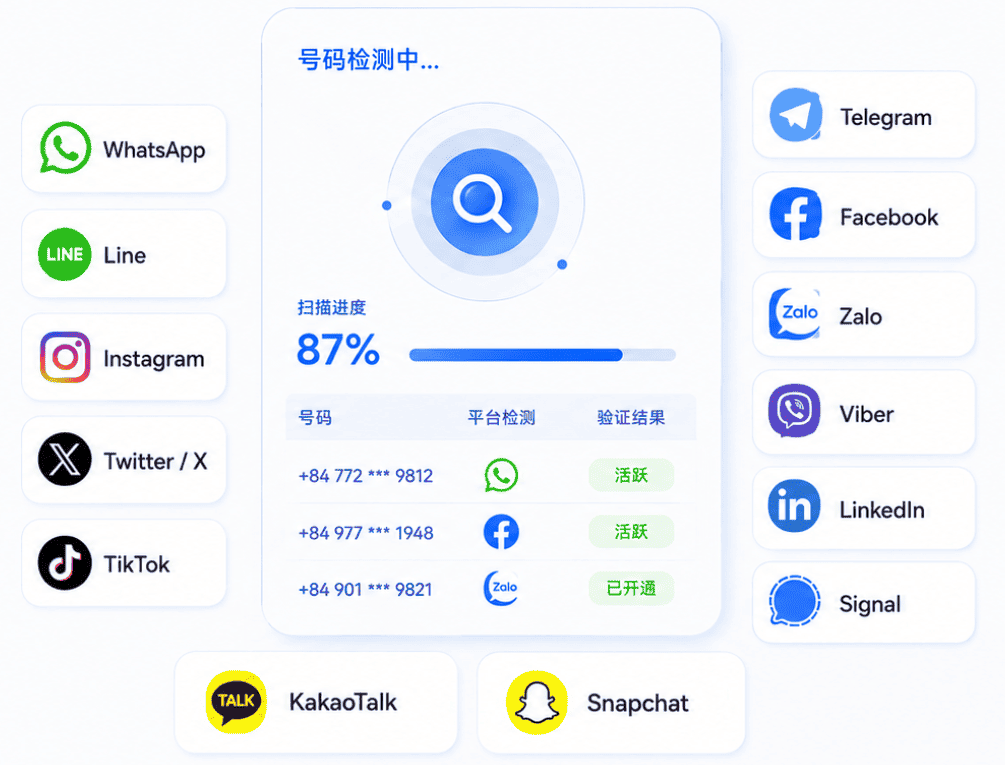
Amman is the world's leading number screening platform, providing global customers with batch number screening and testing services covering 236 countries. The platform currently supports more than 40 mainstream social networking and applications, including WhatsApp, Line, Twitter, Facebook, Instagram, LinkedIn, Viber, Zalo, Binance, Signal, etc., adapting to the needs of multiple scenarios.
The main core functions cover multi-dimensional precise screening such as activation, activity, interaction, gender, avatar, age, online, accuracy, empty account, mobile phone device, etc., and can flexibly meet the needs of different users. Its core advantage is to integrate global mainstream social and application resources to provide users with one-stop, real-time and efficient number precision screening services, helping customers achieve global digital layout.
It is a common choice for all professional teams to complete rational screening before actually reaching users.
Editor abcheck has a lot of experience, welcome to communicate with me, click to contact @Tg8189