
Recently, when many teams are working on Telegram communities, they will have a very intuitive feeling: the operation method has not changed significantly, but restrictions and blocks have appeared more frequently. Some accounts were restricted as soon as they started, and some groups were interrupted as soon as they became active.
On the surface, it seems that the platform is tightening, but the more practical reasons often lie in data and usage methods. In particular, the mixing of new accounts and old accounts has become a key point affecting stability.
Why is the physical sensation of lockdown more obvious recently?
From the actual use point of view, it is not a single reason that leads to the closure, but the result of the superposition of several factors.
First, the operation behavior is more concentrated. A large number of people added or contacted in a short period of time will be recognized by the system as abnormal.
Second, the data quality has declined. Many accounts themselves are inactive or have abnormal status, and there is no normal interaction after being contacted.
Third, there are more batch operations. If there is no filtering, the overall behavior is more likely to be amplified.
The combination of these factors will make it easier for account behavior to deviate from normal usage, thus triggering restrictions.
The essential difference between the new account and the old account
In the Telegram system, the performance of new accounts and old accounts are completely different.
New accounts are usually used for a short time and have few historical behaviors, so the system judges their stability more strictly. Once centralized operations occur within a short period of time, they can easily be restricted.
Old accounts are relatively stable, and their historical behavior is closer to real users. Even if there are certain operations, they are more likely to be accepted by the system.
To put it simply, the new model is more "sensitive" and the old model is more "durable".
Why mixing is more likely to cause problems
In actual operations, many teams will mix new accounts with old accounts. This method will not cause obvious problems in the early stage, but in the current environment, it will amplify the risks.
The behavior patterns of the new account and the old account are different. If the operating rhythm is unified, imbalance will easily occur.
Some accounts are subjected to too high frequency of operations, while others do not have enough behavioral support.
The overall behavior looks unnatural and is easier for the system to recognize.
This kind of mixed use will bring the old accounts that can be used stably into an unstable state.
The practical significance of separate screening
Screening and using new accounts and old accounts separately is essentially controlling the rhythm of behavior.
For new accounts, you can reduce the intensity of operations and extend the use period so that the account can gradually establish normal behavior.
For older accounts, they can take on more contact tasks and improve overall efficiency.
Through layered use, different types of accounts can function independently rather than affecting each other.
How should the filtering logic be adjusted?
In the current environment, screening is not just based on registration, but also account status.
You can start from several dimensions:
Whether the account is registered with Telegram
Whether the account has any usage behavior
Account usage duration or stability
Through these conditions, new accounts and old accounts can be roughly distinguished, and then different usage strategies can be entered.
When using Amman, it is more suitable for account layering processing.
In actual operation, it is difficult to accurately distinguish account status if manual judgment is relied on. A more practical approach is to complete the stratification as the data enters the process.
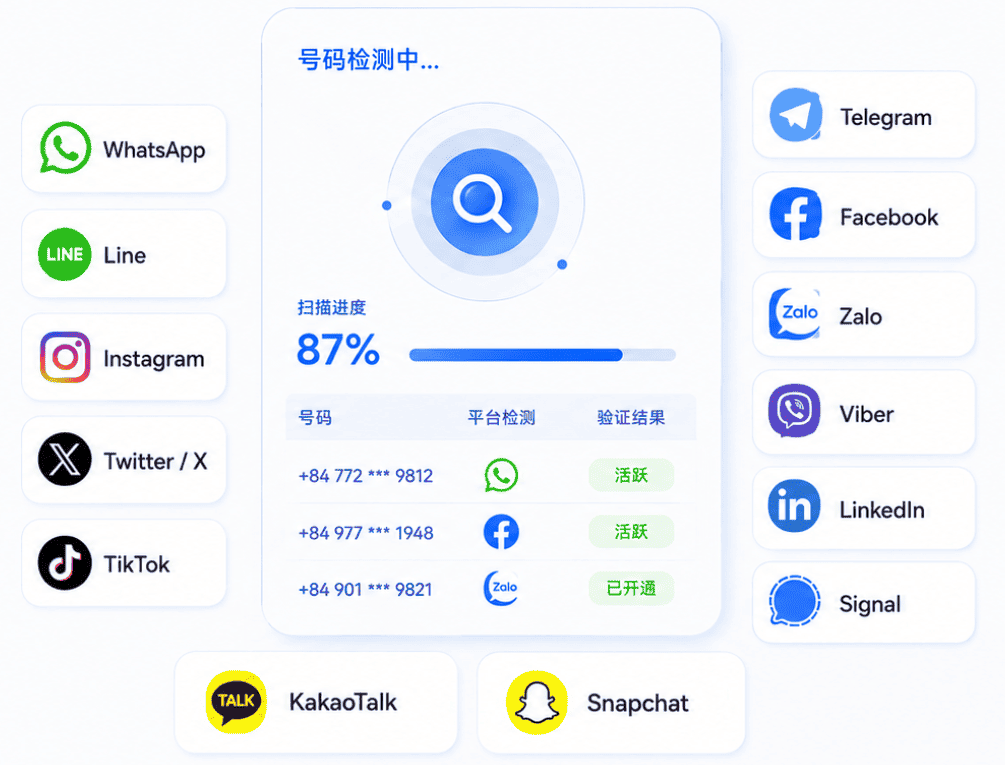
Through Amman, you can conduct batch detection of numbers, identify Telegram account status, and further filter based on dimensions such as activity level. In this way, the data can be divided into different levels in one round of processing for subsequent use.
The advantage of this method is that screening and use are connected together, rather than using first and then adjusting.
Stability is not about reducing operations, but about controlling structures
Many teams will interpret the blocking problem as too many operations, but what is more critical is whether the operation structure is reasonable.
When the new account and the old account are used separately and the data is filtered, the overall behavior will be closer to normal usage. You can continue to do touch, but the method will be more stable.
In the current environment, if you want to run steadily in the long term, it is not about reducing movements, but making each step more controllable.
Amman is the world's leading number screening platform, providing global customers with batch number screening and testing services covering 236 countries. The platform currently supports more than 40 mainstream social networking and applications, including WhatsApp, Line, Twitter, Facebook, Instagram, LinkedIn, Viber, Zalo, Binance, Signal, etc., adapting to the needs of multiple scenarios.
The main core functions cover multi-dimensional precise screening such as activation, activity, interaction, gender, avatar, age, online, accuracy, empty account, mobile phone device, etc., and can flexibly meet the needs of different users. Its core advantage is to integrate global mainstream social and application resources to provide users with one-stop, real-time and efficient number precision screening services, helping customers achieve global digital layout.
It is a common choice for all professional teams to complete rational screening before actually reaching users.
Editor abcheck has a lot of experience, welcome to communicate with me, click to contact @Tg8189