
In user acquisition in the Korean market, KakaoTalk is almost an unavoidable core channel. The problem is not whether there are numbers, but whether these numbers can be converted into reachable users. In many cases, the amount of data is not small, but the proportion of people who can actually communicate and generate feedback is not high. The key is that the screening process is not done well.
Taking the entire process apart, from number pool to effective access, at least two levels of processing are required: activation detection and usage status screening. After the order is clear, the data will gradually converge into a group of users that can be used directly.
Number pool stage: data is only overwritten, does not mean available
Whether obtained through channels or generated through rules, the number pool is essentially just a coverage area. This usually contains several types of data:
KakaoTalk number not registered
Accounts that have been registered but not used for a long time
Numbers with abnormal or unavailable status
Real users using it
If you don't make a distinction and use it directly, the result is usually a high sending volume but little feedback. The problem is not the channel, but the data itself is not being processed.
The role of activation detection: separate "existence" and "availability"
The core of the activation test is to confirm whether the number has been registered with KakaoTalk.
Through this layer of screening, unregistered numbers can be directly eliminated, turning the data from a mixed state into "usable basic data". Although this step is simple, it is very critical. If you skip it, all subsequent operations will be interfered with by invalid numbers.
In actual operation, Amman can be used to batch test the number pool to quickly identify which numbers have been subscribed to KakaoTalk, while filtering out obviously unavailable data. After this step is completed, the data size will be reduced, but the quality will be significantly improved.
The second level of screening: from available to accessible
Open does not mean accessible. Although many accounts exist, the users are not active. This type of data has limited effect in actual use.
Therefore, after enabling the detection, it is necessary to perform another layer of usage status screening to filter out low-active users. The key point is to filter out accounts with usage behavior and recent activity, so that these users are more likely to respond.
After this level of screening is completed, the data will be further shrunk, but the structure will be clearer.
Data stratification: Let data of different qualities be used separately
After the screening is completed, it is not recommended to mix all the data together, but to do simple stratification:
Users who have activated and are active can be reached first
Users who have already activated but have average activity can be used as a supplement
Unavailable or low-quality data is directly eliminated.
Through layering, each batch of data can be used in the appropriate scenario, rather than being processed one-size-fits-all.
From screening to reaching: processes need to be consistent
When the screening process is stable, the entire customer acquisition process will be smoother.
After new data enters, the activation test is first performed, then the usage status is screened, and then the access process is entered. Each batch of data is processed according to the same logic, and the results will be more stable and easier to reuse.
If the filtering method is different each time, the data quality will fluctuate and the subsequent results will also be unstable.
Use Amman to complete the entire set of processing from number pool to contact
In actual implementation, Amman can combine these two levels of screening to complete it. Through batch detection, KakaoTalk activation status can be directly identified, and at the same time, filtering is performed based on account activity, and the data is sorted from the number pool stage to the reachable user stage.
Supports batch processing and API access, and can adapt to data usage scenarios of different scales. The data has been filtered before being used and does not need to be processed repeatedly later.
The key steps in moving data from “available” to “usable”
In the Korean market, KakaoTalk itself does not lack users. The key is to screen out people who can really communicate.
The number pool is just the starting point, enabling detection determines the available range, and active screening determines the quality of reach. After these steps are straightened out, the data will gradually be transformed into sustainable user resources.
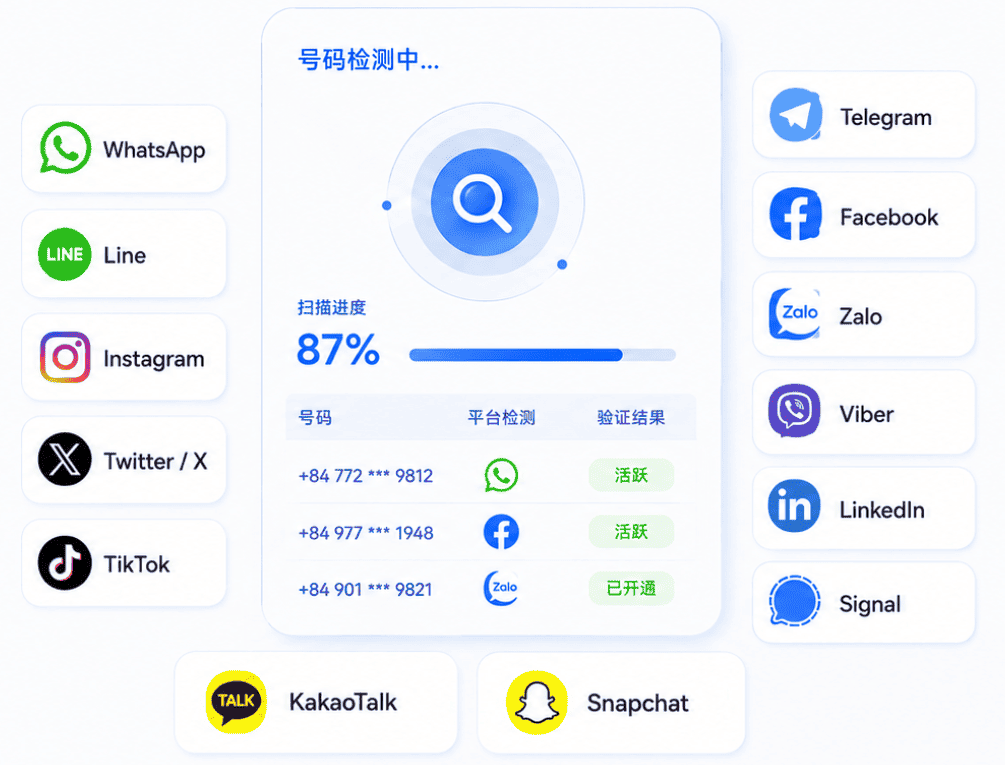
Amman is the world's leading number screening platform, providing global customers with batch number screening and testing services covering 236 countries. The platform currently supports more than 40 mainstream social networking and applications, including WhatsApp, Line, Twitter, Facebook, Instagram, LinkedIn, Viber, Zalo, Binance, Signal, etc., adapting to the needs of multiple scenarios.
The main core functions cover multi-dimensional precise screening such as activation, activity, interaction, gender, avatar, age, online, accuracy, empty account, mobile phone device, etc., and can flexibly meet the needs of different users. Its core advantage is to integrate global mainstream social and application resources to provide users with one-stop, real-time and efficient number precision screening services, helping customers achieve global digital layout.
It is a common choice for all professional teams to complete rational screening before actually reaching users.
Editor abcheck has a lot of experience, welcome to communicate with me, click to contact @Tg8189