
When doing user acquisition in Telegram, the source of data is usually not a problem. The question is whether the filtered data has practical value. The number of accounts can pile up very quickly, but if there is no effective screening, a large number of accounts will just exist without communication and conversion significance.
The essence of the function of the screening assistant is to structure the originally messy data and filter out a part of the mixed data that is closer to the real users. But the tools are only the starting point, and the screening logic determines the final result.
First clarify the goal of screening, and then use the tools
Before using the filter assistant, you need to clarify the filtering goals first, rather than directly importing data to start the operation.
Different usage scenarios have very different data requirements:
- Scenarios that focus on real-time communication place more emphasis on activity and online frequency.
- For long-term operation scenarios, account stability and continuous usage habits are more important.
- Focus on conversion scenarios, paying more attention to user behavior and participation
If the goal is not clear, the filtered data can easily deviate from the actual needs. Even if the quantity looks good, problems will arise in subsequent use.
Basic screening should be done first to avoid interference with invalid data.
Telegram data usually contains some invalid or low-quality accounts, such as abnormal accounts, accounts that have not been used for a long time, accounts with incomplete information, etc.
If basic screening is not done, this part of the data will continue to interfere with judgment during subsequent refined screening.
This layer can focus on:
- Remove obvious abnormalities or unavailable accounts
- Eliminate accounts with no avatar, no nickname, and serious missing information.
- Filter duplicate data
The goal of this step is to transform the data from a mixed state into a processable state.
Activity is the most critical layer in screening numbers
In the Telegram environment, activity directly determines whether the data is valuable.
Even if an account exists, if it does not have any speech records, interactive behaviors, or is not online for a long time, the actual effect will be very limited.
When filtering, you can focus on:
- Is there any recent online behavior?
- Whether to participate in group interaction
- Whether there is a speech record
- Are there any traces of continued use?
After this layer of screening is completed, the data will become significantly more concentrated, and the feedback for subsequent use will be more stable.
Group behavior is more valuable than a single state
Just looking at the online status can easily lead to misjudgment, because many accounts will be online briefly but do not participate in any interaction.
In contrast, group behavior better reflects real usage.
You can prioritize filtering:
- Users who have spoken records in the group
- Accounts that participate in multiple related groups
- Users who interact in specific topics
This type of data is usually closer to real users, rather than simply existing accounts.
When using the filter assistant, the focus is on filtering combinations
The value of the filter assistant lies not in a single function, but in the combined filtering of multiple conditions.
In actual use, filtering logic can be combined, for example:
- Basic usable + active behavior
- Activity + group participation
- Complete information + traces of use
By combining filtering conditions, the data can be gradually compressed into a more accurate batch, rather than relying on single-dimensional judgment.
In this process, screening tools like Shi'anman can provide relatively complete screening capabilities and are suitable for batch processing and multi-condition screening:
- Support large-scale data batch screening to improve processing efficiency
- Can be filtered based on multiple dimensions such as activity, behavior, status, etc.
- Data filtering results are more uniform and manual judgment bias is reduced.
This method is more suitable for scenarios that require stable output data, rather than one-time filtering.
The data structure is stable and more important than a single result
Screening is not a one-time action, but a process that requires continuous optimization.
If the screening criteria are unstable, the quality of the data obtained each time will fluctuate significantly, and subsequent use will also be affected.
A more effective way is to gradually fix the filtering logic to keep the data structure stable, for example:
- Clarify basic filter conditions
- Fixed activity criteria
- Keep filtering dimensions consistent
Each batch of data filtered out in this way is closer to the same quality level, and the overall use is more controllable.
If you do the filtering step well, the data will be more controllable.
In the Telegram environment, the difference in data is often not the source, but the way it is filtered.
Through the filter assistant, combining basic filtering, active filtering, and behavioral filtering, the data will gradually change from messy to a clearly structured part.
When the screening logic is stable, there is no need to rely on more data, and the existing data itself can continue to generate value.
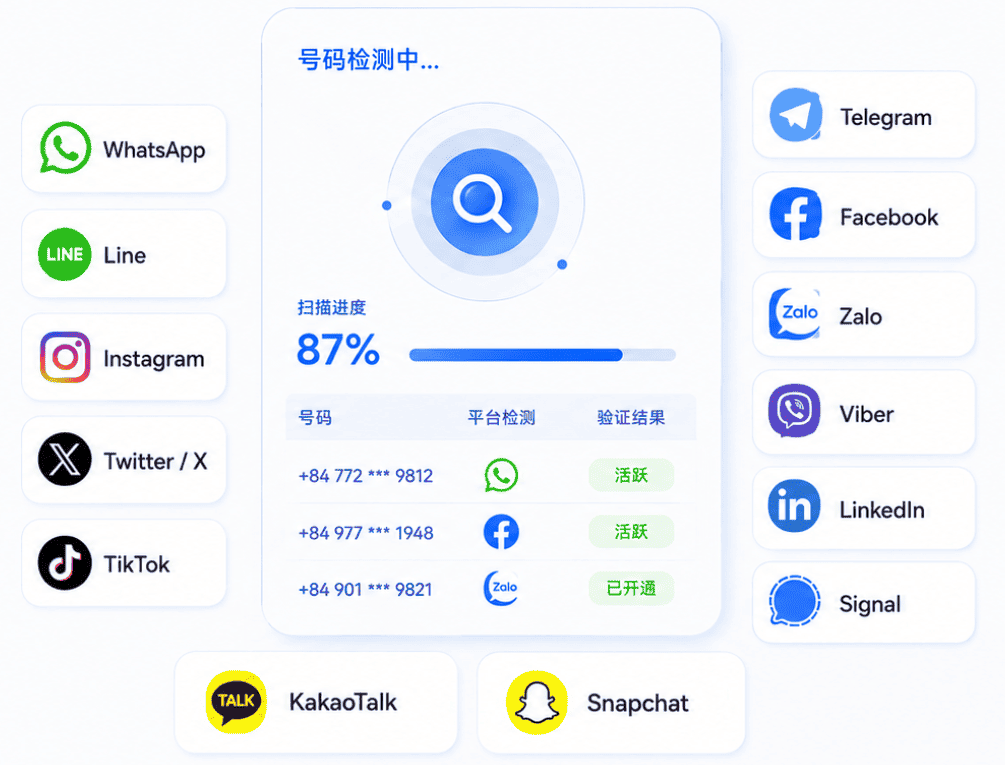
Amman is the world's leading number screening platform, providing global customers with batch number screening and testing services covering 236 countries. The platform currently supports more than 40 mainstream social networking and applications, including WhatsApp, Line, Twitter, Facebook, Instagram, LinkedIn, Viber, Zalo, Binance, Signal, etc., adapting to the needs of multiple scenarios.
The main core functions cover multi-dimensional precise screening such as activation, activity, interaction, gender, avatar, age, online, accuracy, empty account, mobile phone device, etc., and can flexibly meet the needs of different users. Its core advantage is to integrate global mainstream social and application resources to provide users with one-stop, real-time and efficient number precision screening services, helping customers achieve global digital layout.
It is a common choice for all professional teams to complete rational screening before actually reaching users.
Editor abcheck has a lot of experience, welcome to communicate with me, click to contact @Tg8189