
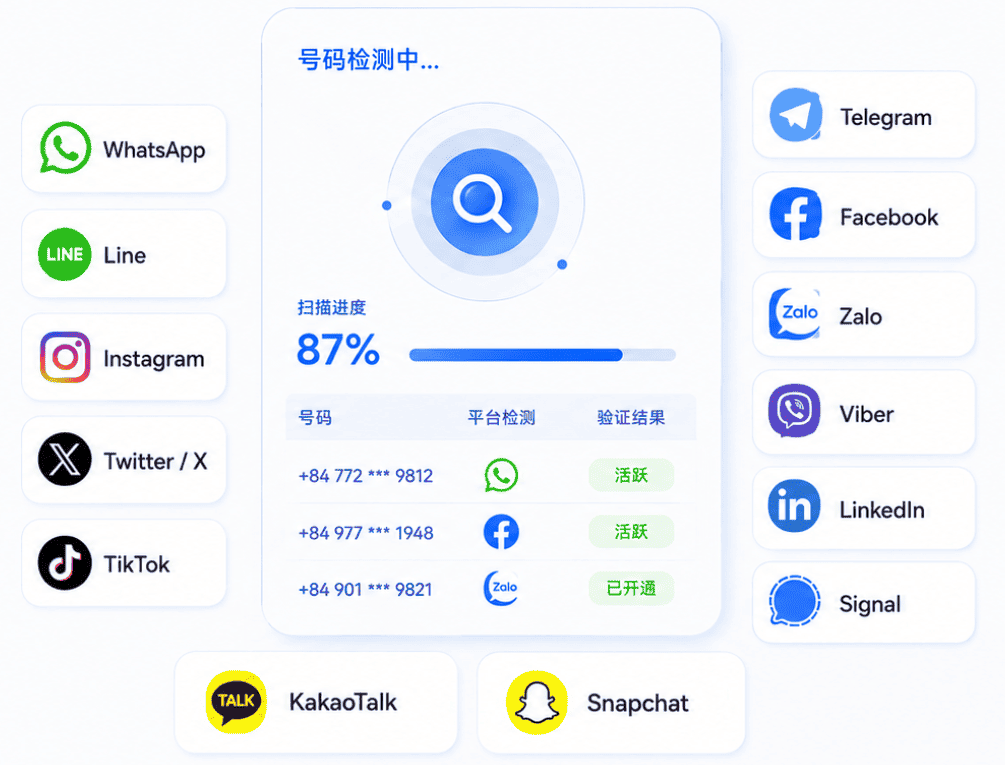
When acquiring customers for WhatsApp, if the amount of data starts to increase, it will be difficult to support it simply by manually filtering numbers. On the one hand, the efficiency cannot keep up, but more importantly, the screening standards are not uniform, resulting in large fluctuations in the quality of each batch of data. At this stage, the value of the screening API is obvious, and the screening step can be standardized and automated.
First, let’s clarify the access process. The whole process is actually not complicated. The key is to get it in the right order.
1. First determine what data you want to filter
Before accessing the API, you need to clarify the data source and filtering goals.
Common data types include mobile phone number lists, historical precipitation data, or numbers collected from other sources. The quality of data from different sources varies greatly. If they are screened together without distinction, the results will be unstable.
At the same time, the screening goals must be clearly defined. For example, as long as the number can be used, active users must be further screened out. If the goal is not clear, the data returned by the subsequent interface will be difficult to use directly.
2. Use API to check number status first
The first step is to prioritize number detection and filter out numbers that are obviously unusable.
By submitting numbers in batches for testing through the API, you can quickly get status results, such as whether they are registered for WhatsApp, whether they are available, etc. The purpose of this step is to establish a basic data pool to ensure that the data processed later are valid numbers.
If you skip this step and use the original data directly, all subsequent actions will be slowed down by invalid numbers.
3. Screen active users based on detection
Having a usable number is only the minimum standard, the real value is users who have usage behavior.
When the API returns results, it can further determine the activity based on the account status and filter out low-active users. The data filtered out in this way is not only usable, but closer to the real people using it.
After this level of screening is completed, the data quality will be significantly improved, and feedback will be more likely to occur in subsequent contacts.
4. Batch processing to avoid repeated screening of data
When the amount of data is large, it is recommended to perform batch processing through API instead of manual filtering in batches.
Running through the data at once can ensure consistent filtering criteria and avoid repeated operations. If there is new data in the future, you only need to run it again according to the same process, and there is no need to readjust the logic.
This method is more suitable for long-term use rather than one-time disposal.
5. Directly connect the screening results to the usage process
One advantage of the API is that it can directly integrate the screening results into subsequent processes.
After the screening is completed, the valid numbers can be directly imported into the usage system without the need for manual sorting in the middle. This can reduce losses during data transfer and improve overall efficiency.
In actual operation, when using Amman for API access, it can complete number status identification and activity judgment at the same time, and support batch detection processing. Screen numbers and uses can be directly connected, reducing intermediate links and improving overall reach efficiency.
6. Fixed filtering logic to keep data stable
After API access, there is no need to readjust the filtering method every time. It is recommended to fix the filter number logic.
For example, unify detection standards, unify active filtering conditions, and unify data formats, so that the quality of each batch of data after processing will remain consistent.
When the screening step is stable, subsequent use will be smoother, and there is no need to rely on a large number of tests to find effective users.
Amman is the world's leading number screening platform, providing global customers with batch number screening and testing services covering 236 countries. The platform currently supports more than 40 mainstream social networking and applications, including WhatsApp, Line, Twitter, Facebook, Instagram, LinkedIn, Viber, Zalo, Binance, Signal, etc., adapting to the needs of multiple scenarios.
The main core functions cover multi-dimensional precise screening such as activation, activity, interaction, gender, avatar, age, online, accuracy, empty account, mobile phone device, etc., and can flexibly meet the needs of different users. Its core advantage is to integrate global mainstream social and application resources to provide users with one-stop, real-time and efficient number precision screening services, helping customers achieve global digital layout.
It is a common choice for all professional teams to complete rational screening before actually reaching users.
Editor abcheck has a lot of experience, welcome to communicate with me, click to contact @Tg8189