
When doing batch import and private messaging in Telegram, many teams pay more attention to the import speed, sending efficiency and number of accounts, but what really affects the overall effect is whether data filtering is done in the step before importing.
If the data is not processed, the cost will not disappear, it will just be moved to the back. The more you send, the greater the waste, until the entire link becomes increasingly inefficient.
The cost is not just spent on sending
In actual operations, cost distribution is dispersed, not just account or tool fees.
Common costs include:
- Account cost, used for batch import and sending
- Network and equipment costs to maintain the operating environment
- Labor costs to follow up and process responses
- Time cost to test and adjust strategies
If the data is not screened, these types of costs will be amplified and difficult to detect in a timely manner.
Without filtering data, waste will appear concentratedly
A batch of unprocessed numbers usually contains users in multiple statuses:
- Invalid number or wrong data
- Accounts that have been registered but have not been used for a long time
- Users who are less active and rarely respond
After the data is imported, it will occupy the same resources but will not produce results.
For example, if half of a batch of 10,000 numbers belong to low-active or invalid users, then:
- Half of sending resources are wasted
- Half of the accounts consume no output
- Half the man-time is worthless
As scale increases, this waste is magnified rather than spread evenly.
A simple cost calculation method
There is a very straightforward way to judge the value of filtering.
Assumptions:
- Import 10,000 numbers
- Actual effective users account for 30%
So that means:
- 7000 pieces of data will not produce any actual interaction
- 70% of sending and operating costs are consumed on invalid data
If manual follow-up is added, this cost will be further expanded.
Through filtering, the proportion of effective users is increased to more than 60%. Although the amount of data is reduced, the overall cost will be significantly reduced.
What can data filtering change?
Filtering does not reduce data, but changes the data structure.
After filtering:
- Invalid numbers are removed
- Increased proportion of active users
- Data distribution is more concentrated
The changes this brings are:
- Send more targeted
- Response rate is more stable
- Human input is more valuable
On the whole, it is not that costs are reduced, but that costs are used on effective users.
Use time to control costs in advance
In actual operation, if you rely on manual filtering, it is difficult to achieve stable filtering in large-scale data. A more reasonable way is to complete batch testing before importing.
Through Telegram, several key things can be done before the data enters Telegram:
- Does the batch inspection number actually exist?
- Determine whether the Telegram account is registered
- Identify activity levels and filter out active users
In this way, invalid data can be filtered out before importing, instead of consuming resources to verify after importing.
In a batch of 10,000 pieces of data, only 4,000 pieces may be retained after being filtered by Shi Amman, but these 4,000 pieces are part of the data that is closer to the real users, and each subsequent transmission will be more effective.
API makes filtering the default action
When data sources continue to grow, manual filtering can be difficult to keep up with. Through the Amman API, filtering can become part of the data process.
Can be achieved:
- Data import automatic detection
- Automatically mark available and unavailable numbers
- Automatically stratify different active users
In this way, every batch of data entering the system has been filtered and will not be processed later.
The cost depends on whether the data is processed
In the Telegram batch import scenario, the cost is not fixed, but is directly related to data quality.
If the data is mixed, costs will be amplified in all aspects of sending, labor, and time; if the data is filtered, costs will be concentrated on effective users.
Filtering before importing is the most easily overlooked step in the entire process, but has the greatest impact.
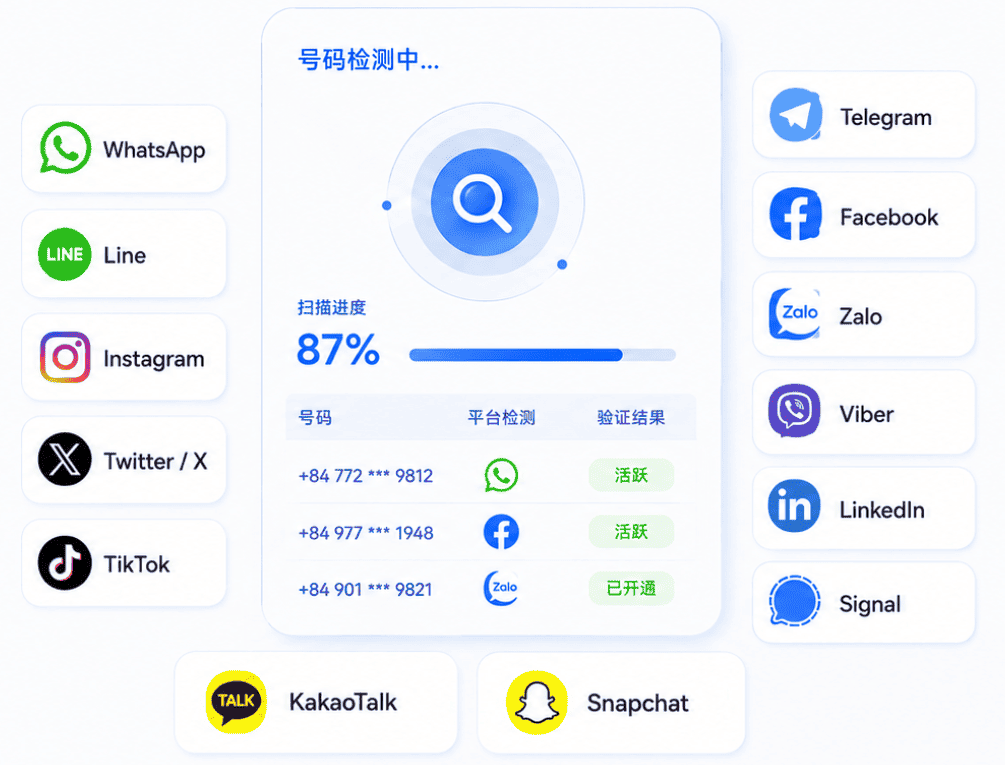
Amman is the world's leading number screening platform, providing global customers with batch number screening and testing services covering 236 countries. The platform currently supports more than 40 mainstream social networking and applications, including WhatsApp, Line, Twitter, Facebook, Instagram, LinkedIn, Viber, Zalo, Binance, Signal, etc., adapting to the needs of multiple scenarios.
The main core functions cover multi-dimensional precise screening such as activation, activity, interaction, gender, avatar, age, online, accuracy, empty account, mobile phone device, etc., and can flexibly meet the needs of different users. Its core advantage is to integrate global mainstream social and application resources to provide users with one-stop, real-time and efficient number precision screening services, helping customers achieve global digital layout.
It is a common choice for all professional teams to complete rational screening before actually reaching users.
Editor abcheck has a lot of experience, welcome to communicate with me, click to contact @Tg8189