
When it comes to user acquisition in the Southeast Asian market, Zalo is often underestimated. On the one hand, its users are highly localized. On the other hand, its usage habits are more biased towards acquaintance socialization and private communication, which makes it neither as "open" as traditional social media nor as "completely controllable" as instant messaging tools. Because of this in-between characteristic, if Zalo’s screening logic is copied from other platforms, the effect will usually be greatly reduced.
The truly effective approach is to start from "platform features" rather than "tools". Tools are just means, and screening logic is the key to determining the results.
Zalo's user structure determines that the filter number cannot follow the conventional path.
Zalo's core users are concentrated in Vietnam, and local users account for a very high proportion, which means that it cannot be roughly screened through simple tags like some global platforms. The connections between users are more based on real relationship chains rather than interests or content distribution.
This has two direct impacts:
- User authenticity is generally higher, but screening is also more difficult
- Judging value simply by "whether you are registered" or "whether you are online" has limited accuracy.
In addition, Zalo's usage scenarios are more focused on daily communication, such as work contacts, life exchanges, local services, etc. This type of behavior itself is not easy to be fully reflected by surface data.
In other words, if you only look at the "surface data" when filtering numbers on Zalo, it is easy to screen out a group of users who look normal but actually have no conversion value.
Three prerequisites that must be clarified before screening
Before starting to filter, there are three prerequisites. If you do not think clearly about it, the effect will not be stable no matter how you optimize the filtering conditions later.
The first is the target area.
Although Zalo is mainly based in Vietnam, user activity and spending power vary significantly in different cities and regions. If the screening scope is too general, it can easily lead to a decrease in the matching degree of subsequent communication.
Second is the type of business.
Different businesses have completely different requirements for user quality. For example, telemarketing pays more attention to connection rate and response speed, while private domain precipitation pays more attention to long-term interaction capabilities. If the screening criteria are not combined with the business objectives, it is easy to end up with a situation where "the screening is accurate but not useful".
The third is user usage habits.
Zalo users prefer instant communication. If the selected users rarely actively use the chat function, even if the account itself is normal, it will be difficult to form effective contacts.
These three premises are essentially answering a question: Are the users you screen out "suitable to be used by you?"
From "usable" to "easy to use": the core judgment dimension of screen numbers
The first layer of screening is to determine whether the account is "usable", but what really determines the effect is the second layer - whether it is "easy to use".
In the Zalo environment, you can focus on several dimensions:
- Active behavior : Are there recent login records and are there signs of continued use?
- Interaction traces : whether there are chat records and friend interaction behaviors (reflecting the frequency of use)
- Account integrity : whether the avatar, nickname, and basic information are complete
- Friend structure : number of friends and relationship distribution, whether there is a basic social network
Only by combining these dimensions can we get closer to the real user status, rather than judging by a single indicator.
It should be noted that a lot of Zalo’s behavioral data is not as intuitive as the open platform, which is one of the reasons why relying solely on manual screening is inefficient. At this time, the role of some screening software begins to show - but the key is not "whether there are tools", but "what rules to use to screen".
Different businesses have very different requirements for Zalo user quality.
For the same sieve number, the differences in standards under different business scenarios are very obvious.
If it is a business that favors electronic sales or rapid conversion, what is more needed is:
- High activity
- Fast response
- Have the habit of instant communication
And if you are doing private domain precipitation or long-term operations, you will pay more attention to:
- User stability
- Long-term usage habits
- receptiveness to content
There are also some partial distribution or fission businesses that pay more attention to the strength of users’ social relationships, such as the number of friends, frequency of interaction, etc.
This means that there is no "uniform standard" for screen numbers, but needs to be dynamically adjusted according to business goals. Using the same set of screening logic for different projects will often lead to significant deviations in the results.
How to use it after screening to determine whether the screening number is meaningful?
The screen number itself will not directly bring about conversions. What really produces results is the subsequent use.
On a platform like Zalo that favors private domain attributes, reach methods are particularly critical. If the initial communication method does not conform to the habits of local users, it can easily be ignored or even directly blocked.
In actual implementation, you can pay attention to several details:
- Don’t be too direct in initial contact, prefer natural communication.
- The pace should not be too fast and avoid frequent contacts in a short period of time.
- The content should be close to the local context rather than rigidly translated.
At the same time, the selected users also need to be simply stratified, such as giving priority to the more active ones, so that feedback can be seen faster and subsequent strategies can be optimized.
Why do some screen sizes appear to have many results, but the actual results are very poor?
In actual operations, a situation often occurs: a large number of users are screened out, but the proportion of users who can actually interact is very low.
Common reasons include:
- The data itself is not new enough and the users are no longer active
- The filtering dimension is too single, only looking at registration or online status
- Mixed regions or user attributes lead to decreased communication matching
- Subsequent contact methods are not in line with platform habits
The superimposition of these problems will lead to "the data looks fine, but the results are not good when used".
In essence, screening is not a one-time action, but a process of continuous adjustment. Filtering rules, data sources, and usage methods all influence each other. Any deviation in any link will affect the final result.
When the sieve number begins to shift from "quantity-oriented" to "matching-oriented", the overall efficiency will gradually improve. As for how to make the screening step more stable and efficient, different people will have different paths. Some people prefer manual fine screening, and some will use screening software to do batch processing. But what really widens the gap is often not the tool itself, but the screening logic and usage behind it.
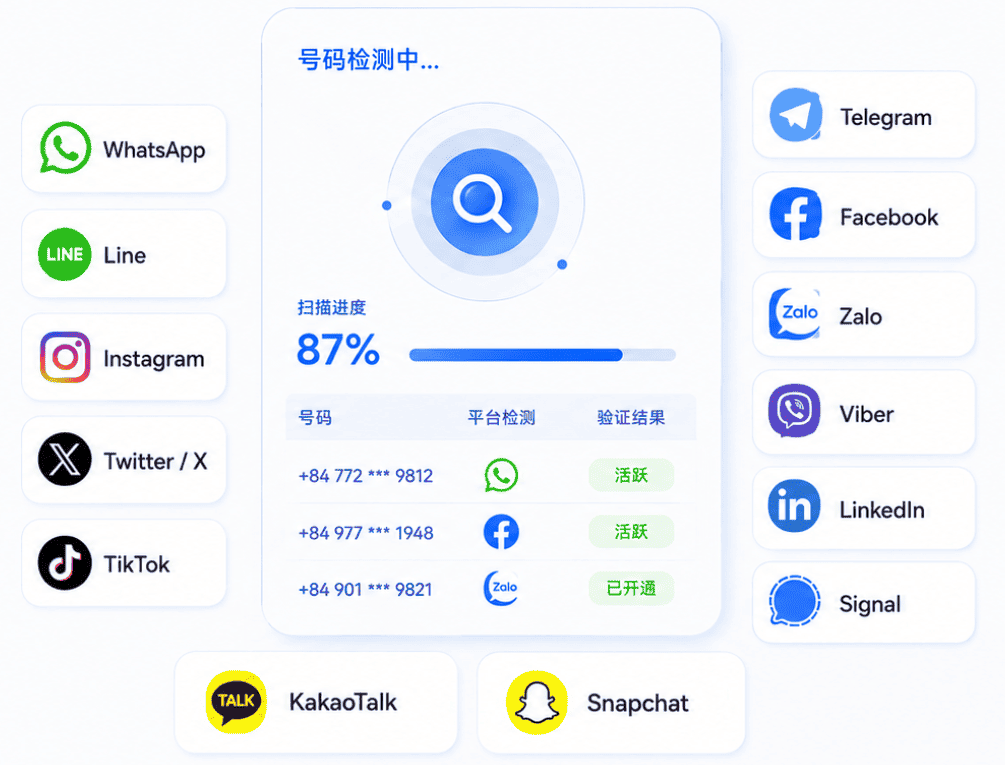
Amman is the world's leading number screening platform, providing global customers with batch number screening and testing services covering 236 countries. The platform currently supports more than 40 mainstream social networking and applications, including WhatsApp, Line, Twitter, Facebook, Instagram, LinkedIn, Viber, Zalo, Binance, Signal, etc., adapting to the needs of multiple scenarios.
The main core functions cover multi-dimensional precise screening such as activation, activity, interaction, gender, avatar, age, online, accuracy, empty account, mobile phone device, etc., and can flexibly meet the needs of different users. Its core advantage is to integrate global mainstream social and application resources to provide users with one-stop, real-time and efficient number precision screening services, helping customers achieve global digital layout.
It is a common choice for all professional teams to complete rational screening before actually reaching users.
Editor abcheck has a lot of experience, welcome to communicate with me, click to contact @Tg8189