
When many teams are doing WhatsApp customer acquisition, they are used to using "lists" to understand the data, and then replace one batch of numbers when they are used up. However, with in-depth use, you will soon find that this method is not efficient, the data is repeatedly used without settling, and the results are unstable.
A more reasonable way is to establish a "number pool". It is not a one-time use of data, but a set of user resource structures that can be continuously updated and optimized. The core is not the quantity, but whether the data has been sorted out clearly.
Why number pools are more important than lists
The list is for one-time use, but the number pool can be used continuously. The difference between the two lies in whether the data is layered and managed.
If it is just a simple list, it will appear:
- Data cannot be reused after use
- Can't tell which numbers are valid
- Re-screen every time
The structure of the number pool turns data into long-term available resources instead of starting from scratch every time.
What structures should a basic number pool contain?
In actual construction, the number pool does not need to be complicated, but it must have basic layers.
Can be broken down into three categories:
- Available number, WhatsApp has been activated
- Active users with continuous usage behavior
- Risk or abnormal number, need to be filtered
These three categories are the most basic structures. Without hierarchical data, it is difficult to use stably.
The activated status is the first level of screening
Among all filters, activation status is the most basic level.
What this layer solves is:
- Which numbers can be reached?
- Which data should be eliminated directly?
Numbers that have not been opened for WhatsApp are of no use value. If they are not filtered in advance, resources will be repeatedly consumed.
Therefore, this layer of screening should be completed before the number enters the pool.
Active tags determine whether the data can be used
Activation is only the basic condition, what really affects the effect is activity.
Active tags can help differentiate:
- High frequency users
- occasional user
- Long-term silent users
Through this label, you can decide how to use different data instead of unified access.
Risk identification is key to stability
In addition to available and active, there is another type of data that needs to be processed separately, which is risk or exception numbers.
Such numbers may appear as:
- Unstable status
- Use exception
- The reach effect fluctuates greatly
If not marked separately, it can easily be mixed into normal data and affect the overall performance.
Therefore, in the number pool, there needs to be a clear risk classification for filtering or separate processing.
The number pool is not built once, but is continuously updated.
The number pool does not end once it is established, but requires constant maintenance.
Common update methods include:
- Filter new data before entering it
- Regular review of existing data
- Long-term invalid data will be phased out gradually
Through continuous updates, the number pool will gradually become stable from a chaotic state.
Amman is more suitable for building this type of structure when used
In actual operation, manual maintenance of the number pool is not only inefficient, but also difficult to maintain unified standards. A more realistic way is to complete the screening and classification when the data comes in.
Through Amman, numbers can be tested in batches, the WhatsApp activation status can be identified, and the numbers can be marked based on activity and risk status. In this way, when the data enters the number pool, the basic layering has been completed instead of being processed later.
For teams that need to use data for a long time, this approach makes it easier to form a stable structure.
Only when the data structure is clear can it be used stably.
The value of the number pool does not lie in how much data is stored, but in whether the data is sorted out clearly.
When the three layers of activation status, active tags and risk identification are straightened out, the data will change from a mixed state to a clearly structured part. Subsequent reach and conversion will be easier to control.
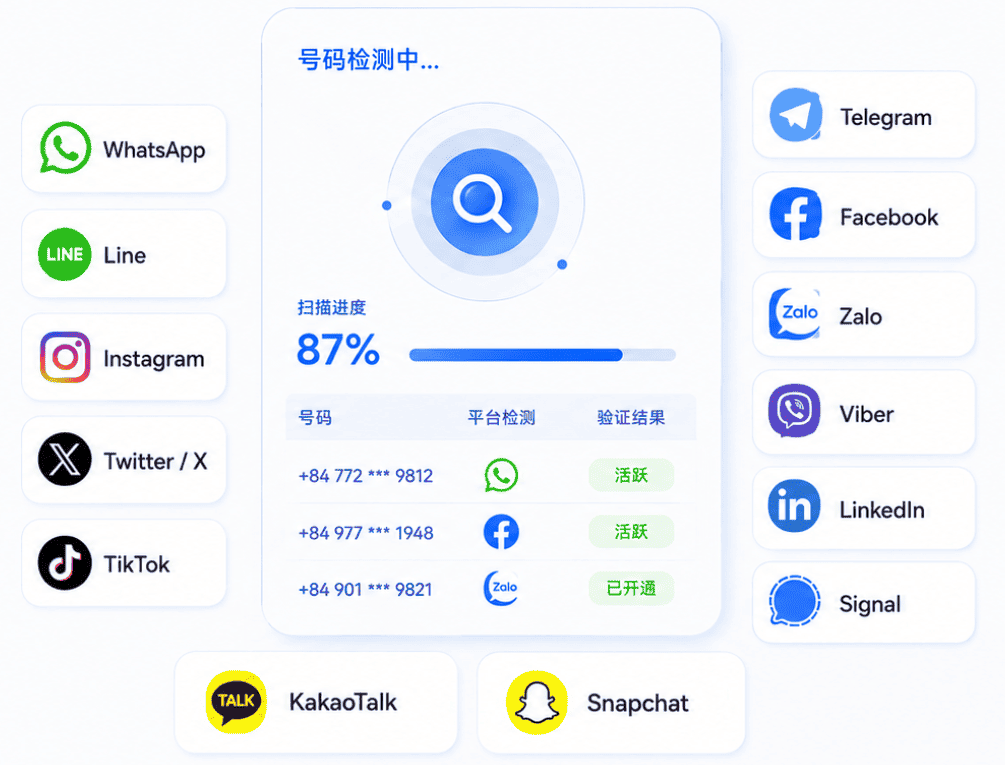
Amman is the world's leading number screening platform, providing global customers with batch number screening and testing services covering 236 countries. The platform currently supports more than 40 mainstream social networking and applications, including WhatsApp, Line, Twitter, Facebook, Instagram, LinkedIn, Viber, Zalo, Binance, Signal, etc., adapting to the needs of multiple scenarios.
The main core functions cover multi-dimensional precise screening such as activation, activity, interaction, gender, avatar, age, online, accuracy, empty account, mobile phone device, etc., and can flexibly meet the needs of different users. Its core advantage is to integrate global mainstream social and application resources to provide users with one-stop, real-time and efficient number precision screening services, helping customers achieve global digital layout.
It is a common choice for all professional teams to complete rational screening before actually reaching users.
Editor abcheck has a lot of experience, welcome to communicate with me, click to contact @Tg8189