![How to check if a Saudi user’s WhatsApp number is in use [Practical Tips]](/_nuxt/img/android-chrome-192x192.deac7789b80c.png)
When acquiring WhatsApp customers in the Saudi market, a very common problem is: the number looks normal and messages can be sent, but there is no response. Many people will immediately change their words or adjust their contact methods, but the actual problems often arise earlier.
The key point is "whether the number is in use", not "whether it can be sent".
Many Saudi numbers are registered, but their usage varies greatly. Without filtering, the data may appear usable, but it is actually difficult to convert.
Why is the Saudi number “can be sent but no reply”
One obvious feature of the Saudi market is that the WhatsApp registration rate is very high, but the level of activity is also clearly stratified. The simple understanding is that many numbers are activated, but not everyone is using them.
Common situations include:
- The user has registered but has not logged in for a long time
- Some numbers are backup numbers or work numbers and are rarely used.
- Some numbers are for short-term use and will rarely come online again in the future.
If you use this data directly, the reach can be completed, but the user will not see the message at all, let alone interact.
To determine whether it is in use, you cannot just look at the activation status.
When screening accounts, many teams only focus on "whether to activate WhatsApp". This was enough in the early days, but it is obviously not enough now.
The activation status can only indicate that the number exists, but it cannot indicate:
- Is the user active?
- Whether used recently
- Is it worth investing resources in reaching out?
Therefore, if you only stop at enabling detection, the effect will easily fluctuate.
Practical method one: Activity screening (the most direct)
The most direct way to determine whether a number is in use is to look at the activity.
Numbers can be divided into several categories through detection:
- Recently active users
- occasional user
- Long-term inactive users
In the Saudi market, the real value lies in the first group of people, because they are more likely to see the news and more likely to respond.
Through Amman, the active status of numbers can be identified in batches, and user levels can be directly distinguished during the screening stage instead of making subsequent judgments. This step can significantly improve overall reach efficiency.
Practical Method 2: Combining Behavior and Usage Stability
In addition to activity, some indirect indicators can also be used to determine whether users use it for a long time.
For example:
- Whether the use is ongoing rather than short-term and concentrated
- Whether the status is stable and there are no abnormal fluctuations
- Is it a normal usage environment?
This information does not mean much when viewed individually, but when combined together, it can be closer to judging user quality.
During the screening process, Amman not only determines the activation, but also further identifies the account status to help filter out some unstable or abnormal data and make the remaining users more concentrated.
Practical Method Three: Small Batch Verification
After the screening is completed, a round of small-scale reach testing can be done to verify the screening results.
However, it should be noted that this step is verification, not screening. Many teams treat contact as screening, which is the wrong order.
The correct logic should be:
- Use Amman first to screen out highly active users
- Do small batch contact verification again
- Adjust usage strategies based on feedback
Only in this way can the test be meaningful, otherwise it will just be repeated trial and error on low-quality data.
Suggested screening order for the Saudi market
In this market, the screening order is very critical. If the order is wrong, everything will be affected later.
A more reasonable way is:
First do the activation test and filter out unavailable numbers.
Then do active filtering to filter out those who are using it.
Then filter abnormal conditions to ensure data stability
Finally, use it in layers instead of unified access.
Through Amman, these steps can be integrated into one process instead of scattered operations, reducing human errors.
Actual value of time spent in Amman in Saudi data
In a market like Saudi Arabia, where the registration rate is high but the activity varies widely, the role of screening tools will be magnified. If you only do basic testing, it will be difficult to improve the effect.
The advantage of Shi Amman here is that it can be done at the same time:
- Batch activation status detection
- Activity recognition
- Exception status filtering
- Data label output
And it supports API access, so you can embed these filtering logic directly into your business system, so that each batch of new data has already been filtered when it enters, instead of having to process it later.
This means your data is “filtered” from the start, not mixed.
The Saudi market is more suitable for "less but more accurate"
Many teams tend to fall into a misunderstanding in this market, which is to pursue quantity, but the actual effect is often the opposite. Saudi users do not have a high tolerance for contact. If the data quality is not good, it is easy to directly lose communication opportunities.
When you pass Amman and filter out highly active users, the amount of data will decrease, but the overall quality will be significantly improved. The number of touches may be reduced, but the response rate will be more stable and conversions will be more likely to occur.
To determine whether it is being used, the essence is to sift through data rather than guessing users.
Many people will try to "test whether the user is online" through words or time, but this method is very costly and unstable.
A more direct method is to screen out the "people who are using it" at the data stage.
When Amman processes the dimensions of activation, activity, and status at once, what you get is no longer a batch of numbers, but a batch of data that is closer to real users.
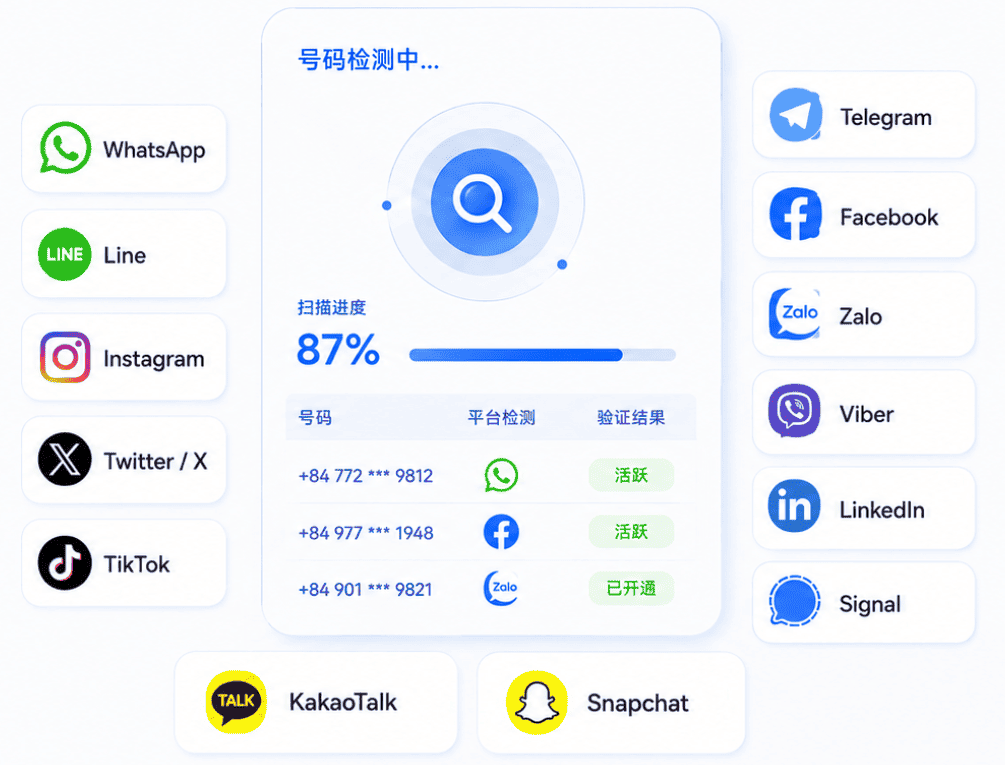
Amman is the world's leading number screening platform, providing global customers with batch number screening and testing services covering 236 countries. The platform currently supports more than 40 mainstream social networking and applications, including WhatsApp, Line, Twitter, Facebook, Instagram, LinkedIn, Viber, Zalo, Binance, Signal, etc., adapting to the needs of multiple scenarios.
The main core functions cover multi-dimensional precise screening such as activation, activity, interaction, gender, avatar, age, online, accuracy, empty account, mobile phone device, etc., and can flexibly meet the needs of different users. Its core advantage is to integrate global mainstream social and application resources to provide users with one-stop, real-time and efficient number precision screening services, helping customers achieve global digital layout.
It is a common choice for all professional teams to complete rational screening before actually reaching users.
Editor abcheck has a lot of experience, welcome to communicate with me, click to contact @Tg8189