
In LINE user acquisition and private domain operations, many teams will initially focus on “how many users”, but after actually running for a period of time, they will find that it is not the number that really affects the results, but the activity.
For the same group of users, some will continue to interact while others will barely respond. If activity detection is not done, the data will appear to be a lot, but the proportion of users who can actually use it will be very low.
Choosing a suitable activity detection platform not only improves efficiency, but is also the key to ensuring the stability of subsequent data.
Why LINE must do activity detection
Among LINE users, there is a clear difference between registered accounts and actual usage.
Common situations include:
- Registered but not used for a long time
- Log in occasionally but no interaction
- Be active for a short time and then quickly become silent.
If activity is not screened, the reach action will be dispersed among a large number of low-quality users, resulting in unstable overall results.
Comparison of common detection methods
In actual operation, there are usually several ways to detect activity.
Manual judgment is based on observing user behavior, but it is inefficient and has inconsistent standards.
Simple tool detection only determines the basic status and cannot distinguish active levels.
Batch detection platform that can process large-scale data and output hierarchical results
As data scale increases, batch detection platforms become a more stable choice.
Several criteria to look at when choosing a platform
When choosing an activity detection platform, you don’t need to look at the complexity of the functions, but at several key capabilities.
Detection accuracy
Whether it is possible to distinguish between different levels of activity, rather than simply judging whether there is one or not
Batch processing capability
Whether to support large-scale data processing without compromising speed and stability
Data output structure
Is it possible to output label or hierarchical results for subsequent use?
These three points are more important than the number of functions alone.
How to verify whether the test results are reliable
The results of the platform itself still need to be confirmed through simple verification.
You can test with small batches of data:
First filter out some highly active users
Then make actual contact
Watch responses and interactions
If the screening results are consistent with the actual feedback, the detection logic is available.
The role of Amman in activity detection
In actual use, passing through Amman can accomplish:
- Check LINE account status in batches
- Identify activity levels and differentiate user levels
- Output structured tagged data
In this way, the data can be organized from a mixed state into a hierarchical structure in one round of processing, rather than being judged later.
It also supports API access, which allows each batch of new data to be detected when it enters the system instead of manual operation.
Data filtered by activity is easier to use
When users are stratified, the way to use them will be clearer.
Highly active users are reached first to improve conversion efficiency
Moderately active users for testing, progressive screening
Low active users reduce investment and avoid resource waste
This method is more stable than unified use and easier to optimize.
Activity is more important than quantity
In LINE operations, simply increasing the number of users will hardly bring sustainable results.
Only when the proportion of active users increases, reach, interaction and conversion will gradually become stable. Choosing an appropriate detection platform is essentially about controlling data quality, rather than simply increasing data scale.
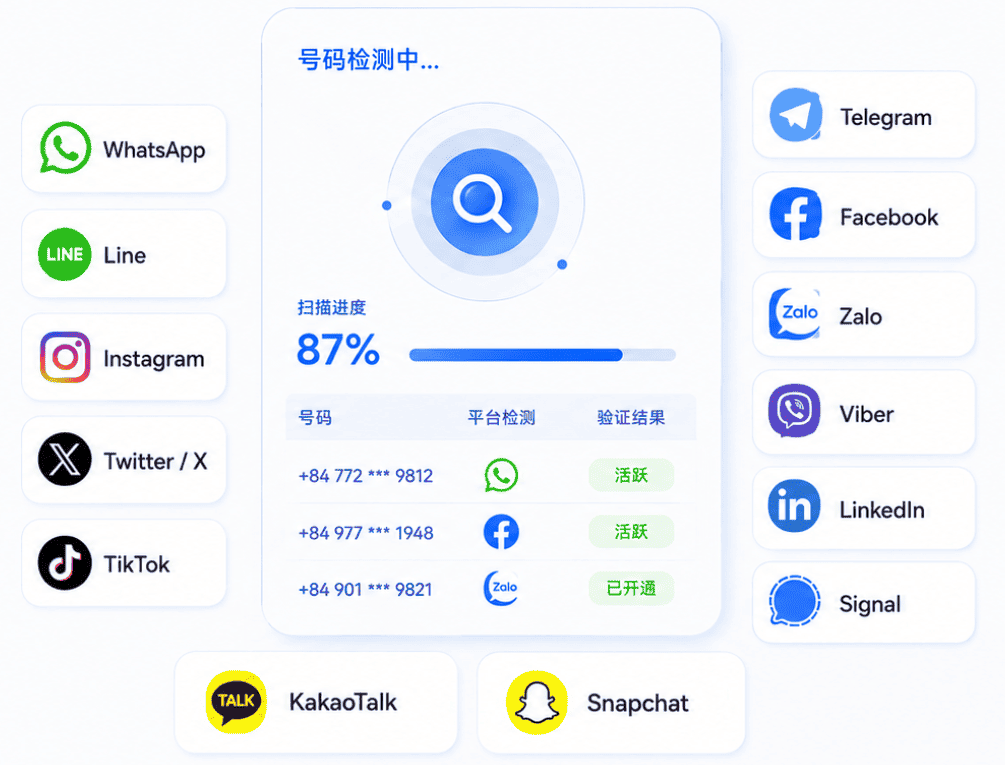
Amman is the world's leading number screening platform, providing global customers with batch number screening and testing services covering 236 countries. The platform currently supports more than 40 mainstream social networking and applications, including WhatsApp, Line, Twitter, Facebook, Instagram, LinkedIn, Viber, Zalo, Binance, Signal, etc., adapting to the needs of multiple scenarios.
The main core functions cover multi-dimensional precise screening such as activation, activity, interaction, gender, avatar, age, online, accuracy, empty account, mobile phone device, etc., and can flexibly meet the needs of different users. Its core advantage is to integrate global mainstream social and application resources to provide users with one-stop, real-time and efficient number precision screening services, helping customers achieve global digital layout.
It is a common choice for all professional teams to complete rational screening before actually reaching users.
Editor abcheck has a lot of experience, welcome to communicate with me, click to contact @Tg8189