
Among U.S. e-commerce customers, WhatsApp has become a stable communication portal. Many teams have number sources, but only a small part of the users can actually convert. The reason is not the quantity, but whether the screening logic is detailed enough.
Instead of constantly looking for new data, it is better to fine-tune existing numbers and compress "available users" into "convertible users".
Data source is not the key, filtering is the key
There is no shortage of sources of U.S. e-commerce related numbers, common ones include:
- E-commerce historical orders or membership data
- Advertising leads, such as forms or private messages to WhatsApp
- US number segment data provided by third-party data providers
The data itself does not distinguish user quality, and the effect of direct use is often unstable. What really makes the difference is the subsequent screening step.
The first step: the basic screening must be done cleanly
Before all subdivisions, deal with the basic conditions first.
include:
- Empty number filtering, eliminating non-existent numbers
- WhatsApp activates testing to confirm whether it is reachable
Through this, Amman can complete these two steps in batches and filter out invalid numbers before the data is used. The purpose of this step is not to improve conversions, but to avoid subsequent waste of resources.
Step 2: T card identification and judging the basic quality of the number
In the US market, number type itself is a screening dimension. T cards usually represent a specific operator environment, and the overall stability and usage scenarios are relatively concentrated.
The significance of screening T cards is:
- Filter out some low-quality virtual numbers
- Improve overall number stability
- Make data closer to real user environment
Through Amman, you can directly identify the operator and type of the number, without the need to manually determine the number segment, and large-scale data can be quickly classified.
Step 3: Screen iPhone users to narrow the scope of the crowd
Device type is a very practical auxiliary condition in e-commerce scenarios. iPhone users generally have a more stable device environment and are closer to the target group in some categories.
The function of this layer of filtering is:
- Further compress the data range
- Improve overall population quality
- Make subsequent contacts more focused
Shi'anman supports device type recognition and can directly mark iOS users in the screening stage. No additional operations are required during the screening process.
Step 4: Identify blue label accounts and lock business attributes
Blue label accounts usually represent corporate or commercial usage scenarios in WhatsApp. This type of account is more valuable in some e-commerce businesses.
Filtering blue label accounts can help:
- Determine whether the user has commercial attributes
- Distinguish between ordinary users and commercial users
- Used for specific B-side or distribution scenarios
Through Amman, the account status can be identified during the detection process, and the blue-labeled account can be marked separately for subsequent individual use.
Step 5: Activity screening to determine the final effect
The previous filters are all about "narrowing down the scope", and it is this layer that really determines the effect.
Activity filtering can divide users into:
- High frequency users
- Medium user
- Low active or silent users
Only the first group of people are the priority targets.
Through Amman, activity identification can be completed in one round of detection, without the need for subsequent manual judgment. Filtering results can be directly output as tags to facilitate hierarchical use.
Filter order is more important than filter criteria
In actual operation, it is not recommended to superimpose all conditions at the beginning, otherwise the data will be over-compressed.
A more reasonable order is:
- Do basic screening first (open + empty number)
- Then do the number type filtering (T card)
- Do device filtering again (iPhone)
- Finally do active screening
Through Amman, these steps can be integrated into a set of processes, and the data will be layered when it enters the system, instead of being split and processed later.
Use Amman to turn screening into a standard action
In a scenario like American e-commerce with a large amount of data, manual screening is basically not feasible. The role of Amman is not a single test, but to turn screening into the default process.
Can be achieved:
- Batch detection number status
- Automatically identify T-card, device type, and account attributes
- Activity hierarchical output
- API access to CRM or marketing system
This way the data is "filtered" from the beginning, rather than in a mixed state.
Segmentation is not for complexity, but for greater concentration
Screening T-cards, iPhone users, and blue label accounts is essentially narrowing the scope and compressing the data to a part closer to the target group.
When the filtering logic is clear, even if the amount of data is reduced, the overall reach efficiency and conversion rate will be more stable. Compared with continuously expanding the scale of data, this method is more suitable for long-term e-commerce customer acquisition.
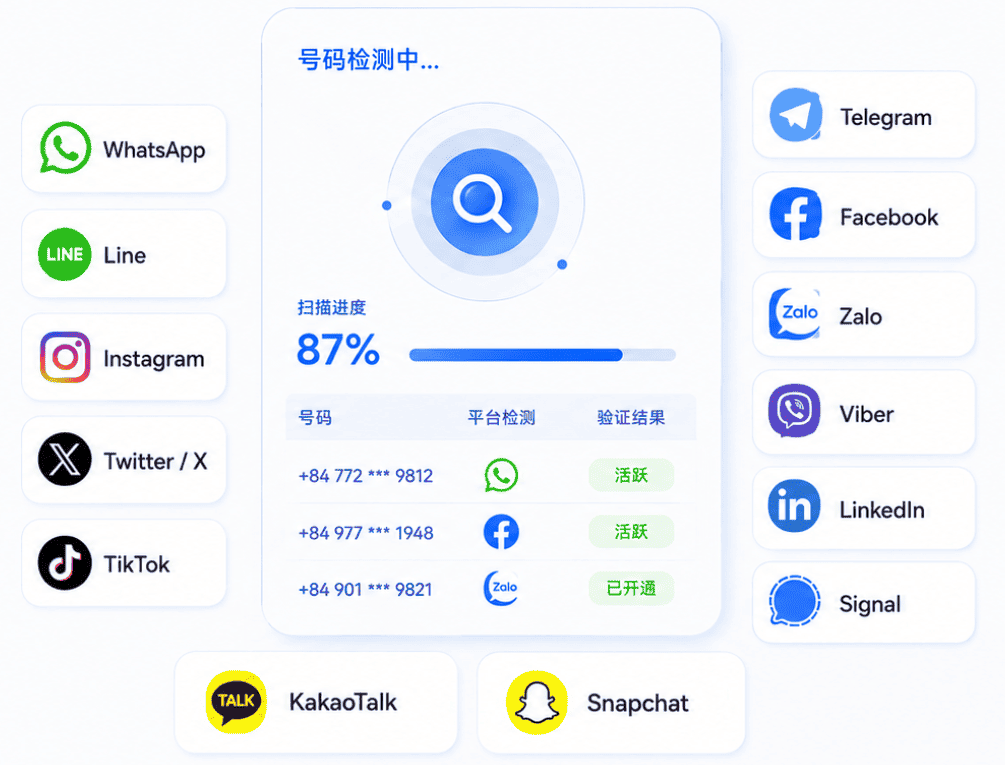
Amman is the world's leading number screening platform, providing global customers with batch number screening and testing services covering 236 countries. The platform currently supports more than 40 mainstream social networking and applications, including WhatsApp, Line, Twitter, Facebook, Instagram, LinkedIn, Viber, Zalo, Binance, Signal, etc., adapting to the needs of multiple scenarios.
The main core functions cover multi-dimensional precise screening such as activation, activity, interaction, gender, avatar, age, online, accuracy, empty account, mobile phone device, etc., and can flexibly meet the needs of different users. Its core advantage is to integrate global mainstream social and application resources to provide users with one-stop, real-time and efficient number precision screening services, helping customers achieve global digital layout.
It is a common choice for all professional teams to complete rational screening before actually reaching users.
Editor abcheck has a lot of experience, welcome to communicate with me, click to contact @Tg8189