
In Zalo user screening, many teams will start directly from the number, region, and activity level, but there is a faster and more intuitive judgment dimension that is often ignored, which is the avatar. Avatar is not a decisive factor, but in the first round of screening, it can help you quickly filter out a large number of low-quality users. In the case of large amounts of data, this step can significantly improve the efficiency of subsequent screening.
The role of avatar filtering is not to judge conversions, but to filter
It needs to be made clear first that avatars cannot directly determine whether a user will convert, but they can help determine whether the account is closer to a real user.
In the raw data, usually mixed in:
- Account without avatar set
- Accounts using default or template images
- Avatars that don’t match real user behavior
If no screening is done, these accounts will enter the subsequent process and occupy the same reach resources.
The significance of avatar filtering is to do a quick layer of filtering first, rather than replacing subsequent data filtering.
Which avatars can be retained first?
In actual operation, simple rules can be used to determine which users are more worthy of advancing to the next step.
Common types of avatars that are prioritized for retention include:
- Real photos, especially clear photos of faces
- Photos of life scenes, not stock photos
- Highly personalized, non-repetitive avatars
This type of account is usually closer to real users and more likely to have actual usage behavior.
Which avatars are recommended to be filtered directly?
Similarly, there is also a category of avatars that can be eliminated directly in the first round to avoid entering subsequent processes.
For example:
- Blank avatar or default avatar
- Landscape pictures, cartoon pictures, material pictures
- Obvious duplicate or batch-generated avatars
A large part of these accounts do not have real use value, and even if they are reached, it is difficult to generate effective interaction.
Where should avatar screening be placed?
Avatar screening is best placed at the front of the process, rather than being judged after contact.
A more reasonable order is:
Do a preliminary screening of avatars first to quickly reduce low-quality data
Do a number check again to confirm whether the account exists
Then filter activity and lock in active users.
Through this sequence, the data size can be reduced at the earliest stage, allowing subsequent screening to be more focused.
Avatar filtering must be used in conjunction with data filtering
It should be noted that avatars can only be used as the first layer of filtering and cannot be used alone.
The reason is simple:
- Some real users don’t use avatars
- Some low-quality accounts also use pictures of real people
If you only rely on avatars, misjudgments will occur.
A more stable way is to combine avatar filtering with data filtering.
If you pass Amman, you can continue to complete the following after the initial screening of avatars:
- Account opening status detection
- Activity recognition
- Abnormal account filtering
This can combine visual judgment with data judgment to reduce errors.
Use Amman to improve overall screening efficiency
In large-scale data, if you rely entirely on manual screening of avatars, the efficiency will be significantly reduced.
A more reasonable way is to use avatar screening as the first step, and then complete subsequent batch inspections through Amman.
Can be achieved:
- Quickly filter obviously low-quality accounts
- Check account status in batches
- Output available user data
This can change screening from "manual judgment" to "process processing" and reduce repeated operations.
The value of avatar filtering lies in pre-filtering
In a platform like Zalo with a large number of users, the difference in data quality is very obvious. If pre-filtering is not done, subsequent reach and operations will be slowed down.
By first reducing some low-quality accounts through avatar screening, and then combining it with Shi Anman for data layer screening, the entire batch of data can be closer to real users from the beginning, instead of being constantly revised later.
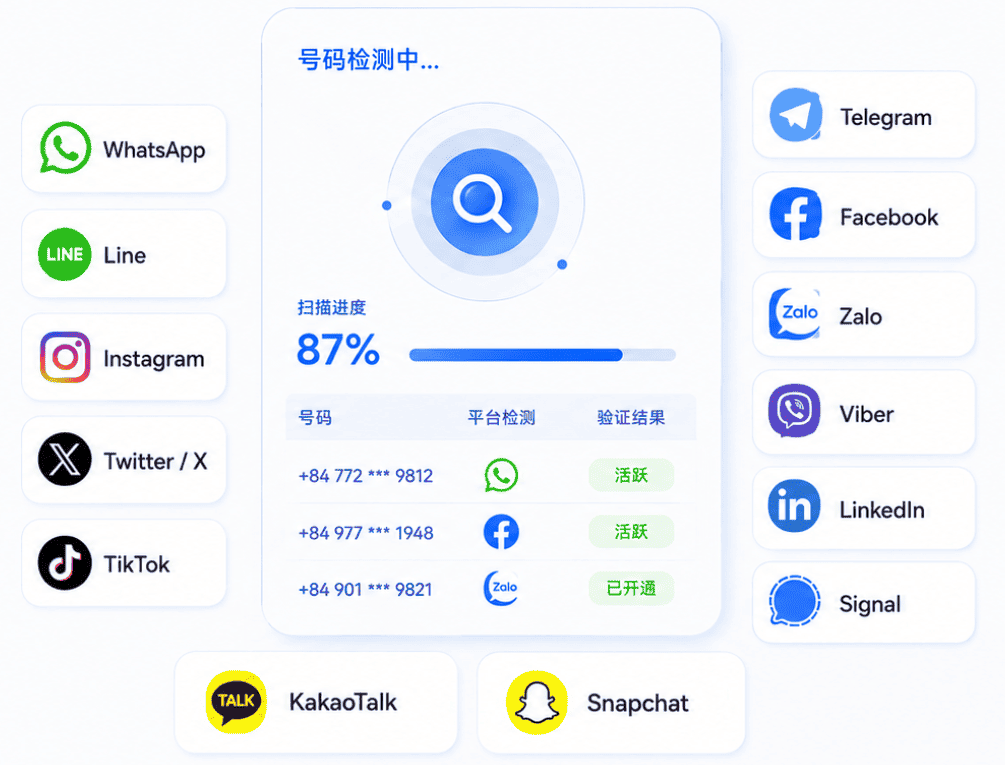
Amman is the world's leading number screening platform, providing global customers with batch number screening and testing services covering 236 countries. The platform currently supports more than 40 mainstream social networking and applications, including WhatsApp, Line, Twitter, Facebook, Instagram, LinkedIn, Viber, Zalo, Binance, Signal, etc., adapting to the needs of multiple scenarios.
The main core functions cover multi-dimensional precise screening such as activation, activity, interaction, gender, avatar, age, online, accuracy, empty account, mobile phone device, etc., and can flexibly meet the needs of different users. Its core advantage is to integrate global mainstream social and application resources to provide users with one-stop, real-time and efficient number precision screening services, helping customers achieve global digital layout.
It is a common choice for all professional teams to complete rational screening before actually reaching users.
Editor abcheck has a lot of experience, welcome to communicate with me, click to contact @Tg8189