
When acquiring customers on Telegram, data is never a problem. The real question is "whether the filtered data is useful." There are also tens of thousands of users, some can achieve stable conversions, while others have almost no feedback. The difference often lies in the screening of materials.
Screening is not about simply exporting accounts, but about removing invalid users from the beginning and screening out people who are truly active, engaged, and capable of communicating. As long as this is done correctly, the subsequent efficiency will naturally improve.
The core of TG screening materials is not quantity, but quality
Telegram is very open and the threshold for obtaining an account is low, which leads to a problem:
It seems that there are many users, but the proportion of real value is not high.
If you use raw data directly without filtering, you will usually encounter the following situations:
- Many accounts have been offline for a long time
- There are a large number of users in the group who “only watch and speak”
- High proportion of data duplication and invalidity
- It looks like a user, but in fact it has no interactive value.
This kind of data essentially consumes time and resources.
The purpose of sifting is to filter out in advance those users who “seem to be useful but are actually useless”.
What are the key points to look at when screening TG materials?
In the Telegram environment, judging whether a user is valuable does not depend on a single indicator, but on the overall status.
Some of the more critical points include:
- Have you had any recent online behavior?
- Have you participated in group speaking?
- Is there basic account information (avatar, nickname, etc.)
- Are there any traces of normal use?
Only by combining this information can we determine whether the user is a "real person using TG".
If you only look at the online status, it is easy to screen out a batch of accounts that are temporarily online but have no actual value; if you only look at the number of groups, you may also screen out a large number of non-interactive users. Therefore, screening materials must be based on multi-dimensional judgment rather than single-point screening.
Why is it so difficult to get results when manually screening materials?
In theory, all this information can be judged manually, but in actual operation, a few hundred is OK, but thousands or tens of thousands of data are basically impossible to process.
Frequently asked questions are:
- Judgment standards are not unified
- Filtering is slow
- It’s easy to miss key information
- When there is too much data, it gets out of control
This is also the reason why many people "seem to be sifting", but the results are still unstable.
It will be much easier to use Amman to filter TG data.
In actual use, directly using Shianman to make TG screening materials will be much clearer than manual processing.
Its advantage lies in two points:
First, strong batch processing capabilities
Large batches of TG data can be directly detected without looking at them one by one, which greatly saves time.
Second, the screening dimensions are more complete
You can filter based on multiple dimensions such as activity, status, account information, etc. instead of making a single judgment.
The benefits of doing this are straightforward:
The filtered data itself is already filtered, not a bunch of mixed data.
Why is it better to do this step of screening materials as early as possible?
Many people are used to getting data first, operating it first, and then optimizing it. However, in an environment like TG, this approach is very costly.
Because TG users themselves are highly mobile, if the data is not clean at the beginning and then adjusted later, a lot of time will have been wasted.
Putting the screening material in front is equivalent to setting the direction from the beginning.
By filtering clean data and taking subsequent actions, the overall rhythm will be more stable.
The essence of screening materials is actually to "reduce ineffective actions"
In Telegram, the biggest waste is not lack of data, but repeated operations for invalid users.
The more accurate the screening is, the fewer invalid users will be, and each of your contacts will be more meaningful.
Using Amman to do TG screening is essentially to do this step faster and more accurately, without repeated trial and error, and without relying on experience to judge.
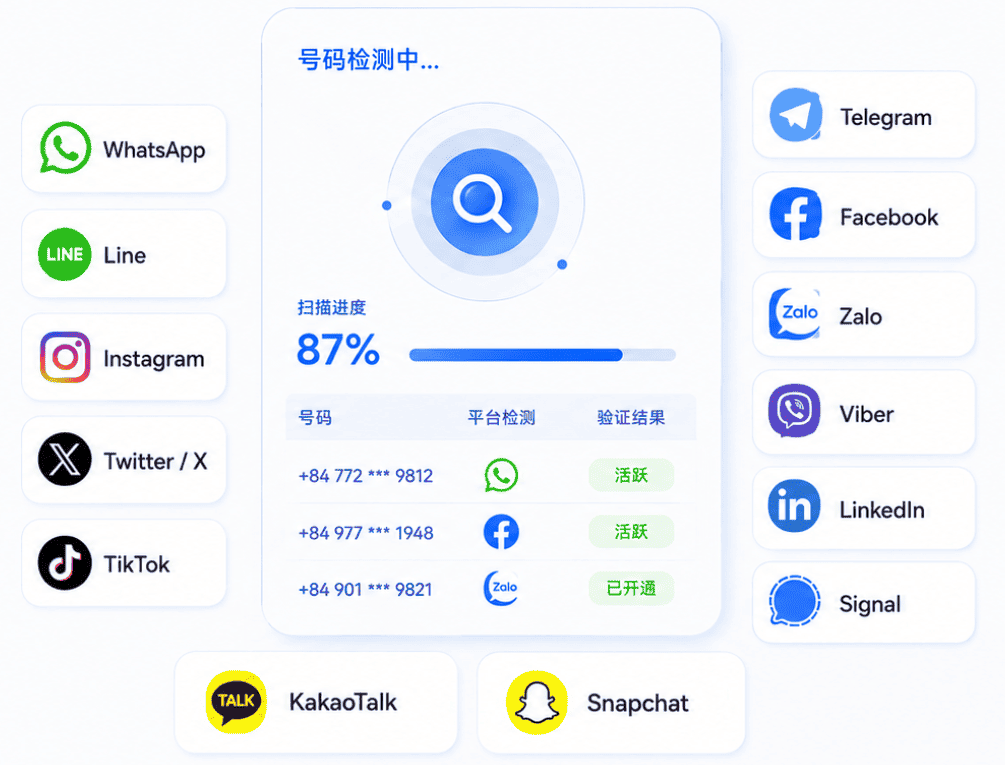
Amman is the world's leading number screening platform, providing global customers with batch number screening and testing services covering 236 countries. The platform currently supports more than 40 mainstream social networking and applications, including WhatsApp, Line, Twitter, Facebook, Instagram, LinkedIn, Viber, Zalo, Binance, Signal, etc., adapting to the needs of multiple scenarios.
The main core functions cover multi-dimensional precise screening such as activation, activity, interaction, gender, avatar, age, online, accuracy, empty account, mobile phone device, etc., and can flexibly meet the needs of different users. Its core advantage is to integrate global mainstream social and application resources to provide users with one-stop, real-time and efficient number precision screening services, helping customers achieve global digital layout.
It is a common choice for all professional teams to complete rational screening before actually reaching users.
Editor abcheck has a lot of experience, welcome to communicate with me, click to contact @Tg8189