
In the cross-border customer acquisition process, many teams will focus on delivery and reach, but the actual effect is often stuck in the previous step: whether the data itself is available. The number of numbers seems to be quite large, but the proportion that can actually be reached is not high. This difference usually comes from the failure to identify the registration status.
The core of registration status identification is not a technical issue, but a data screening issue. It solves a very specific thing: Which of these numbers can be used and which are not worth continuing to invest in.
Why cross-border customer acquisition must first identify registration status
In cross-border scenarios, the source of numbers is usually complex and may come from placement, channel cooperation, historical accumulation, etc. When these data are mixed together, obvious structural problems will arise.
Common situations include:
- Some numbers are not registered with WhatsApp
- Some accounts exist but are in abnormal status
- Some data has expired
If you do not identify and enter the contact process directly, the result will usually be a high sending volume, but very few effective contacts, and it will be difficult to follow up. Therefore, the role of registration status identification is to divert data at the front end, rather than waiting until the use stage to find problems.
What practical problems can registration status identification solve?
From a practical perspective, this step can directly solve several key issues.
The first is the issue of reach.
- Only by registering a WhatsApp number can you meet the basic communication conditions
- Continuing to invest in unregistered numbers will only increase costs.
The second is the problem of data waste.
- The original list has a high proportion of invalid numbers
- Unfiltered data will be repeatedly involved in delivery and testing
Then there is the confusion in the follow-up process.
- The list is unclear and the results are difficult to determine.
- Valid users cannot be distinguished during the follow-up phase
Through registration status identification, these problems can be filtered out before use, instead of being continuously amplified during the process.
A set of processing methods more suitable for cross-border customer acquisition
In actual implementation, registration status identification can be placed as the first step in the data entry process, rather than as a supplementary operation.
A clearer processing logic is:
- Import number data and perform unified testing
- Filter out registered WhatsApp numbers
- Eliminate unregistered or abnormal status data
After this step is completed, the data will change from a mixed state to "reachable basic data", and all subsequent actions will be based on this layer. If this step is not done, subsequent reach, testing, and conversions will be affected.
Why just identifying registration status isn’t enough
It should be noted that the registration status is only the first layer of screening. It solves the problem of "can it be used", but does not mean "whether it is easy to use".
In many scenarios, further judgment is required:
- Is the account in use?
- Whether the user has active behavior
If the recognition only stays in the registration state, although the data is available, the quality is still unstable. Therefore, a more reasonable approach is to superimpose activity screening after registration and identification.
When using Amman, registration identification and screening are put into the same process
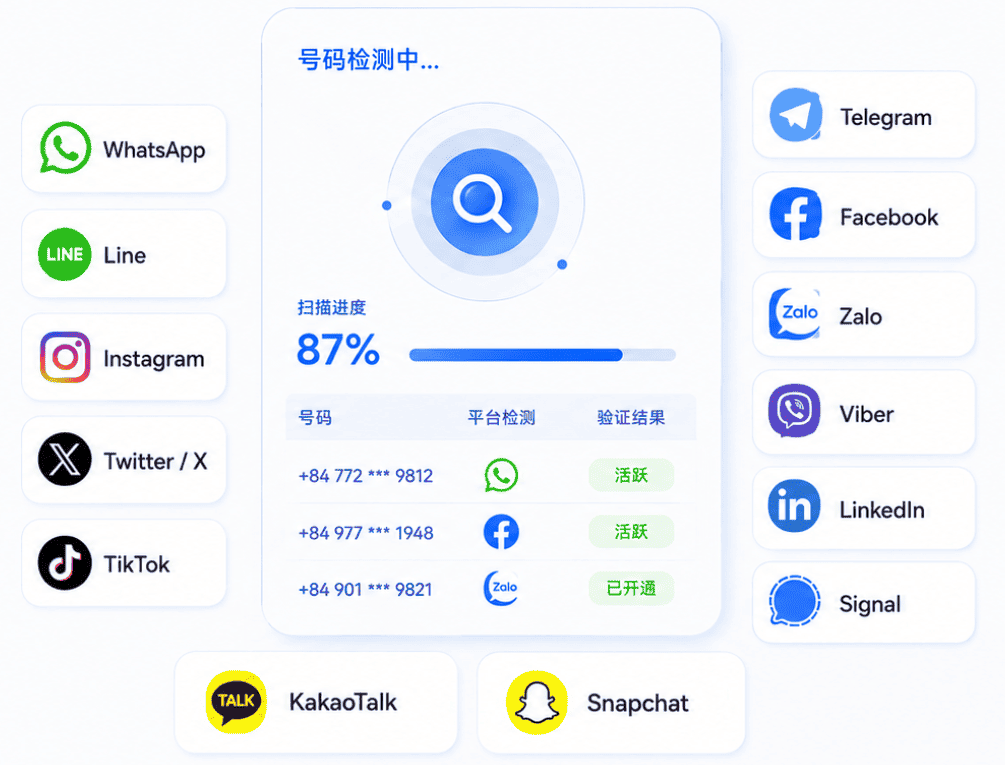
In actual operation, Amman can directly conduct batch detection of numbers, identify WhatsApp registration status, and support activity judgment. This can organize the data from its original state into a clearer structure in one round of processing:
- Reachable users
- High quality active users
It also supports batch processing and API access. This layer can be directly embedded into the cross-border customer acquisition process, so that new data can be screened when it enters the system without the need for subsequent repeated processing.
Solve the "can it be used" step in advance?
In cross-border customer acquisition, registration status identification is not an optional step, but a basic step. It determines whether the data meets the conditions for reaching it and also directly affects subsequent efficiency.
After this layer is processed on the front end:
- Data will be cleaner
- The process will be more stable
Instead of constantly optimizing the contact methods later, it is better to screen the data itself first.
Amman is the world's leading number screening platform, providing global customers with batch number screening and testing services covering 236 countries. The platform currently supports more than 40 mainstream social networking and applications, including WhatsApp, Line, Twitter, Facebook, Instagram, LinkedIn, Viber, Zalo, Binance, Signal, etc., adapting to the needs of multiple scenarios.
The main core functions cover multi-dimensional precise screening such as activation, activity, interaction, gender, avatar, age, online, accuracy, empty account, mobile phone device, etc., and can flexibly meet the needs of different users. Its core advantage is to integrate global mainstream social and application resources to provide users with one-stop, real-time and efficient number precision screening services, helping customers achieve global digital layout.
It is a common choice for all professional teams to complete rational screening before actually reaching users.
Editor abcheck has a lot of experience, welcome to communicate with me, click to contact @Tg8189