
When doing Instagram marketing, many teams will encounter a problem: with the same set of content, some accounts have great results, while others have almost no feedback. Many times the problem is not the content itself, but the user mismatch.
Age group is one of the most direct factors affecting the effectiveness of content. Young users and mature users have very different browsing habits, concerns, and interaction methods. If you use the same content to cover everyone, the results will often be unstable.
Why does age group directly affect content performance?
Instagram itself is a content-driven platform, and users will quickly make judgments about staying or swiping based on their interests. Different age groups have completely different criteria for judging content.
Young users are more likely to be attracted by the rhythm and visuals, while mature users are more concerned about whether the content itself is valuable. If you don’t differentiate between groups of people, it’s easy for the content to appeal to everyone, but impress no one.
Therefore, age group is not a label issue, but a core condition that determines the direction of content.
What content do young users prefer?
Judging from the actual data performance, young users prefer instant feedback in content selection.
More likely to be attracted by strong visual images
More sensitive to short-paced content
More willing to engage in interaction, such as commenting or clicking
This type of user's requirements for content are simple and direct, and do not require much explanation. If the pacing is slow or the message is too heavy, it can easily be ignored.
What content do mature users value more?
Mature users have obviously different content preferences. They are more concerned about whether the information is complete and whether it is worth spending time to read.
Pay more attention to content logic and clarity of expression
Pay more attention to the value of the product or information itself
Sensitive to frequent interruptions and invalid messages
This type of user will not stay too long because of the visual effects, but if the content matches their needs, it will be easier for them to continue to pay attention.
Why are the effects of the same content so different?
When a set of content faces two types of users at the same time, differentiation can easily occur.
Young users may be more interactive with fast-paced content, but mature users will skip it directly.
Mature users may respond to information-heavy content, but young users will find it difficult to stay.
This difference will make the overall data look unstable and even make it difficult to judge whether the content is effective.
How to tailor your content strategy to age groups
A more effective way is to clarify the target audience before content is produced, rather than looking at the results after publishing.
If it is aimed at young users, the visuals and rhythm can be strengthened, the information density can be reduced, and the content can be more easily accepted quickly.
If it is aimed at mature users, it is necessary to improve the completeness of information and express it more clearly so that users have a basis for judgment.
This kind of adjustment does not mean changing the content, but adjusting the way of expression.
Crowd screening will directly affect content performance
One thing that many teams overlook is that even if the content is adjusted correctly, if the people reached do not match, the effect will still not be stable.
If you send younger content to mature users, or if you send more rational content to young users, there will be conversion problems. Therefore, you need to do a good job of crowd screening before content.
In actual operation, users can be multi-dimensionally filtered through Shi'anman, and the data can be divided into different groups based on conditions such as region and activity level, and then matched with corresponding content. This can reduce the problem of mismatch between content and crowd.
The core of content strategy is not to do too much, but to do it right
In Instagram marketing, the content itself is not lacking, what is really missing is the matching. Users of different age groups are essentially looking for different information.
When the content direction matches the user structure, the overall effect will be more stable even if the publishing frequency is not high. On the other hand, if you keep using the same content to cover different groups of people, it will be difficult to get continuous feedback.
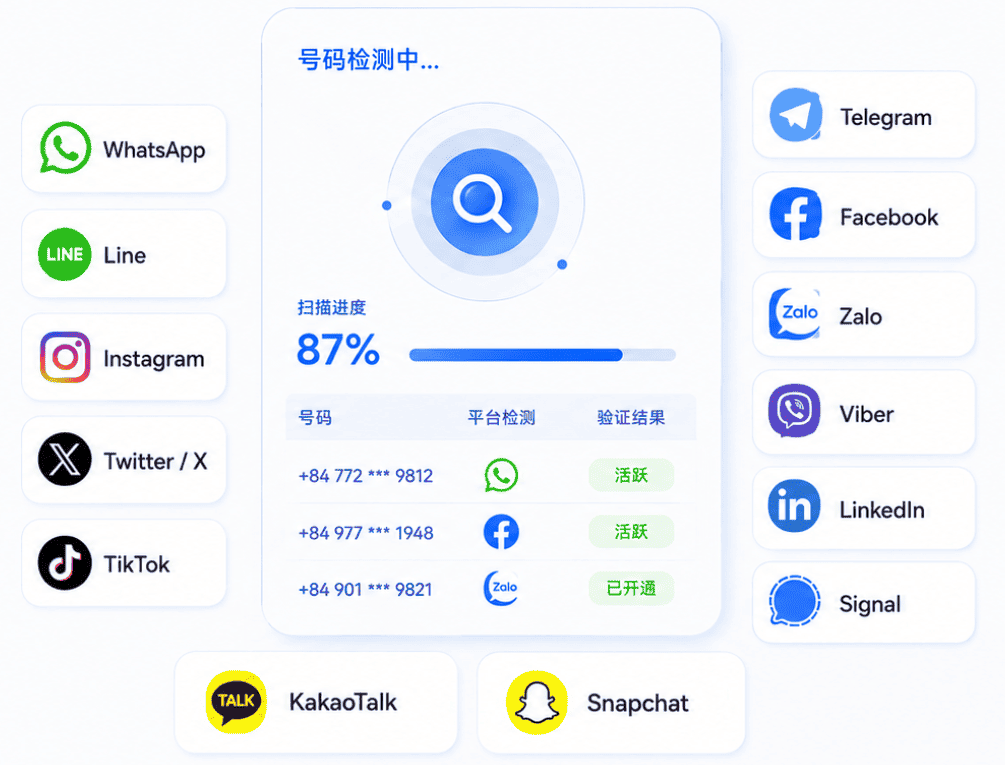
Amman is the world's leading number screening platform, providing global customers with batch number screening and testing services covering 236 countries. The platform currently supports more than 40 mainstream social networking and applications, including WhatsApp, Line, Twitter, Facebook, Instagram, LinkedIn, Viber, Zalo, Binance, Signal, etc., adapting to the needs of multiple scenarios.
The main core functions cover multi-dimensional precise screening such as activation, activity, interaction, gender, avatar, age, online, accuracy, empty account, mobile phone device, etc., and can flexibly meet the needs of different users. Its core advantage is to integrate global mainstream social and application resources to provide users with one-stop, real-time and efficient number precision screening services, helping customers achieve global digital layout.
It is a common choice for all professional teams to complete rational screening before actually reaching users.
Editor abcheck has a lot of experience, welcome to communicate with me, click to contact @Tg8189