
When doing user acquisition in the Japanese market, many teams used to prefer young people, but recently, the direction has begun to change. More and more projects are beginning to focus on mature users, especially on local high-penetration platforms such as Line. This change is even more obvious.
It’s not that young users have no value, but that mature users are more stable at the current stage and are easier to convert. The key is that such users cannot be obtained simply, but need to be screened and judged.
Why Japan’s Line user structure is changing
Judging from usage habits, Japanese users are very dependent on Line, and people of all ages use it for a long time. However, a change can be seen in the actual data. The behavior of young users is becoming more and more dispersed, while mature users are more concentrated.
Young users are more likely to switch to different platforms and have unstable usage frequency, while mature users usually maintain fixed usage habits and have higher account stability. This structural change makes the latter easier to exploit in actual operations.
Several typical characteristics of mature users
During the screening process, such users usually show some obvious characteristics.
The account has been used for a long time and the status is stable.
The rhythm of interaction is relatively rational and does not fluctuate frequently.
The acceptance of information is more selective and less likely to be interfered with
From a conversion perspective, these characteristics mean a more stable basis for communication rather than short-term fluctuations.
Why older age groups are getting more attention these days
From a business perspective, this variation is related to the type of project. High-priced products and long-term service projects rely more on stable users rather than short-term traffic.
Mature users usually have clearer decision-making logic, are less likely to be interrupted frequently, and are more likely to form continuous communication relationships. In this case, even a small amount can lead to more stable results.
This is why many teams have begun to adjust their strategies and shift some resources to this group of people.
How to judge whether such users are real and available
In actual operation, you cannot just look at the age tag, but need to judge by the account status.
You can start from several angles:
Does the account exist normally?
Is there any continued use behavior?
Is the account information complete?
Only by combining this information can we judge whether a user is actually using it, rather than simply existing.
If you only rely on tags, it will be easy to filter out inactive users, and the actual effect will not be improved.
What adjustments need to be made to the filtering logic?
When the target turns to mature users, the screening logic also needs to be adjusted simultaneously.
No longer pursue data scale, but prioritize ensuring data quality
Reduce the proportion of low active users
Improve account stability requirements
In other words, it’s a shift from “finding more people” to “finding more suitable people.”
Although this adjustment will reduce the amount of data, the usage efficiency will be significantly improved.
Amman is better suited to handle this type of screening needs
When processing Japanese Line user data, it will be difficult to stably screen out such users if we rely on manual judgment. A more practical way is to complete the first round of filtering through systematic screening.
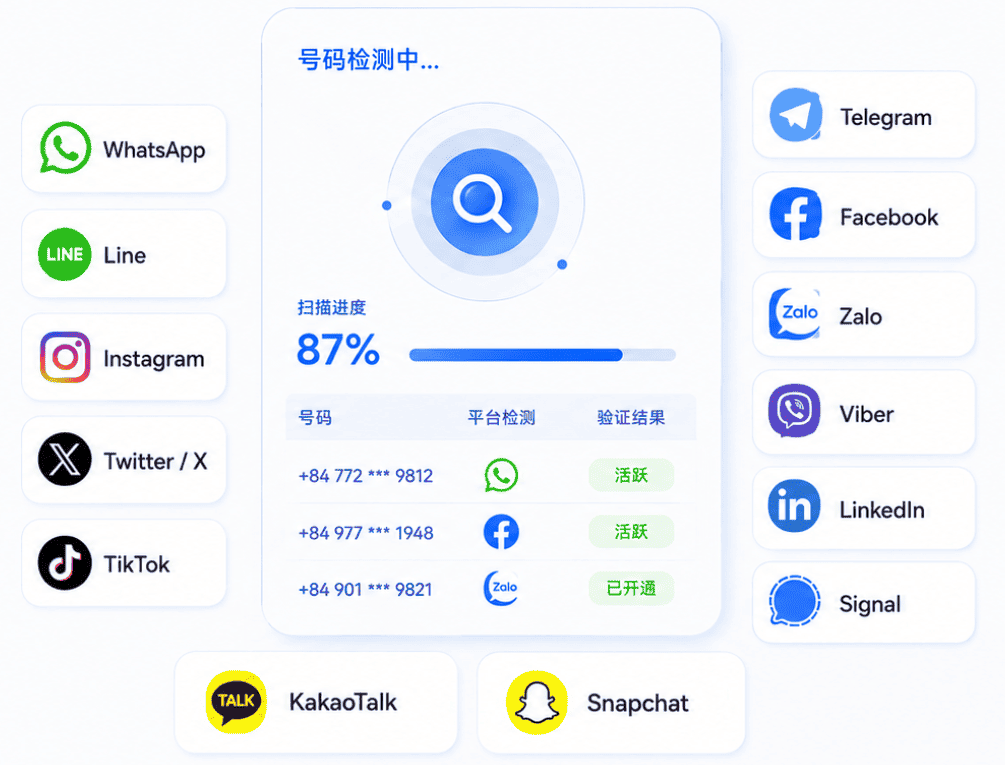
Through Amman, you can conduct batch detection of numbers, identify Line account status, and filter based on activity levels. In this way, the original data can be organized into a set that is closer to the real users, rather than mixed data.
This method is more suitable for teams that need to continuously acquire high-quality users.
The transformation of data from dispersed to centralized is the change brought about by filtering
When the filtering logic is adjusted, the data will change from a dispersed state to a centralized state. Although the overall number is reduced, the structure is clearer and it is easier to produce stable results when used.
For the current stage, this change is more valuable than simply expanding the size of the data.
Amman is the world's leading number screening platform, providing global customers with batch number screening and testing services covering 236 countries. The platform currently supports more than 40 mainstream social networking and applications, including WhatsApp, Line, Twitter, Facebook, Instagram, LinkedIn, Viber, Zalo, Binance, Signal, etc., adapting to the needs of multiple scenarios.
The main core functions cover multi-dimensional precise screening such as activation, activity, interaction, gender, avatar, age, online, accuracy, empty account, mobile phone device, etc., and can flexibly meet the needs of different users. Its core advantage is to integrate global mainstream social and application resources to provide users with one-stop, real-time and efficient number precision screening services, helping customers achieve global digital layout.
It is a common choice for all professional teams to complete rational screening before actually reaching users.
Editor abcheck has a lot of experience, welcome to communicate with me, click to contact @Tg8189