
When acquiring customers overseas, many teams will ask the same question: where can they get a large number of WhatsApp number resources. On the surface, it seems to be a "resource issue", but after actually running it, you will find that what really widens the gap is not how many numbers you get, but how many of these numbers can be used.
The resources themselves are not scarce, the screening ability is the threshold. Without filtering, no matter how much data you have, it will just accumulate; if you filter correctly, a small batch of data can produce stable results.
What are the common sources of WS numbers?
The path to obtain a WhatsApp number is not complicated, and the core focuses on three categories.
- Data provider channels
Covers many countries, has fast acquisition speed, and is suitable for rapid expansion, but the quality varies greatly and must be screened
- Historical business accumulation
From advertising, communities, old customers, etc., this type of data is closer to real users, but the scale is limited.
- Rule generation or expansion
Generated by number segment or existing data extension, low cost, but high proportion of empty numbers and invalid numbers
There is no absolute advantage or disadvantage among these three types of sources. The key lies in the subsequent processing methods. If used directly, the effect is unstable; if filtered, any source can become usable data.
Why is it so ineffective to use number resources directly?
Many teams will import the data into the system and send it directly to groups or private chats. In the short term, there will be action, but in the long term, there will be no precipitation. The core reason is that the data is in a mixed state.
Typical questions include:
- A large number of empty or invalid numbers occupy sending resources
- The number has not been opened for WhatsApp and cannot be reached.
- Users who have been activated but are inactive rarely respond.
- Abnormal accounts affect the overall sending environment
After these problems are superimposed, there will be a situation where a lot of messages are sent but few replies are received, and the performance of each batch of data fluctuates greatly, making it difficult to optimize.
A practical screening process
To turn number resources into usable data, standard processes must be established instead of ad hoc processing. A stable process usually consists of three layers.
- Empty number filtering
Eliminate non-existent or obviously wrong numbers to reduce basic waste
- Open detection
Determine whether to activate WhatsApp and only retain users who meet the conditions for reaching it
- Active filtering
Filter out users with recent usage behavior to increase the probability of messages being seen
Through these three steps, the original data can be compressed into a group of "reachable + in use" users.
Through Amman, the above process can be completed in one round of testing and the labeled results can be output to avoid repeated processing in steps.
Activity screening is the key to determining the effect
In actual data, the opening rate is usually not low, but what really determines the effect is activity.
Users can be simply divided into three categories:
- High-frequency active users are reached first and have the highest probability of reply and conversion.
- Moderately active users, suitable for testing and nurturing
- Low active or silent users, reduce investment or delay use
If this step is not done, the mass sending action will be dispersed among a large number of low-value users, resulting in a decline in the overall effect.
Shianman can directly identify the active level and output labels, so that the data has a hierarchical structure before being imported into the system.
How to use data after stratification
Completing the screening is only the first step, what really makes the difference is the way of use. The layered data cannot be sent uniformly, but must be treated differently.
- Highly active layer
Use more direct conversion techniques, prioritize manual work or focus on follow-up
- middle active layer
Test different content in small batches and gradually select users who can convert
- low active layer
Control sending frequency to avoid consuming accounts and resources
This method allows each type of data to play a different role instead of being consumed at once.
The importance of batch processing and API access
When the data scale increases, manual filtering is difficult to ensure efficiency and consistency. A more reasonable approach is to embed screening capabilities into the system.
Through the Amman API, you can achieve:
- New data import automatically completes empty account, activation, and activity detection
- Automatically label and distribute data to different data pools
- Linked with CRM or mass messaging system to directly enter the corresponding strategy
In this way, the data will be in "filtered status" as soon as it enters the system, instead of being processed later. After the process is fixed, the results will be more stable.
Differences in the use of resources in different regions
The performance of global WS number resources varies significantly in different regions, and the screening logic also needs to be adjusted appropriately.
- Southeast Asian market
The activation rate is high, but the activity varies greatly, and it relies more on active screening.
- Middle East market
The registration rate is high, but there are many silent users, so it is necessary to focus on screening active users.
- US market
The data is relatively stable, and device and account attributes can be superimposed after basic filtering.
Region is not a determining factor, but it does influence screening focus. The core logic is still to ensure availability first and then improve quality.
How to determine whether a batch of data is worth continuing to use
After screening, you can use simple indicators to determine whether the data quality meets the standards.
- Is the delivery rate stable?
- Whether initial replies are concentrated in the high activity layer
- Whether the fluctuation of data in different batches is reduced
If these three indicators gradually stabilize, it means that the data structure is healthy and can be used continuously.
Use Amman to turn resources from disposable to reusable
The problem for many teams is not that there is no data, but that the data becomes invalid after being used once. The reason is that there is no filtering and stratification.
Through Amman, the original number can be processed into structured data:
- Separate valid numbers from invalid numbers
- Centralized output for active users
- Tag management for easy reuse
In this way, the same batch of data can be used in multiple rounds instead of being consumed all at once. As filtering and stratification accumulate, the private domain pool will gradually stabilize instead of starting over every time.
The value of a resource depends on how it is processed
In WhatsApp customer acquisition, number resources are just the starting point. What determines the outcome is not how much you get, but how many "available users" you leave behind.
When the screening process is fixed and the hierarchical strategy is clear, the data will change from chaotic to structured, and the access will change from random to controllable. Compared with constantly looking for new resources, this method is easier to form long-term and stable customer acquisition capabilities.
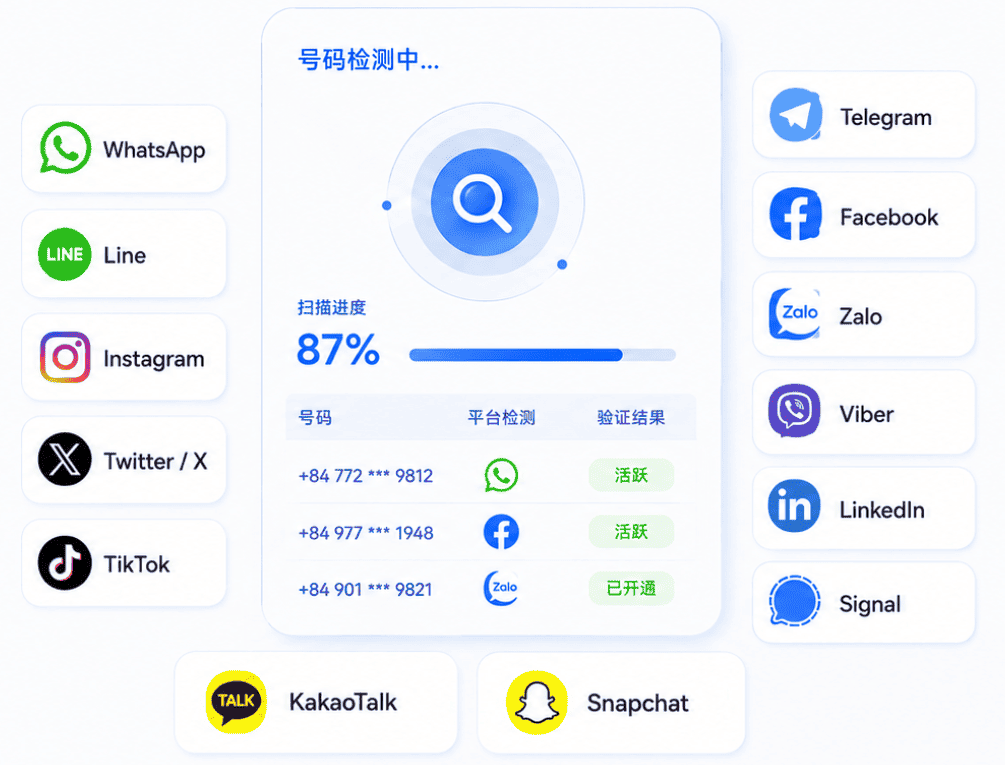
Amman is the world's leading number screening platform, providing global customers with batch number screening and testing services covering 236 countries. The platform currently supports more than 40 mainstream social networking and applications, including WhatsApp, Line, Twitter, Facebook, Instagram, LinkedIn, Viber, Zalo, Binance, Signal, etc., adapting to the needs of multiple scenarios.
The main core functions cover multi-dimensional precise screening such as activation, activity, interaction, gender, avatar, age, online, accuracy, empty account, mobile phone device, etc., and can flexibly meet the needs of different users. Its core advantage is to integrate global mainstream social and application resources to provide users with one-stop, real-time and efficient number precision screening services, helping customers achieve global digital layout.
It is a common choice for all professional teams to complete rational screening before actually reaching users.
Editor abcheck has a lot of experience, welcome to communicate with me, click to contact @Tg8189