
Messenger has always been an underestimated but very stable reach channel in the overseas customer acquisition system, especially in the Facebook ecosystem. Its open rate and immediacy are better than many traditional methods. However, many teams will find a problem in actual use: there is a lot of data and a lot of data is sent, but there are very few truly effective users.
The problem is not with Messenger, but with “material”. If the screening material is not done well, all subsequent actions will be slowed down.
The essence of screening is not to simply filter, but to turn a batch of mixed data into "usable data."
Why Messenger data generally “looks like a lot but is poorly used”
Messenger data usually comes from multiple channels, such as ads, forms, communities, historical customers, etc. There is no uniform standard for obtaining these data, resulting in a very confusing structure.
Common situations include:
- The same user appears multiple times
- A high proportion of accounts that have been inactive for a long time
- Abnormal accounts or low-quality accounts are mixed in
- Some accounts cannot be reached normally
If you don’t do screening, these problems will be directly reflected in the results: a lot of sending, but almost no effective interaction.
The core problems to be solved by screening materials
Screening is not to reduce the data, but to make the data "usable".
In the Messenger scenario, whether a piece of data is available must meet at least:
- The account is real
- Can receive messages normally
- Have certain usage behavior
Only if these three points are met, follow-up contact will be meaningful.
Through Amman, these basic judgments can be completed before data is imported, instead of repeated verification during the sending process.
A set of floor-mounted screening process
In order for the screening material to be performed stably, the process must be fixed instead of being processed temporarily every time.
You can follow this logic:
Import raw data
Check account validity
Filter active users
Filter abnormal accounts
Output available data
In this way, the original data can be compressed layer by layer instead of being judged all at once.
Through Amman, these steps can be integrated into one round of processing to reduce repeated operations.
The weight removal must be placed at the front of the sieve material
Repeat users are very common in Messenger data. If you don't remove the duplicates first, it will lead to:
- The same user was reached multiple times
- Statistical distortion of data
- Screening efficiency decreases
The correct order should be:
Remove the heavy ones first
Filter again
This ensures that all subsequent operations are based on unique users rather than duplicate data.
Active screening determines subsequent results
Of all screening steps, activity is the most critical.
The reason is simple:
- Only active users will see the message
- Only users with behaviors can interact.
If this layer is not handled well, subsequent touches will be almost meaningless.
Through Amman, users' active status can be identified and the data can be divided into different levels to provide a basis for subsequent use.
After screening, the material must be used in layers
After the screening of materials is completed, if you continue to send them in a unified manner, the effect will still not be stable.
A more reasonable way is to use data in layers:
Highly active users
Prioritize reach for conversion
Moderately active users
for testing and screening
Low active users
Reduce frequency of use
This approach allows data to be more concentrated rather than consumed evenly.
Use Amman to make screening materials a standard process
When the amount of data is large, manual screening is almost impossible. When passing Amman, the sifting material can be turned into a fixed action.
Can be achieved:
- Batch account detection
- Activity filter
- Abnormal account filtering
- Data label output
In this way, each batch of data has completed basic processing before entering Messenger, instead of subsequent screening.
It also supports API access, allowing new data to automatically enter the screening process and reducing manual intervention.
Screening determines “who deserves to be reached”
In Messenger marketing, many people focus on the sending volume, but what really affects the results is the reaching objects.
Screening materials well can allow:
- Reach more concentrated
- Replies are more stable
- Data is easier to optimize
Compared with continuously increasing the size of sending, filtering the data well will make the effect more sustainable.
If the data is not filtered, it will all be consumed.
Messenger itself is a high-reach channel, but only if the user itself is "available."
If the data is not filtered, no matter how much data is sent, it will only consume resources; only by putting filtering materials in front of you can subsequent contacts be valuable.
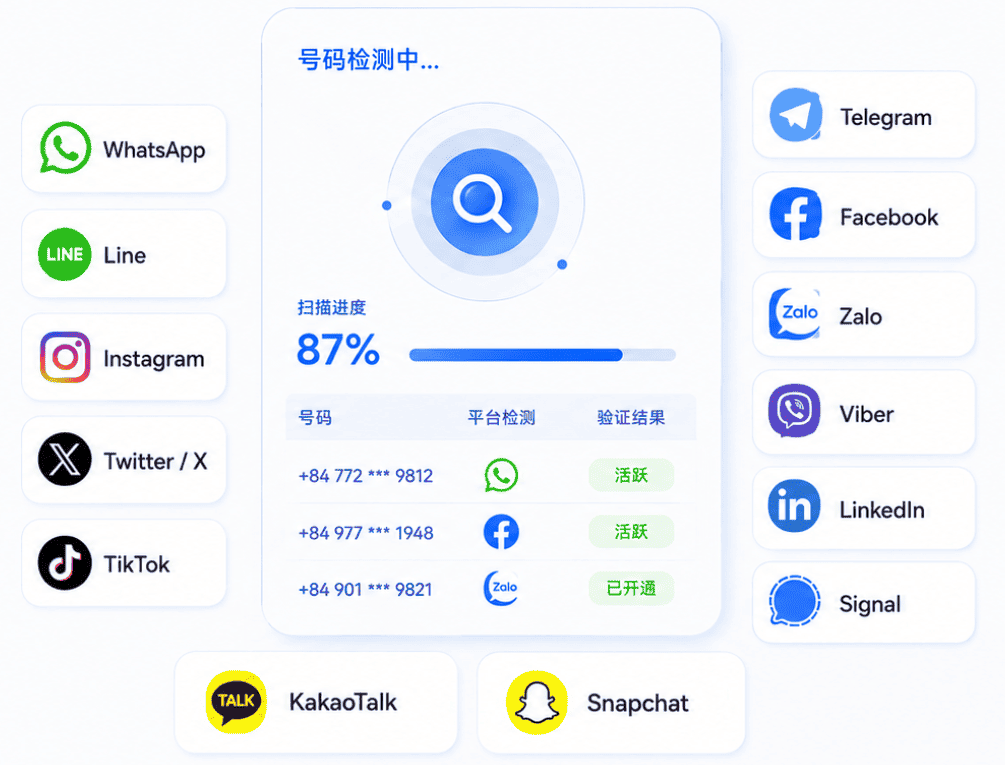
Amman is the world's leading number screening platform, providing global customers with batch number screening and testing services covering 236 countries. The platform currently supports more than 40 mainstream social networking and applications, including WhatsApp, Line, Twitter, Facebook, Instagram, LinkedIn, Viber, Zalo, Binance, Signal, etc., adapting to the needs of multiple scenarios.
The main core functions cover multi-dimensional precise screening such as activation, activity, interaction, gender, avatar, age, online, accuracy, empty account, mobile phone device, etc., and can flexibly meet the needs of different users. Its core advantage is to integrate global mainstream social and application resources to provide users with one-stop, real-time and efficient number precision screening services, helping customers achieve global digital layout.
It is a common choice for all professional teams to complete rational screening before actually reaching users.
Editor abcheck has a lot of experience, welcome to communicate with me, click to contact @Tg8189