
When many people screen Telegram users, they subconsciously regard “region” as the first filtering condition, thinking that as long as they target the target country, the data will be more accurate. However, in actual operation, a situation often occurs: the region is correct, but the user does not respond.
The problem is not the region, but the order of selection. Regions are just labels, not results. If the order is wrong, it will be useless no matter how fine you sift.
What problem does regional filtering solve?
Let’s make this issue clear first. Regional filtering has only one function: narrowing the scope.
It can help you do:
- Concentrate users in target countries
- Avoid cross-regional interference
- Improve the relevance of delivery or reach
But it doesn't solve:
- Is the user using it?
- Does the user have needs?
- Will the user reply?
If you only rely on regional screening, all the subsequent problems will arise.
Why do many regional data “look correct, but cannot be used”
In actual data, there is a very common situation:
The users filtered out are indeed from the target country, but the usage effect is very poor.
The reasons usually come from three aspects:
- Although the user is in the area, he has been inactive for a long time
- The usage environment is unstable and not a real user
- The data source itself is of low quality
In other words, the region is right, but the users are "dead".
This is why many people misjudge it as a market problem, but it is actually a data problem.
Correct location for region filtering
Regional filtering should not be placed in the first step, but in the middle layer.
A more reasonable order is:
First confirm whether the account exists
Filter active users
Final screening area
The advantage of doing this is to first ensure that "the person is alive" and then judge "where the person is".
If the order is reversed, it will be easy to screen out a group of low-active users and then invest resources.
Common regional judgment methods
In Telegram data processing, regions are usually judged in several ways:
- Number ownership
- Usage environment (IP, equipment, etc.)
- Historical behavior tags
However, it should be noted that single-dimensional judgments are prone to distortion.
for example:
The number is from a certain country, but the actual location of the user is different
The account environment has changed, but the data has not been updated simultaneously.
Therefore, regions can only be used as reference conditions, not as absolute judgments.
How to use region filtering correctly
A more effective way is to use regions as "filters" rather than "screening cores."
It can be used like this:
Screen active users first to ensure that the data has usage behavior
Then filter by region to retain users from the target country
Then combine it with other conditions to make subdivisions
With Amman, activity and region tags can be recognized simultaneously during the filtering process, rather than being processed separately. This avoids screening areas first and then discovering that the data is unavailable.
Once the data is in the correct order, the results will be more stable
When the filtering order is straightened out, there will be an obvious change:
Data size may be smaller, but quality is more focused
The touch is more stable instead of fluctuating high and low
Subsequent optimization will make it easier to determine the direction
This is more valuable than simply expanding regional data.
Use Amman to make regional filtering no longer exist alone
In actual operation, Shi Amman can integrate regional filtering into the entire data processing process instead of as a separate action.
It can be done:
- First identify the account status
- Filter active users
- Also mark regional information
- Finally output available data
What you get in this way is not a batch of "numbers from a certain country", but a batch of "users currently using it and belonging to the target country."
Region is just the starting point, not the end
In Telegram filtering, region is a necessary condition, but far from sufficient.
Regional filtering is meaningful only after basic conditions such as activity and account status are established. Otherwise, the filtered data will only look more accurate, but the actual effect will still be unstable.
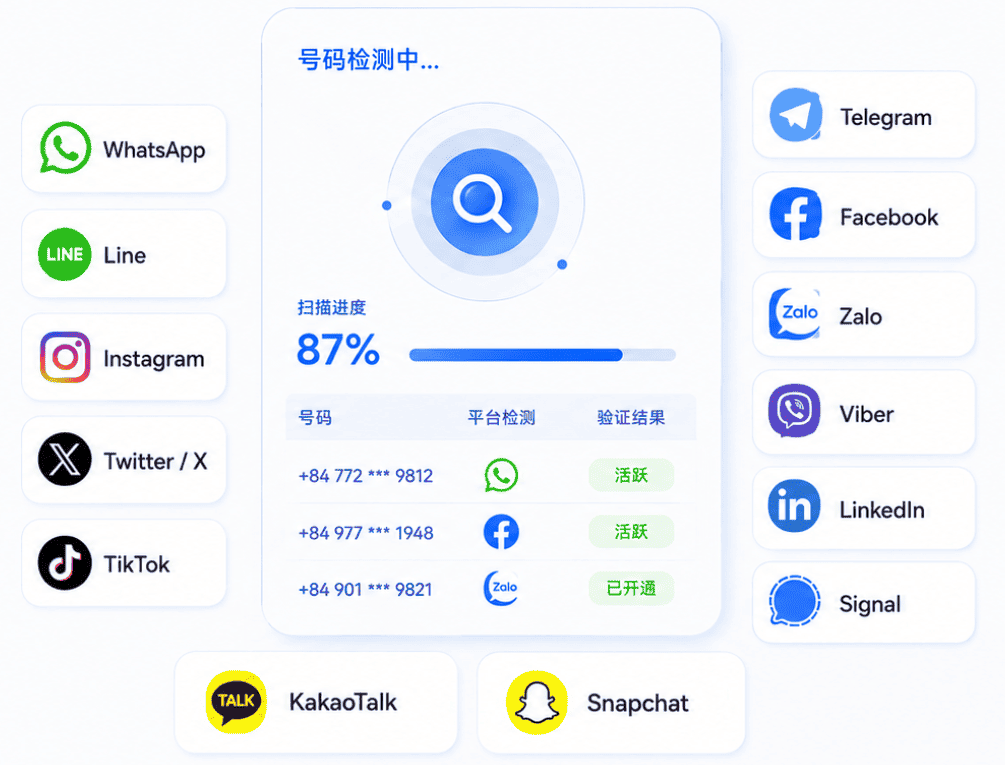
Amman is the world's leading number screening platform, providing global customers with batch number screening and testing services covering 236 countries. The platform currently supports more than 40 mainstream social networking and applications, including WhatsApp, Line, Twitter, Facebook, Instagram, LinkedIn, Viber, Zalo, Binance, Signal, etc., adapting to the needs of multiple scenarios.
The main core functions cover multi-dimensional precise screening such as activation, activity, interaction, gender, avatar, age, online, accuracy, empty account, mobile phone device, etc., and can flexibly meet the needs of different users. Its core advantage is to integrate global mainstream social and application resources to provide users with one-stop, real-time and efficient number precision screening services, helping customers achieve global digital layout.
It is a common choice for all professional teams to complete rational screening before actually reaching users.
Editor abcheck has a lot of experience, welcome to communicate with me, click to contact @Tg8189