
In Telegram multi-account operations, many teams focus on equipment, IP, login environment and operating frequency. However, after actual operation for a period of time, you will find that the risks will not completely disappear, and may even appear concentrated at certain stages.
The problem is often not the operation itself, but the data. What kind of numbers are imported and what kind of users are reached will directly affect the performance of the account. If the data quality is unstable, no matter how dispersed the operations are with multiple accounts, the risk will still be amplified.
The source of risk is often not operations, but data
In a multi-account environment, the most easily overlooked point is that the actions performed by all accounts essentially revolve around the same batch of data.
If there are a large number of anomalies or low-quality users in the data, several typical phenomena will occur:
- Sending behavior does not match user behavior
- Lack of interaction after the message is sent
- There are obvious differences in the performance of different accounts
When these conditions are superimposed, the overall operation will show unnatural characteristics, and this instability often comes from the data rather than the frequency of operation.
Common risk triggers for multiple accounts
Without filtering data, multiple account operations can easily trigger some common problems.
Importing a large number of invalid numbers will increase meaningless contact behaviors.
The proportion of low active users is high, resulting in a low interaction ratio
The same batch of data is reused across multiple accounts, resulting in centralized behavior
These problems will not appear on the first day, but will gradually accumulate as the operation continues.
Why screening reduces risk
The role of screen number is not only to improve conversions, but more importantly, to make the behavior closer to the real user environment.
After the data has been filtered:
- Invalid numbers are removed
- Increased proportion of active users
- More feedback on user behavior
In this way, there will be a match between the sending behavior and the user behavior, rather than a one-way output.
This matching relationship will make the overall operation more natural and reduce the probability of exceptions.
A screening process suitable for multi-account environments
In actual operation, the screening can be broken down into several fixed steps instead of making a one-time judgment.
First filter the empty numbers to remove obviously invalid data.
Then check whether the account is registered with Telegram and confirm that it is basically available.
Then filter active users and give priority to accounts with recent usage behavior.
Through these three steps, the original data can be compressed into a batch of numbers that are closer to real users.
Through Amman, this entire set of screening can be completed before importing, instead of processing it step by step after importing.
Recommendations for data usage in the case of multiple accounts
Even if screening is completed, it is not recommended to use all data together.
A more reasonable way is to allocate and use:
Highly active data is allocated to the main account first
Medium active data for test or secondary accounts
Low activity data is used less or processed separately
This can prevent a single account from carrying too much low-quality data, causing abnormal performance.
The actual role of using time Amman in risk control
In multi-account operations, the value of Shi'anman is not just screening, but making screening a prerequisite action.
Can be achieved:
- Batch detection number validity
- Determine whether a Telegram account exists
- Identify activity levels and filter out active users
- Output hierarchical data for easy distribution
At the same time, API access is supported, and filtering capabilities can be directly embedded into the system, so that each batch of imported data has been processed.
This can prevent low-quality data from entering the operation link and reduce risks from the source.
Risk is not about controlling operations, but about controlling data
In a Telegram multi-account environment, simply limiting the frequency of operations can only delay the problem, but it cannot solve it.
The truly effective way is to control the quality of data entering the system.
When the data itself is stable, operations will naturally become more stable.
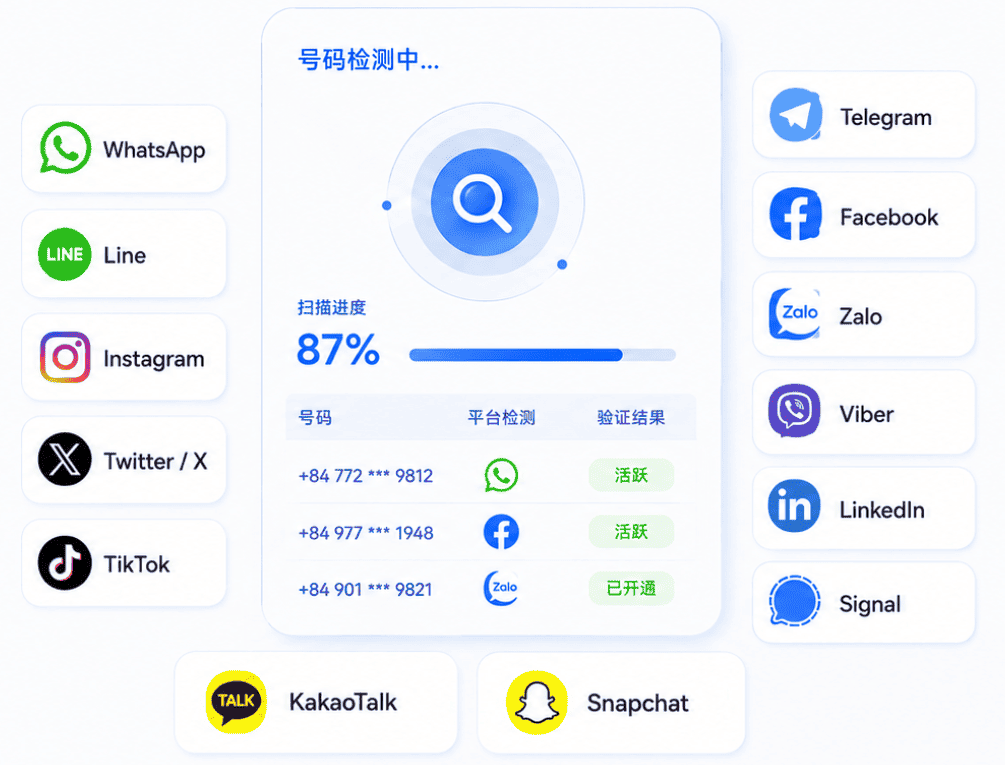
Amman is the world's leading number screening platform, providing global customers with batch number screening and testing services covering 236 countries. The platform currently supports more than 40 mainstream social networking and applications, including WhatsApp, Line, Twitter, Facebook, Instagram, LinkedIn, Viber, Zalo, Binance, Signal, etc., adapting to the needs of multiple scenarios.
The main core functions cover multi-dimensional precise screening such as activation, activity, interaction, gender, avatar, age, online, accuracy, empty account, mobile phone device, etc., and can flexibly meet the needs of different users. Its core advantage is to integrate global mainstream social and application resources to provide users with one-stop, real-time and efficient number precision screening services, helping customers achieve global digital layout.
It is a common choice for all professional teams to complete rational screening before actually reaching users.
Editor abcheck has a lot of experience, welcome to communicate with me, click to contact @Tg8189