
In WhatsApp marketing, many teams will go through a stage: the sending volume continues to increase, but the response rate never increases. So I started to adjust my words, optimize the sending time, and even change the contact method, but the overall effect was still unstable.
These optimizations have a hard time working when the data is not filtered. Because the problem is not how you send it, but who you send it to. After screening customers, the change is not a simple increase of a few percentage points, but a change in the overall structure.
Typical behavior of unfiltered data
Without screening, a batch of numbers is usually mixed.
Common manifestations include:
- Sent successfully but no actual reading
- Replies are concentrated on a very small number of users
- Different batches of data fluctuate greatly
In this case, even if you continue to send, it is difficult to judge which method is effective.
After filtering, the reach will change first
After basic screening, the first thing that changes is not the response rate, but the quality of reach.
Filtering can remove:
- Number that has not been activated for WhatsApp
- Non-existent or wrong data
- Accounts that have not been used for a long time
The remaining users must meet at least two conditions: they can receive messages and they have usage behavior.
After this step is completed, the sending action really starts to make sense.
Changes in response rates are not linear
Many people would expect a small increase in response rates after screening, but the actual situation is more obvious.
Changes are usually reflected in three aspects:
- The number of effective replies increased
- Replies are more evenly distributed
- Significantly less volatility
In other words, it is not just "a little more reply", but also a change from an originally unstable state to a state of sustainable optimization.
A simple comparison scenario
This change can be understood with a common data comparison.
In unfiltered data:
- Send 10,000 messages
- Effective responses may be concentrated among 200–300 people
- A lot of data without any feedback
After filtering:
- The actual number sent may be reduced to 5,000
- But the number of replying users is more concentrated
- Each batch of data performs more stably
Although the sending volume has decreased, the overall efficiency has improved, and labor and time costs have also been reduced.
The core change comes from the increase in the proportion of active users
The most critical change after screening is the increase in the proportion of active users.
In the original data, there are usually only a few active users, and the purpose of screening is to extract these people.
When the proportion of active users increases:
- Messages are more visible
- Users are more likely to interact
- Replies make it easier to form continuous communication
This is why filtered data is easier to convert, rather than simply improving response rates.
Use Amman to make screening a standard action
In actual operation, manual screening is not only inefficient, but also difficult to ensure that each batch of data is consistent.
When passing through Amman, this can be done before sending:
- WhatsApp activation status detection
- Activity filter
- Data hierarchical output
In this way, each batch of data that enters the group has been processed, rather than the original mixed data.
For teams that need to do WhatsApp marketing for a long time, this step can keep the data structure stable instead of retesting every time.
Optimization only makes sense after screening
It is difficult to draw valid conclusions when optimizing words based on unfiltered data. Because there are too many variables, it is impossible to determine the source of the problem.
After the data has been filtered:
- User status is relatively unified
- Feedback is easier to analyze
- Optimization direction is clearer
At this time, adjusting the content or rhythm will have obvious effects.
The essence of the change in response rate is the change in data structure
On the surface, it seems that the response rate is improved, but the essence is that the data structure is reorganized.
From mixed data to centralized data
From an uncontrollable state to an optimizable state
When the data becomes stable, subsequent sending, follow-up, and conversion will gradually become controllable.
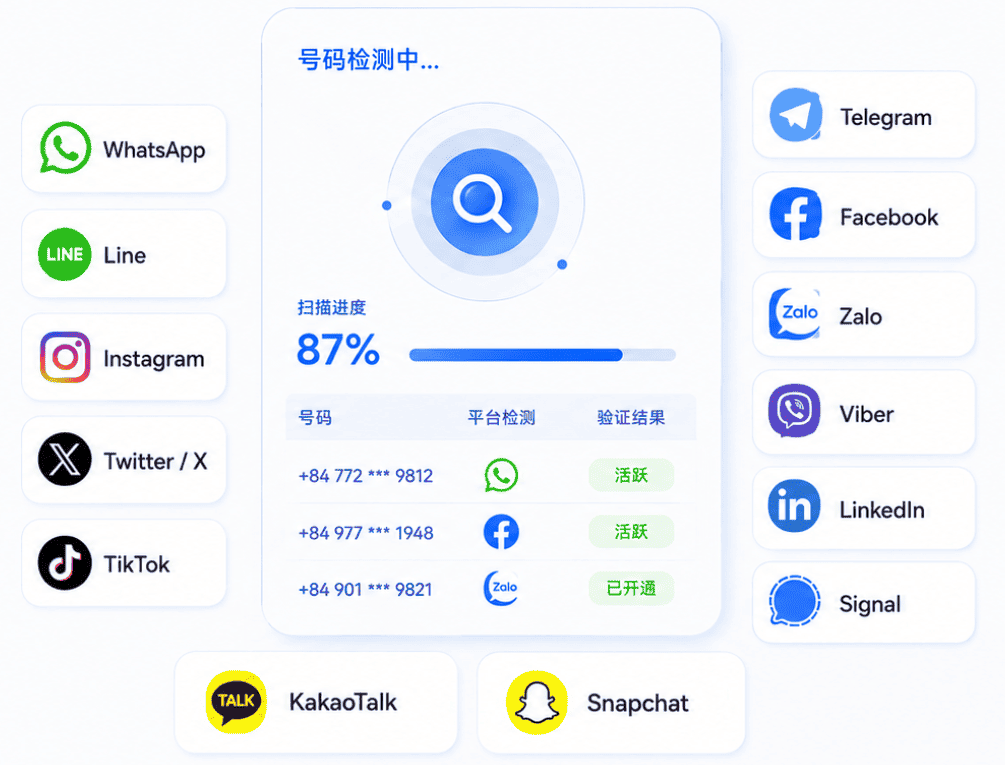
Amman is the world's leading number screening platform, providing global customers with batch number screening and testing services covering 236 countries. The platform currently supports more than 40 mainstream social networking and applications, including WhatsApp, Line, Twitter, Facebook, Instagram, LinkedIn, Viber, Zalo, Binance, Signal, etc., adapting to the needs of multiple scenarios.
The main core functions cover multi-dimensional precise screening such as activation, activity, interaction, gender, avatar, age, online, accuracy, empty account, mobile phone device, etc., and can flexibly meet the needs of different users. Its core advantage is to integrate global mainstream social and application resources to provide users with one-stop, real-time and efficient number precision screening services, helping customers achieve global digital layout.
It is a common choice for all professional teams to complete rational screening before actually reaching users.
Editor abcheck has a lot of experience, welcome to communicate with me, click to contact @Tg8189