
When doing Telegram automated operations, many problems do not lie in the tool itself, but in the data entry layer. If the data entering the system is not filtered, the subsequent automated processes will only amplify invalid operations, and it will be difficult to get feedback no matter how much data is sent.
For automation to really work, the filter number must be preset, and it must be as real-time as possible instead of relying on one-time screening.
Why automation scenarios rely more on screening API
Manual screening is suitable for small-scale processing, but once you enter the automation stage, data continues to flow in. If you still use manual processing, two problems will arise:
- First, the processing speed cannot keep up with data growth.
- Second, the screening results are not uniform, which affects the overall stability.
The function of the screening API is to make the screening step a part of the system. The data is filtered into a usable state before entering the automated process.
The core logic of real-time filtering
In an automation scenario, screening is not a one-time action, but an ongoing process. The core logic can be broken down into three steps:
- First check whether the number is registered with Telegram
- Then determine whether the account status is normal
- Finally, filter out users with usage behavior
After these three levels of screening are completed, the data enters the automated process. This ensures that subsequent operations are based on real users rather than mixed data.
How to integrate the screening API into the automated process
In actual operation, the process can be set up like this:
- After new data enters the system, the filter number API is first called for detection.
- API returns number status and filter results
- Automatically distribute data based on results, e.g. retain only available and active users
- The filtered data then enters the automated operation process.
The entire process does not require manual intervention, and the data is continuous from entry to use.
Why real-time screening is more stable than one-time screening
One-time filtering is suitable for fixed data, but in automated scenarios, data changes dynamically.
Number status changes and user activity fluctuates. If you only screen once in the early stage, the subsequent data will gradually become distorted.
Through real-time filtering through the API, a judgment can be made when each batch of data enters, ensuring that the data is always available.
It’s easier to use Amman to access the screening API
In practical applications, Amman can directly provide number screening API capabilities to integrate number detection, account status identification and activity judgment.
After the data enters, the interface can be called directly, and the system automatically returns the filtering results and supports batch processing. In this way, the screen number step can be embedded into the automated process without requiring additional splitting steps.
For scenarios that require continuous data running, this method is more stable and easier to maintain.
Data entry is stable and automation makes sense
The prerequisite for automated operations is that the data itself is available. If the screen number layer is unstable, all subsequent processes will be affected.
Controlling the data entry through the screening API can establish the automated process on a stable basis, reduce invalid operations, and make the overall efficiency more controllable.
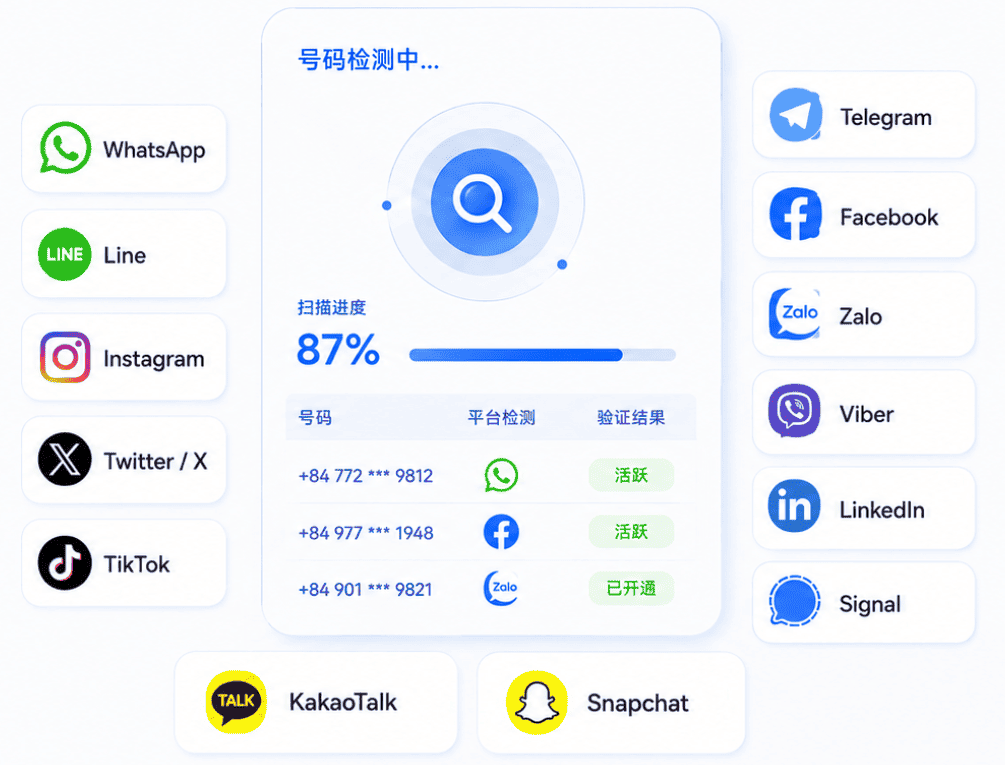
Amman is the world's leading number screening platform, providing global customers with batch number screening and testing services covering 236 countries. The platform currently supports more than 40 mainstream social networking and applications, including WhatsApp, Line, Twitter, Facebook, Instagram, LinkedIn, Viber, Zalo, Binance, Signal, etc., adapting to the needs of multiple scenarios.
The main core functions cover multi-dimensional precise screening such as activation, activity, interaction, gender, avatar, age, online, accuracy, empty account, mobile phone device, etc., and can flexibly meet the needs of different users. Its core advantage is to integrate global mainstream social and application resources to provide users with one-stop, real-time and efficient number precision screening services, helping customers achieve global digital layout.
It is a common choice for all professional teams to complete rational screening before actually reaching users.
Editor abcheck has a lot of experience, welcome to communicate with me, click to contact @Tg8189