
When growing Telegram communities, many teams will focus on traffic channels or methods to attract groups, but the actual results are often unstable. On the surface, it seems to be a problem with the traffic drainage method. In fact, in most cases, the quality of the list is not handled well, resulting in amplified deviations in every subsequent step.
Community growth is not a single action, but a complete path. If you break down the entire process, the common structure can be roughly divided into: obtaining traffic, organizing lists, screening users, introducing communities, and continuing operations. List screening is not an add-on action, but a critical step that must be embedded in the process.
Breakdown of common paths for community growth
From a practical perspective, a complete Telegram community growth path usually consists of several consecutive steps. The first is traffic acquisition, obtaining user clues through social platforms, content channels or data resources. Next is the list compilation, unifying the data from different sources into a unified format and removing obvious anomalies. Then comes the screening process, where users are quality-filtered. Then proceed to introduction and reach, and finally enter the community operation stage.
The problem for many teams is that they put the screening step later, or even omit it completely, and directly import the acquired users into the community. The number of people grows rapidly in the short term, but problems within the group will soon appear, such as silence, decreased interaction, and difficulty in conversion.
Why filtering must be placed before importing
If the position of list screening is misplaced, it will be almost impossible to make up for it later. If the filtering is placed after the import, it means that low-quality users have already entered the community. Cleaning them up at this time will not only be costly, but will also affect the atmosphere in the group.
From the data structure point of view, the original list usually contains three types of users. The first category is unregistered Telegram numbers, which cannot be reached by such users. The second category is accounts that are registered but inactive for a long time. Even if these users enter the community, they will not participate in the interaction. The third category is the users who actually have usage behavior.
If you do not filter before importing, these three types of users will enter the community at the same time. The end result is that the number of people seems to be large, but the actual proportion of active users is very low. Once the quality of the community declines, it will be very difficult to remedy it.
At which step should filtering be embedded?
A more reasonable way is to put the filtering after list sorting and before importing. The process can be understood like this:
Get user data first
Unified list format
Detect and filter account status
Then import the filtered users into the community
The advantage of this is that users entering the community have already gone through basic filtering, making subsequent operations easier and easier to form interactions.
During the screening process, there are several dimensions to focus on. The first is whether the account is registered with Telegram, the second is whether the account has usage behavior, and the third is whether it meets the attributes of the target region or group of people. After combining these conditions, the data will shrink significantly, but the quality will improve.
Without screening, what problems will arise in the community?
Many teams don't feel it clearly at the beginning, but as time goes by, the problem will gradually become apparent. The most direct thing is that the proportion of silent users in the group is too high, there is no response to messages, and it is difficult to establish interaction. Secondly, management costs are rising, and invalid users need to be constantly cleaned up. Then there is the decrease in conversion efficiency, because truly valuable users are overwhelmed by a large amount of low-quality data.
These problems essentially stem from the same reason, which is that the list enters the community without being filtered.
Screening not only affects growth, but also the pace of operations
The significance of list screening is not only to improve the initial quality, but also to affect the rhythm of subsequent operations. If the users who enter the community have usage behavior themselves, it will be easier to interact during operation and the content will be more likely to be fed back.
On the other hand, if most users are low-active, no matter how good the content is, it will be difficult to produce results. In the long run, it will affect the team's judgment on strategy, and may even be mistaken for content or operational problems.
Therefore, screening is not only a preliminary action, but also provides a basis for subsequent operations.
A more efficient way to filter
When the amount of data is large, manual filtering is almost impossible and prone to inconsistent standards. A more stable way is to use tools to complete batch detection when the data enters the process.
For example, in actual use, Shianman can be used to centrally process numbers, complete Telegram account status identification and activity judgment in one go, and filter out low-quality data in advance. The advantage of this method is that there is no need to import and export data repeatedly, and there is no need to split steps. The filtering results can be directly used for subsequent imports.
At the same time, this type of method supports batch processing and can also be connected to the system process, making screening a fixed step rather than a temporary operation.
Focus of screening at different stages
At different stages, the focus of screening can be slightly adjusted. In the early stage, the conditions can be relaxed appropriately to ensure the basic scale, but obviously invalid data still needs to be filtered. In the mid-term stage, the screening standards can be gradually improved and activity requirements increased to improve the quality of the community. In the later stage, it is more important to keep the data stable and control the quality of new users through continuous screening.
This dynamic adjustment is more flexible than setting fixed standards at the beginning, and is more in line with the actual growth pace.
Turn screening into a process, not a remedy
When growing a Telegram community, filtering should not be treated as a remedial measure but should become part of the process. Only when screening is performed at the right location will the entire growth path be smooth.
When data is filtered before entering the community, subsequent interactions, conversions, and management will become simpler. Instead of constantly cleaning and adjusting things later, it is better to screen the list in the front. The impact of this step will run through the entire community life cycle.
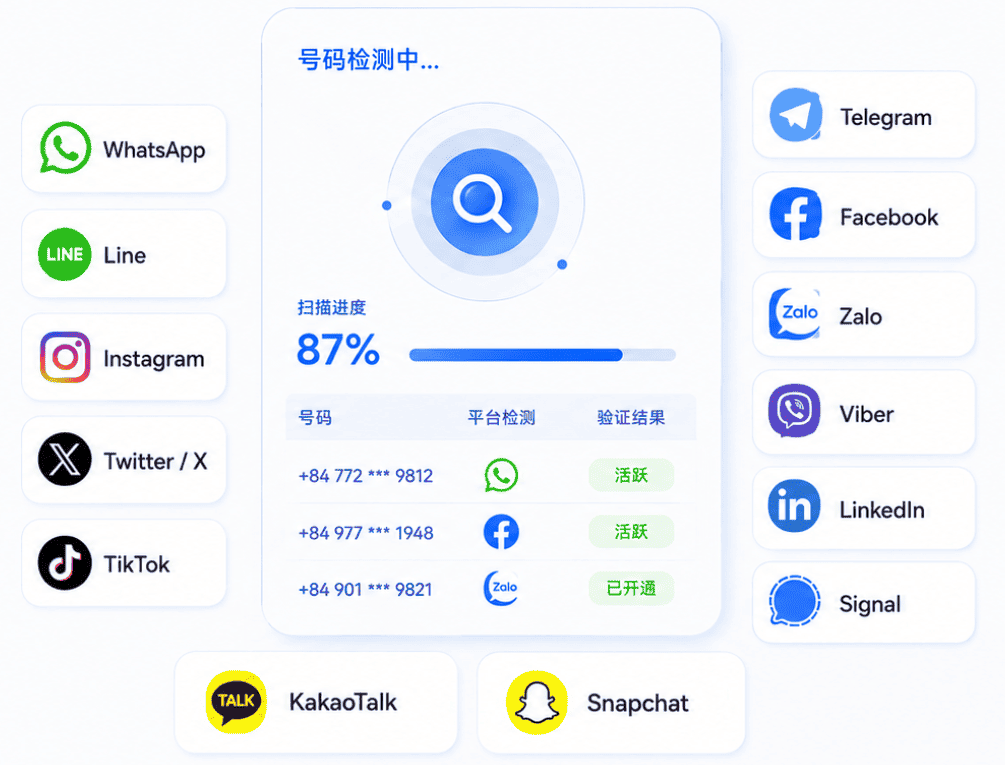
Amman is the world's leading number screening platform, providing global customers with batch number screening and testing services covering 236 countries. The platform currently supports more than 40 mainstream social networking and applications, including WhatsApp, Line, Twitter, Facebook, Instagram, LinkedIn, Viber, Zalo, Binance, Signal, etc., adapting to the needs of multiple scenarios.
The main core functions cover multi-dimensional precise screening such as activation, activity, interaction, gender, avatar, age, online, accuracy, empty account, mobile phone device, etc., and can flexibly meet the needs of different users. Its core advantage is to integrate global mainstream social and application resources to provide users with one-stop, real-time and efficient number precision screening services, helping customers achieve global digital layout.
It is a common choice for all professional teams to complete rational screening before actually reaching users.
Editor abcheck has a lot of experience, welcome to communicate with me, click to contact @Tg8189