
When doing user acquisition and private messaging on Telegram, many teams have realized a problem: it is not that more users are better, but that more “effective users” are better. But when it comes to the implementation level, many filters are still based on a single dimension, such as only looking at whether they are registered or only looking at a certain tag.
The result is data that looks filtered but remains unstable when used in practice. High-quality users are not a simple label, but the result of the superposition of multiple conditions.
Let’s first clarify a core point: high-quality users are the result of the combination
In the Telegram environment, whether a user is "high-quality" usually depends on three basic conditions:
- Does the account exist?
- Is the user using
- Is the account status stable?
These three conditions are indispensable. If only one or two of them are met, the actual reach effect will be affected.
Why single-dimensional filtering fails
Many teams will only look at one indicator when screening, such as:
Only the registration status is screened, and it is considered that as long as you have an account, you can use it.
Only look at the region label and ignore the status of the account itself
Only look at partial behavioral data, not overall usage
The problem with these approaches is that they do not fully understand the user status.
For example, an account that has been registered but has not been used for a long time is technically "available", but is invalid in actual communication.
Screening logic should be hierarchical rather than one-time judgment
A more stable way is to break the screening into several steps and execute them layer by layer.
First do basic screening to confirm that the account exists
Then filter the activity to determine whether it is in use
Then judge the account status and filter abnormal or unstable data
Through this layering approach, the scope can be gradually narrowed down instead of superimposing complex conditions at the beginning.
Through Amman, these basic screenings can be completed in one round of testing, integrating multi-dimensional conditions instead of decentralized operations.
Activity is the most critical layer
Among multiple screening dimensions, activity is the factor that most directly affects the results.
because:
Only active users can see the message
Only users who continue to use it are likely to interact
If this layer is not handled well, the value of other filters will significantly decrease.
Through Amman, users' active status can be identified and the data can be divided into different levels to provide a basis for subsequent use.
Actual performance of high-quality users
After screening, high-quality users usually have several common characteristics:
- Have stable usage behavior
- Have a certain probability of responding to the touch
- Behavior is relatively normal, no abnormal fluctuations
This type of users is not necessarily large in number, but they are more concentrated and more likely to produce stable results.
How to use data after multidimensional filtering
After the screening is completed, it is not recommended to use all the data uniformly, but to do simple stratification.
Highly active users are reached first for key conversions
Moderately active users for testing and observing feedback
Low active users reduce investment and avoid waste
This usage method is easier to optimize than unified sending.
Use Amman to integrate multi-dimensional screening into one process
In actual operation, if you screen in steps, it will not only be inefficient, but also prone to inconsistent standards.
When passing through Amman, it can be done in one round of processing:
- Account existence check
- Activity recognition
- status filter
- Data label output
In this way, the data already has a structure before it is used, instead of having to be sorted out later.
It also supports API access, which allows each batch of new data to be automatically screened and reduces manual intervention.
Only when the screening logic is stable will the results be stable.
In the Telegram environment, the data itself varies greatly. If the filtering logic is unstable, the performance of each batch of data will fluctuate.
When screening changes from a single judgment to a multi-dimensional combination, and a fixed process is formed, the data structure will gradually stabilize, and subsequent reach and conversion will be easier to control.
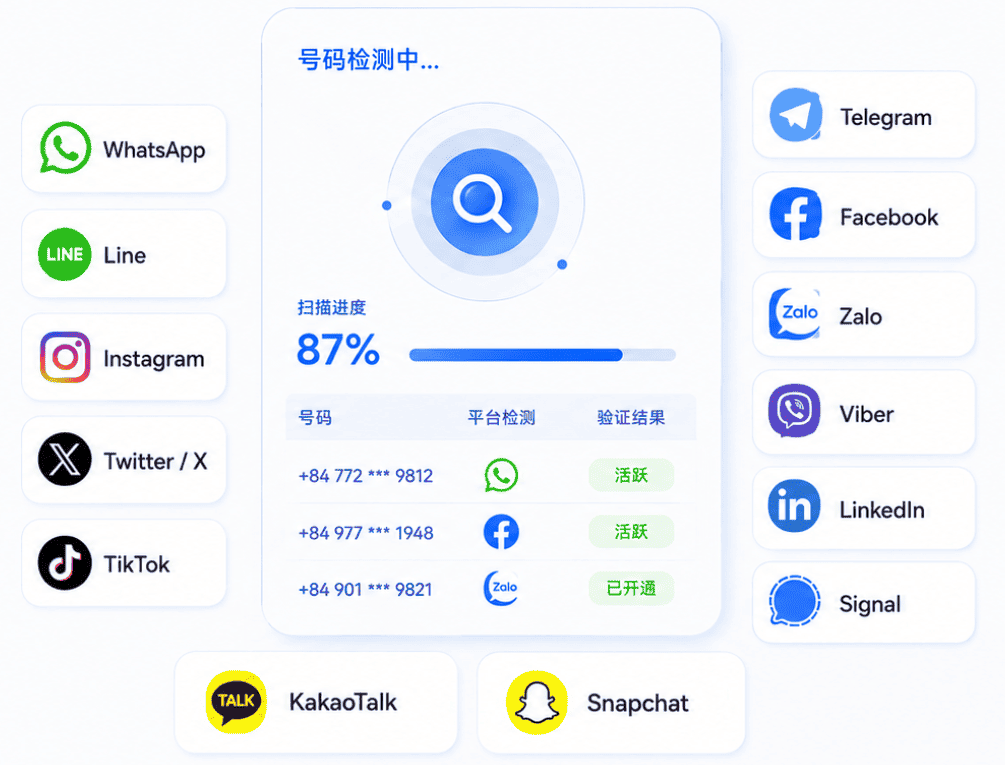
Amman is the world's leading number screening platform, providing global customers with batch number screening and testing services covering 236 countries. The platform currently supports more than 40 mainstream social networking and applications, including WhatsApp, Line, Twitter, Facebook, Instagram, LinkedIn, Viber, Zalo, Binance, Signal, etc., adapting to the needs of multiple scenarios.
The main core functions cover multi-dimensional precise screening such as activation, activity, interaction, gender, avatar, age, online, accuracy, empty account, mobile phone device, etc., and can flexibly meet the needs of different users. Its core advantage is to integrate global mainstream social and application resources to provide users with one-stop, real-time and efficient number precision screening services, helping customers achieve global digital layout.
It is a common choice for all professional teams to complete rational screening before actually reaching users.
Editor abcheck has a lot of experience, welcome to communicate with me, click to contact @Tg8189