
When acquiring customers on the B-side, many teams will focus on one label: blue label account. Because the blue label usually represents corporate certification, many people naturally think that this type of users are closer to business needs and easier to convert.
However, after actual use, a problem will be discovered: screening the blue label alone does not necessarily bring stable results. Some scenes have obvious effects, while others do not have the expected improvement.
The key is not the blue label itself, but how it is used.
What does the blue label account represent?
In the WhatsApp system, a blue label account usually means that the account has completed corporate certification and has clear business attributes.
From a screening perspective, it can help determine:
- Whether it is an enterprise or commercial entity
- Is there a stable business scenario?
- Is it closer to the B-side usage environment?
This is why many teams give priority to this type of account.
Why is it more valuable in B-side scenarios?
In some B-side businesses, it is indeed easier for blue label users to match their needs.
For example:
- Distribution and channel cooperation business
- Enterprise service products
- Cross-border B2B transaction scenario
In these scenarios, the users themselves need to have certain business attributes, and the blue label account can be used as a screening basis to a certain extent.
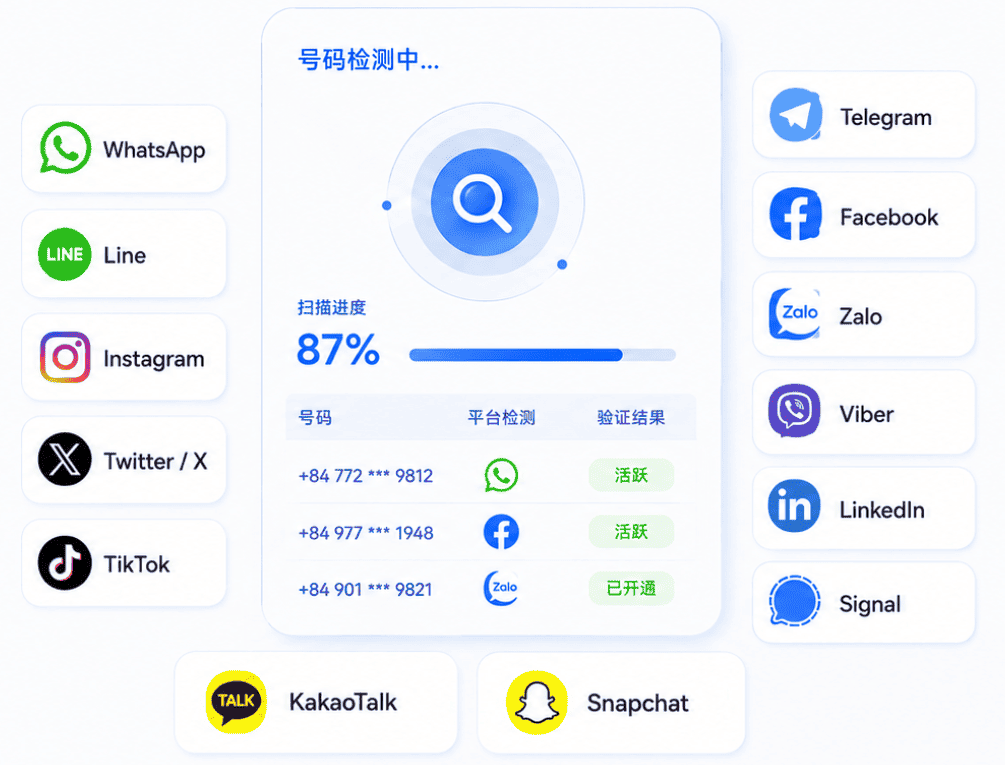
Through Amman, blue label accounts can be identified during the number screening process, and such users can be marked individually to facilitate subsequent centralized use.
Where does the difference in actual performance come from?
In actual use, the difference in the effectiveness of blue label screening between different teams often comes from different screening methods.
Frequently asked questions are:
- Only blue labels are screened, no other screening is done
- Ignore activity and account status
- Use the blue label as the only criterion
The result is that the filtered data, although it has commercial attributes, is not necessarily active and does not necessarily have the conditions for communication.
Limitations of blue label screening
The blue label account itself also has obvious restrictions.
The number is relatively small and cannot support large-scale customer acquisition.
Although some accounts are authenticated, they are not used frequently.
The distribution of blue labels varies greatly among different industries.
If the blue label is used as the only filtering condition, the data size will be insufficient or the structure will be single.
The correct way to use it is as a bonus
A more reasonable approach is to use the blue label as a dimension in the screening system rather than using it alone.
It can be combined according to this logic:
First screen the activation status to confirm that it is reachable
Screen activity again and lock in active users
Then superimpose the blue label to filter out the people closer to the B end.
With Amman, these conditions can be identified simultaneously in one round of inspection rather than treated separately.
How to use it after multidimensional filtering
When the blue label is combined with other conditions, a clearer data structure can be formed.
Blue label + highly active users can be prioritized for key conversions
Blue label but low to medium active users, can be used as a supplement
Non-blue label but highly active users should not be ignored either.
This combination is more stable than single screening.
The actual value of Amman in blue label screening
In the actual screening process, Amman can help complete:
- WhatsApp activation status detection
- Activity recognition
- Blue label account mark
- Data hierarchical output
In this way, blue label filtering can be placed in the overall logic instead of being operated separately.
It also supports batch processing and API access, which can make screening a fixed process instead of manually executing it every time.
The blue label is just a label, not a result
In B-side customer acquisition, the blue label does have reference value, but it does not itself determine conversion.
Only with correct screening logic and combining the blue label with activity, account status and other conditions can truly valuable users be screened out.
If you only look at the tags and not the data structure, the filtered results will be difficult to stabilize.
Amman is the world's leading number screening platform, providing global customers with batch number screening and testing services covering 236 countries. The platform currently supports more than 40 mainstream social networking and applications, including WhatsApp, Line, Twitter, Facebook, Instagram, LinkedIn, Viber, Zalo, Binance, Signal, etc., adapting to the needs of multiple scenarios.
The main core functions cover multi-dimensional precise screening such as activation, activity, interaction, gender, avatar, age, online, accuracy, empty account, mobile phone device, etc., and can flexibly meet the needs of different users. Its core advantage is to integrate global mainstream social and application resources to provide users with one-stop, real-time and efficient number precision screening services, helping customers achieve global digital layout.
It is a common choice for all professional teams to complete rational screening before actually reaching users.
Editor abcheck has a lot of experience, welcome to communicate with me, click to contact @Tg8189