
When doing marketing on WhatsApp, there are many variables that affect the results, but from the perspective of actual implementation, data quality is often the most important and most easily ignored aspect. If the filter number is not accurate enough, all subsequent contact actions will be diluted by invalid data, which shows that the sending volume is not low, but effective feedback will never come.
Breaking down the filtering step, the core is actually three things: first remove the unusable ones, then filter out the inactive ones, and finally remove the unmatched ones. By focusing on these three directions, the data will be significantly cleaner and the use will be more stable.
Do number detection first to establish the basis of "available data"
The starting point for screening numbers is to confirm whether the number is real and available.
A batch of raw data usually contains a certain proportion of invalid numbers, such as deactivated numbers, empty numbers, abnormal status, inability to receive messages, etc. If this part is not processed in advance, no matter how many subsequent messages are sent, it will not produce results, but will instead lower the overall reach efficiency.
Therefore, the first step is to perform batch number detection and filter out obviously unusable data. The goal of this step is not to filter carefully, but to establish a "available data pool."
In actual operation, this layer of processing can be done through Shi Amman. After batch testing, a batch of basic usable numbers can be quickly obtained to avoid efficiency problems caused by manual judgment one by one.
On the basis of availability, screen the users who are “actually using”
Number detection solves "whether it exists", but marketing is more concerned about "whether someone is using it".
Although many numbers are in normal status, the users are no longer active. For example, they have not logged in for a long time, rarely check messages, and have extremely low frequency of use. This type of data is technically achievable, but in practical terms it is often close to invalid.
Therefore, after detection, a further layer of activity screening needs to be done to filter out numbers that have not been used for a long time or have low activity. This can further improve the data from "usable" to "useful".
At this stage, the focus of screening can be on:
- Is there any recent usage behavior?
- Is there any continuous online or login record?
- Is it possible to have basic interactions?
When passed, Amman can continue this step of screening based on number detection, further compress the low activity data, and retain a part that is closer to real users.
Limit the region in advance during the screening process
The use of WhatsApp has obvious regional attributes, and user habits vary greatly in different countries and regions. If there are no regional restrictions in the screening stage, it is easy for the data to be scattered and difficult to access uniformly in the future.
When filtering, it is recommended to prioritize the target area and directly limit the scope during the screening stage, rather than performing secondary filtering later.
For example:
- For the Indonesian market, local Indonesian numbers can be screened first to avoid mixing data from other regions.
- For the Middle East market, it can be further subdivided by country to avoid mixing users from different countries.
- For local service businesses, it can be further refined into cities or regions.
The advantage of this method is that the filtered data itself matches, instead of having to be split later.
Through Amman, you can directly set regional conditions when screening numbers, and exclude numbers that do not meet the target area in advance, reducing subsequent sorting costs.
Adjust screening criteria based on business type
Different businesses have different requirements for user quality, and the screen number standards also need to be adjusted accordingly.
For example:
If it is a business that converts quickly, it is more suitable to prioritize users with high activity and stable usage frequency. Such users are more likely to generate immediate feedback.
If it is a long-term operation or private domain accumulation, the activity requirements can be relaxed appropriately, but the stability and authenticity of the account need to be ensured.
If you are doing local services or regional business, you need to first ensure regional matching, and then consider the level of activity.
Therefore, there is no fixed standard for screen numbers, but needs to be adjusted based on actual business goals. During the screening process, Shianman can achieve screening in different dimensions by combining conditions to adapt to different usage scenarios.
Control the data structure instead of simply pursuing quantity
In actual operation, the amount of data and the effect are not necessarily proportional. What is more important is the proportion of valid data.
If a batch of data has a high proportion of invalid numbers, low active users, and unmatched users, even if the total amount is large, the actually usable part will be diluted.
The goal of sifting is to increase the proportion of effective data, rather than simply expanding the size of the data.
For example:
There are 100,000 pieces of original data, of which there may be only 30,000 pieces of valid data; if these 30,000 pieces are extracted in advance through screening, subsequent efficiency will be significantly improved.
By filtering through Amman, this step can be completed on the front end, optimizing the data structure to a state more suitable for use, instead of repeated trial and error in the future.
Putting the screen number in front can reduce a lot of repeated operations
When conditions such as number detection, active filtering, and region matching are completed on the front end, subsequent operations will be more focused and stable.
The advantages of this approach are:
- Reduce consumption caused by invalid contacts
- Reduce the cost of repeatedly adjusting data
- Improve the effectiveness of every touch
Screening is not an additional step, but a fundamental part of the entire process. Using a tool like Shi'anman, the step of screening is advanced and detailed, which can make subsequent execution smoother.
Overall, the key to WhatsApp screening is not a single point, but whether the process is clear: first detect, then screen for activity, and then match regions and groups. If each layer is processed in place, the data will naturally be more stable and easier to use to produce results.
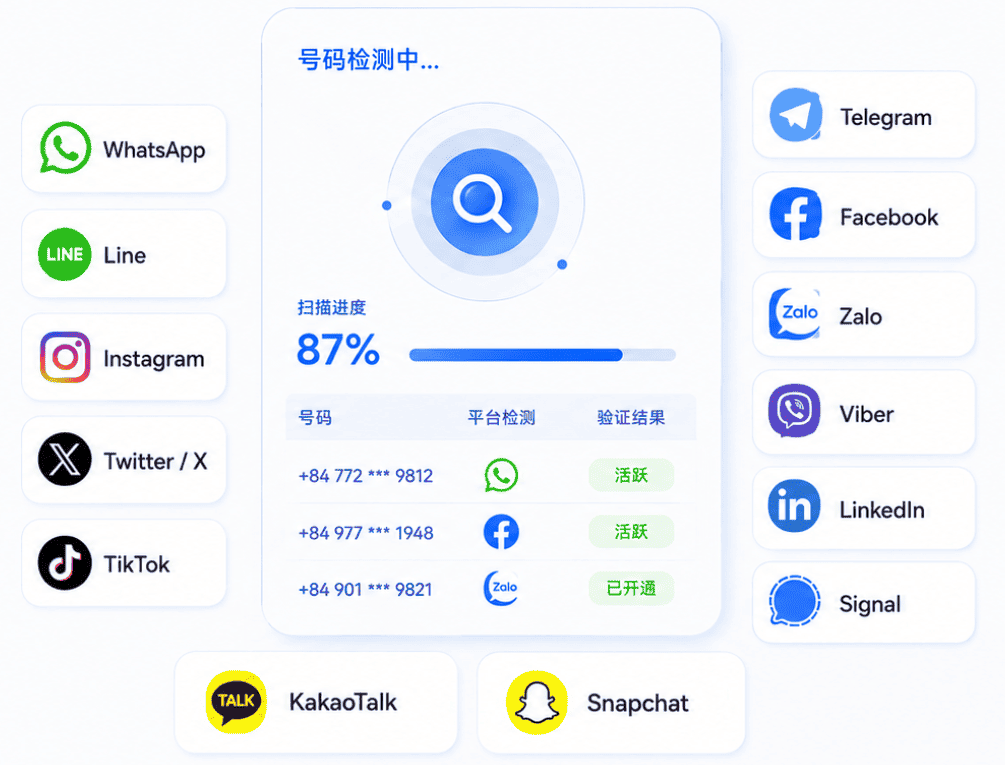
Amman is the world's leading number screening platform, providing global customers with batch number screening and testing services covering 236 countries. The platform currently supports more than 40 mainstream social networking and applications, including WhatsApp, Line, Twitter, Facebook, Instagram, LinkedIn, Viber, Zalo, Binance, Signal, etc., adapting to the needs of multiple scenarios.
The main core functions cover multi-dimensional precise screening such as activation, activity, interaction, gender, avatar, age, online, accuracy, empty account, mobile phone device, etc., and can flexibly meet the needs of different users. Its core advantage is to integrate global mainstream social and application resources to provide users with one-stop, real-time and efficient number precision screening services, helping customers achieve global digital layout.
It is a common choice for all professional teams to complete rational screening before actually reaching users.
Editor abcheck has a lot of experience, welcome to communicate with me, click to contact @Tg8189