
When doing Line user operations, many teams will use "active users" as a unified label, but the actual effect is often unstable. Some batches have good response, while others have almost no feedback. The problem is usually not in the content, but in the fact that the active data is not used separately.
Activity is not a single concept. Activity in different time dimensions represents completely different user states. Online for the day and active for 7 days, both seem to be active users, but the usage patterns are very different.
Why the active time dimension starts to matter
As the use of data becomes more and more sophisticated, simple active judgment can no longer meet the needs. Differences in user behavior at different time periods will directly affect the reach effect.
If the time dimension is not distinguished, common problems include:
- Short-term contact without feedback
- Loss of long-term operating users
- Data usage rhythm is chaotic
These problems are essentially caused by mixing different types of active users.
What scenario is more suitable for online users that day?
Users online on that day represent the status of "currently in use". Such users respond to information more promptly.
This type of user usually has several characteristics:
- Highly used and currently active
- Respond faster to messages
- Easier to form instant interactions
Therefore it is more suitable for:
- Instant access
- Event notification
- short term conversion testing
In these scenarios, response speed is more important than user size.
What scenario is more suitable for 7-day active users?
7-day active users represent "recent usage behavior", but are not necessarily currently online.
The characteristics of this type of users are:
- Usage behavior is relatively stable
- Don’t rely on instant access
- More suitable for continuous communication
More suitable for:
- Private domain precipitation
- Community operation
- Long-term content reach
Compared to same-day online users, this group of people is better suited to building long-term relationships rather than short-term stimulation.
Why two types of data cannot be mixed
If you mix today's online and 7-day active users, there will be obvious problems.
In an instant reach scenario, users who have been active for 7 days may not respond, which lowers the overall effect.
In long-term operations, online users on the same day may participate in the short term, but may not necessarily remain.
This kind of mixing will make the data performance unstable and make it difficult to judge whether the strategy is effective.
How to select data based on scenarios
A more reasonable way is to select corresponding data according to the goal rather than using it uniformly.
If the goal is to get feedback quickly, you can prioritize users who are online on the same day.
If the goal is to establish a private domain, 7-day active users can be given priority.
By matching scene data, each batch of users can be used in a more appropriate position.
It is more direct to use Amman to distinguish the active time dimension.
In actual operation, if the active time is not clearly distinguished, it is difficult to achieve refined use. Through systematic screening, classification can be done as the data comes in.
Through Shi'anman, Line users' activity can be detected and their usage in different time dimensions can be distinguished. In this way, different types of users can be obtained directly during the screening stage without the need to split them later.
For teams that need to continuously operate users, this approach makes it easier to form a stable process.
Being active is not just “using”, but “when you are using it”
In the current environment, active users are no longer a simple label, but a dimension that needs to be split.
What was solved online that day was immediate response.
7 days of activeness solves long-term stability issues
When these two types of data are used separately, the overall reach and operational rhythm will be clearer and the effect will be more stable.
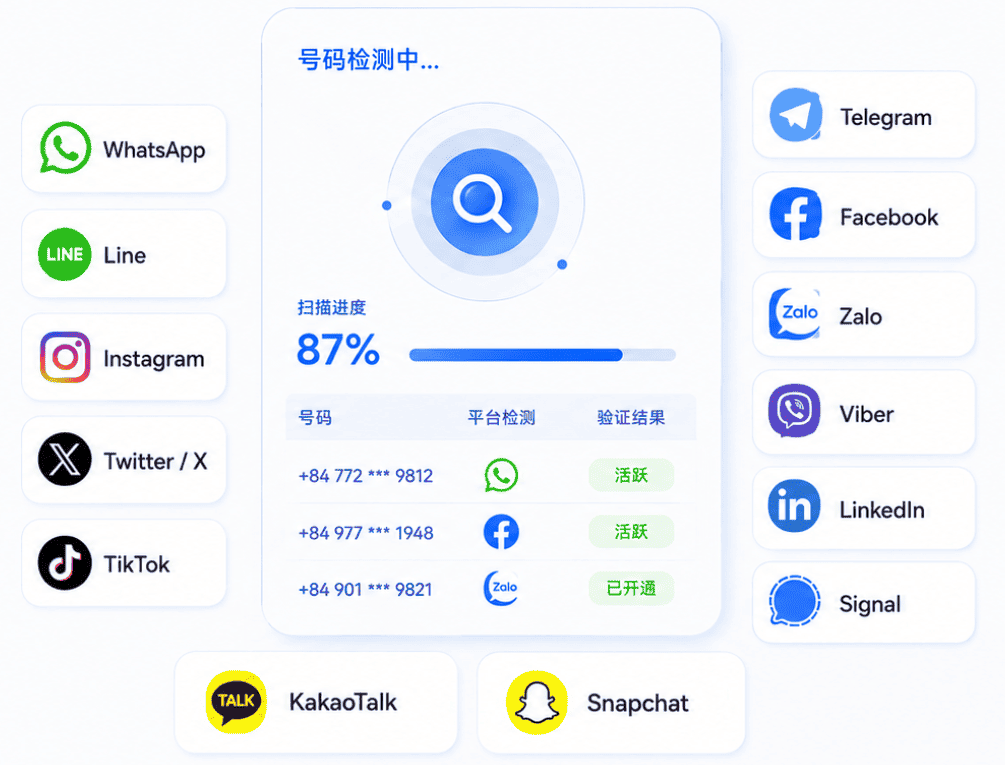
Amman is the world's leading number screening platform, providing global customers with batch number screening and testing services covering 236 countries. The platform currently supports more than 40 mainstream social networking and applications, including WhatsApp, Line, Twitter, Facebook, Instagram, LinkedIn, Viber, Zalo, Binance, Signal, etc., adapting to the needs of multiple scenarios.
The main core functions cover multi-dimensional precise screening such as activation, activity, interaction, gender, avatar, age, online, accuracy, empty account, mobile phone device, etc., and can flexibly meet the needs of different users. Its core advantage is to integrate global mainstream social and application resources to provide users with one-stop, real-time and efficient number precision screening services, helping customers achieve global digital layout.
It is a common choice for all professional teams to complete rational screening before actually reaching users.
Editor abcheck has a lot of experience, welcome to communicate with me, click to contact @Tg8189