
When doing user acquisition in the encryption industry, many people will fall into a misunderstanding: as long as the traffic is large enough, conversion will naturally increase. However, in actual operation, it was found that even though a large number of users are reached every day, only very few people actually complete the registration or even start trading.
The key to the problem is not the traffic, but the user status. Compared with general users, users who have completed OKX activation have stronger transaction willingness and basic knowledge . This group of people is the truly valuable target.
If ordinary traffic is "cultivating demand", then opening users is "having entered the demand stage", and the conversion efficiency of the two is not at the same level at all.
Why should we filter "activated users" instead of general traffic?
In the user path, from "knowing the exchange" to "registering an account" to "actual trading", there are at least three obvious thresholds:
- information cognitive threshold
- Registration operation threshold
- Trust and financial threshold
Most of the ubiquitous traffic is actually stuck in the first stage, and even the basic concept of exchange is not clear. This means that when you communicate, you not only have to convert, but you also have to bear the cost of education.
Users who have already been activated must have at least crossed the first two thresholds . They have a basic understanding of the platform, have completed the registration process, and some have even bound funds or performed simple operations.
This brings two direct advantages:
- Communication costs are lower and there is no need to explain from scratch
- The conversion path is shorter and easier to enter the practical stage.
From the perspective of data performance, the conversion efficiency of registered users is usually several times that of general traffic, which is also the important significance of screening.
What are the characteristics of typical profiles of OKX users?
Not all registered users have the same value. Only by further segmenting the profile can the screening accuracy be improved.
From the perspective of regional distribution, users in some areas are more receptive to crypto transactions. This group of people is usually more active and participates more frequently.
From the perspective of behavioral habits, high-quality subscription users often have the following characteristics :
- Have a fixed online time
- Follow market trends or related content
- Have certain sensitivity to transaction information
From the perspective of financial capabilities, the differences between different users are also obvious. Some people just sign up to try, while others have the ability to continue trading.
Another point that is easily overlooked is "information feedback speed".
Users who are willing to reply and communicate are often easier to convert than "silent users" , even if both have opened accounts.
Through comprehensive judgment in these dimensions, "low-value subscription users" can be further screened out, leaving a group of people with greater potential.
Path 1: Reverse the activation status based on behavioral data
In the absence of direct labels, user behavior can be used to determine whether activation has been completed.
For example:
Whether the user frequently browses crypto-related content, participates in discussions on trading topics, and shows obvious concern about market fluctuations.
The closer the behavior is to the transaction scenario, the higher the probability of activation .
In addition, it can also be judged through the time dimension:
- Are you active during market fluctuations?
- Whether to go online frequently during a specific period of time
These behaviors are often highly correlated with trading behaviors.
It should be noted that this method is more "probabilistic judgment" and is suitable for the preliminary screening stage to quickly narrow down the scope.
Path 2: Filter by channel tags
Different user source channels determine the probability of activation.
For example:
Users who enter through encrypted communities and market information platforms have strong industry interests, and the activation rate of this group of people is significantly higher than that of ordinary social traffic.
The channel itself is a natural filter .
Users generally have higher value if they come from the following types of channels:
- Quote discussion community
- Investment exchange group
- Trading strategy sharing channel
In contrast, no matter how large the number of users brought by pan-entertainment channels is, the actual activation ratio will be low.
Therefore, when screening, we must not only look at the users themselves, but also their source paths, which can greatly improve screening efficiency.
Path 3: Directly lock users who have been activated
Compared with the first two types of "speculative screening", it is undoubtedly more efficient to directly obtain subscribed users.
The core of this method is to skip the judgment step and directly reach the target group .
The advantages are mainly reflected in two aspects:
- Save time and cost , no need for repeated screening and verification
- Improve accuracy and avoid waste of resources caused by misjudgments
However, even if users have been activated, they still need to further screen for quality, such as activity level, transaction frequency, etc. Otherwise, there will still be a situation of "activated but not converted".
How to use it after screening: conversion strategy is the key
Screening is just a preliminary step; what really determines the outcome is the subsequent communication method.
A common problem is: being too direct.
When many people contact users, they directly enter "transaction guidance" or even "profit commitment", which in most cases will arouse users' vigilance.
A more effective way is to advance in stages:
The first stage is to establish basic knowledge
Understand the current status of users through communication, such as whether they have trading experience and whether they understand basic operations.
The second stage is to provide value information
Such as market analysis and operation ideas, allowing users to feel the value of information
The third stage is to gradually guide behavior
Based on trust, guide specific operations
Conversion is essentially a process, not an action that is accomplished in one go .
In addition, rhythm control is also very important.
Frequent interruptions can easily lead to resentment, while being too passive can lead to missed opportunities, so adjustments need to be made based on user feedback.
When the screening object changes from "general users" to "activated users", the overall customer acquisition efficiency will be significantly improved. But more importantly, after screening, how to truly transform these users into long-term value users through more reasonable strategies.
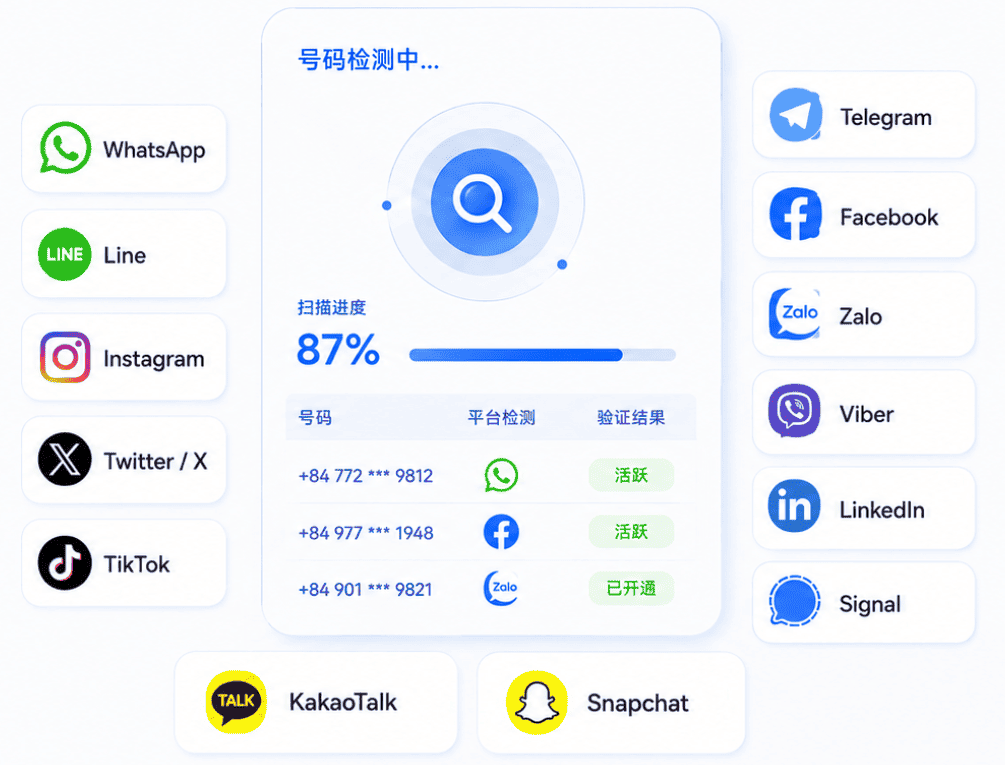
Amman is the world's leading number screening platform, providing global customers with batch number screening and testing services covering 236 countries. The platform currently supports more than 40 mainstream social networking and applications, including WhatsApp, Line, Twitter, Facebook, Instagram, LinkedIn, Viber, Zalo, Binance, Signal, etc., adapting to the needs of multiple scenarios.
The main core functions cover multi-dimensional precise screening such as activation, activity, interaction, gender, avatar, age, online, accuracy, empty account, mobile phone device, etc., and can flexibly meet the needs of different users. Its core advantage is to integrate global mainstream social and application resources to provide users with one-stop, real-time and efficient number precision screening services, helping customers achieve global digital layout.
It is a common choice for all professional teams to complete rational screening before actually reaching users.
Editor abcheck has a lot of experience, welcome to communicate with me, click to contact @Tg8189