
When getting an unfamiliar mobile phone number, many people not only want to know which country the number comes from, but also continue to check another question: which communication operator does the number belong to?
Especially when there are many numbers around the world, data from the United States, Japan, the United Kingdom, Thailand, Germany and other countries are mixed together, and it is not enough to just look at the country area code. If you need to do number classification, operator user screening, communication services or customer data later, you will need to use phone number service provider detection.
The phone number service provider mentioned here mainly refers to the operator that provides mobile communication services to this mobile phone number. A simple understanding is that this mobile phone card corresponds to which telecom operator, not social platforms such as WhatsApp, Telegram, and LINE.
What does the phone number service provider check?
Phone number service provider detection is also often called mobile phone number operator query, SIM operator detection, and mobile phone number service provider query.
It mainly solves the communication service provider information behind the number.
For example, although a group of US mobile phone numbers are all +1 numbers, the users may be from different operators. The same is true for markets such as Japan, the United Kingdom, and Germany. There are often multiple mobile communication service providers in the same country.
If you just know which country the number belongs to, you can't continue to distinguish between different operators.
At this time, if you do a phone number service provider test, you can continue to filter around the operator to which the number belongs.
For a large number of global mobile phone numbers, this classification is much more convenient than manually querying one number one by one.
The international dialing code can only tell you part of the information
When many people look up overseas numbers, they look at the international area code first.
+81 generally corresponds to Japanese numbers, +66 corresponds to Thailand, and +44 corresponds to the United Kingdom. Through the international dial code, you can first determine which country or region the number roughly belongs to.
But the international dialing code cannot tell you which operator it is.
There are often multiple phone number service providers in the same country, so if the current demand has been refined to the operator level, you must continue to conduct mobile phone number operator testing.
This is also the difference between country area identification and operator query.
The former determines which market the number belongs to, and the latter continues to determine which communication service provider the number corresponds to.
Why is it not necessarily enough to only look at the first few digits of the number?
Some people are used to judging the operator based on the first few digits of the mobile phone number.
In some countries and some number segments, this method may provide some reference, but it may not be stable when used on long-term and large-scale global number data.
A typical problem is number portability.
Users may initially use a certain operator, but later keep their original phone number and switch to another operator. The number looks unchanged, but the current service provider has.
If you always judge according to the earliest number segment rules, the result may be inconsistent with the current actual situation.
Therefore, for data that requires newer operator information, simply relying on the number segment table is not enough.
In which scenarios will number service provider query be used?
Phone number service provider detection is not only used in the communications industry.
After the amount of customer number data is relatively large, many scenarios will require the operator's level of information.
For example, when classifying global customer numbers, you can continue to organize them according to operators outside of countries.
When cleaning overseas number data, you can also add operator-related information to help reclassify later.
If the business itself is related to SIM cards, communication networks, and number channels, the importance of operator query will be more obvious.
There are also some multi-country number databases that only have mobile phone numbers and no complete number background. The data will be gradually sorted out through basic tests such as countries and operators.
For global numbers, it is best to clarify the country scope first.
If a file contains numbers from multiple countries such as the United States, Japan, Thailand, India, Germany, etc., it can be handled by directly querying the operator, but it is usually easier to manage by sorting out the country range first.
For example, if we are currently focusing on Japanese numbers, we will first take out the Japanese data, and then continue to query Japanese mobile phone number operators.
If the business is transferred to Thailand, then handle the Thai number.
In this way, whether you look at the operator, number status or social platform related information later, it will be clearer.
Especially after hundreds of thousands of global numbers have been accumulated for a long time, it is much more convenient to manage them in one country and one market than to stuff them all into one big table.
Amman can conduct large-volume phone number service provider testing
When there are only a few dozen numbers, manual query is not a big problem.
But after the number reaches tens of thousands, hundreds of thousands or even more, it is basically unrealistic to manually search for operators.
Shianman supports global number-related detection scenarios. If you need to do phone number service provider detection, SIM operator query, and international number operator screening, you can choose the corresponding capabilities for batch processing according to current needs.
If the numbers come from multiple countries, they can also be combined with global number-related detection to continue sorting.
If other data such as number validity, empty numbers, social platform status, etc. are needed later, you can continue to detect according to the actual business.
Currently, if you just want to know the operator, you can query and process it around the operator. There is no need to do many irrelevant projects at once.
Carrier information and number validity are not the same thing
This distinction is important.
Finding that a number belongs to a certain operator does not mean that the mobile phone number must be in normal use.
Operator detection solves the problem of service provider attribution.
Number validity testing focuses on whether the number can still be used normally.
Therefore, if what is currently needed is customer number cleaning, the two requirements can be processed separately according to the actual situation.
Checking the operator first does not mean that the number validity judgment has been completed; conversely, if the number is normal, it does not mean that the specific operator is known.
Once you know what kind of information you want to check, you won't mix different tests together later.
The operator information of the old number may also change
After the customer database is stored for a long time, the operator label may not always be valid.
The most common reason is that users change operators but keep their original mobile phone number.
Therefore, if the operator information saved a few years ago is reused for operator classification, it is best to re-check it based on actual needs.
Data that has been recently updated does not need to be checked repeatedly.
For long-term maintenance number databases, historical data and recent data can be processed separately, and the detection focus is on numbers that have not been updated for a long time.
This can reduce a lot of duplication of work.
Carrier detection can also be combined with other number screening
If you need to do WhatsApp number screening, Telegram detection, and LINE user screening later, the operator information can continue to be retained as the basic attribute of the number.
For example, if you already have customer data from a certain country, you should first check the phone number service provider, and then check the relevant status of the corresponding social platform based on the current business.
In this way, the customer number is not reorganized every time a requirement is changed, but the required information is continuously supplemented on the basis of the original data.
What the phone number service provider detection really solves is actually a very specific problem: which communication operator provides the service for the mobile phone number in your hand.
When there are more and more numbers around the world, relying on area codes can only solve the problem of national scope, and relying on old number segments may not necessarily reflect the current operator. When it is necessary to further differentiate operators, it will be more reliable to detect the number service provider separately, and it is also more suitable for large-scale data processing.
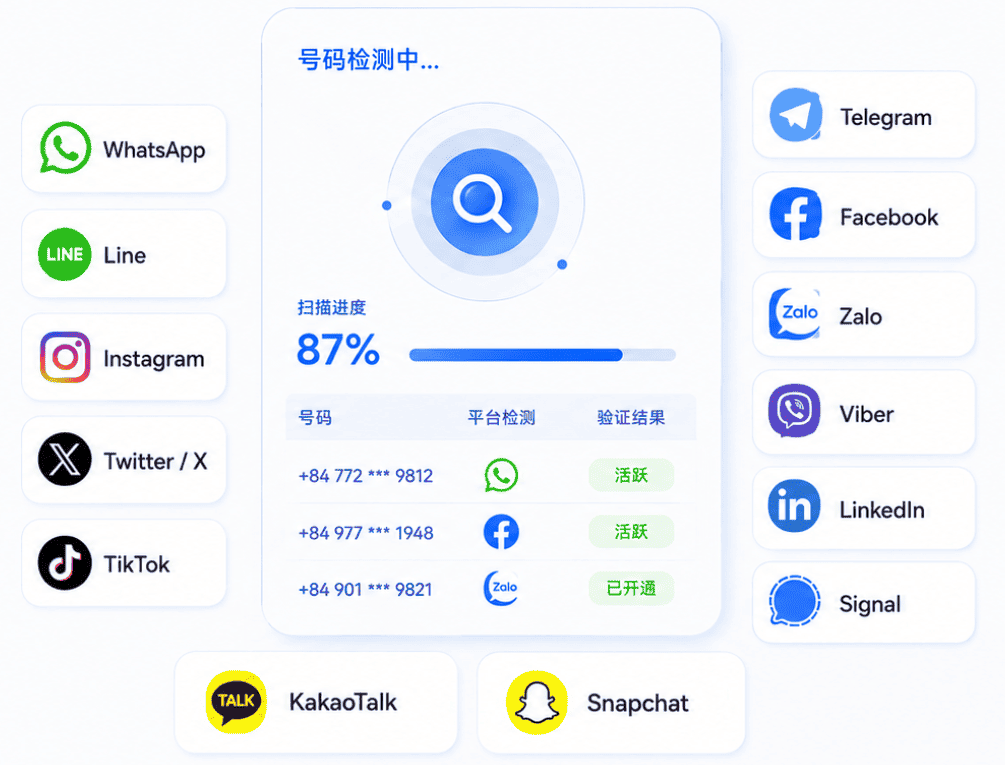
Amman is the world's leading number screening platform, providing global customers with batch number screening and testing services covering 236 countries. The platform currently supports more than 40 mainstream social networking and applications, including WhatsApp, Line, Twitter, Facebook, Instagram, LinkedIn, Viber, Zalo, Binance, Signal, etc., adapting to the needs of multiple scenarios.
The main core functions cover multi-dimensional precise screening such as activation, activity, interaction, gender, avatar, age, online, accuracy, empty account, mobile phone device, etc., and can flexibly meet the needs of different users. Its core advantage is to integrate global mainstream social and application resources, provide users with one-stop, real-time and efficient number precision screening services, and help customers achieve global digital layout.
It is a common choice for all professional teams to complete rational screening before actually reaching users.
Editor abcheck has a lot of experience, welcome to communicate with me, click to contact@Tg8189