
In the stage where user filtering is becoming more and more sophisticated, it is difficult for a single condition to meet the needs. In the past, many teams only looked at registration or activity, but now it is more common to use multiple dimensions together, such as device type, account status, and communication capabilities to filter together.
The three dimensions of iOS user, blue label account, and RCS number represent different information respectively. When they are combined together, the data can be compressed into a more concentrated group of people closer to high-quality users.
Why multi-dimensional combination screening began to increase
As the amount of data increases, the problem of a single filter becomes more and more obvious. If you only look at the registration status, a large number of low-active users will be mixed in; if you only look at the activity level, you may ignore account stability or device differences.
Therefore, many teams began to superimpose conditions and narrow the scope through combined screening. The core logic of this approach is to reduce uncertainty and bring data closer to target users, rather than expanding coverage.
What do the three dimensions represent?
In this type of combination, each dimension has a clear role.
iOS users are more representative of the device environment and user level. Such users usually have a more stable experience.
Blue-labeled accounts represent the degree of account standardization and credibility. Such accounts have more complete information and higher stability.
The RCS number reflects communication capabilities and equipment support, which usually means that the user equipment and network conditions are good.
After the three dimensions are superimposed, the screened users will be more concentrated in terms of devices, accounts and usage environments.
The actual logic of combined filtering
In actual operation, it is not simply to apply the three conditions at the same time, but to filter them in order.
Do basic filtering first and filter out unavailable data.
Screen active users again to ensure that the account is in use
Finally, conditions such as equipment, blue label and RCS are superimposed
Through this sequence, you can avoid overly strict filtering at the beginning, which will cause the data to be directly compressed too much.
Which scenarios is this combination more suitable for?
Multi-dimensional combination screening is more suitable for scenarios with higher conversion requirements, rather than simply pursuing traffic.
For example, products with high customer unit prices need to give priority to users with greater spending power.
Financial or crypto projects require more stable and trustworthy accounts
Boutique e-commerce requires higher quality users for testing and conversion
In these scenarios, data quality is more important than data size.
What are the limitations of combined filtering?
Although this method can improve data quality, it also has obvious limitations. The most direct thing is that the amount of data will decrease. If you rely entirely on this type of users, it will be difficult to support large-scale reach.
Therefore, a more reasonable approach is to treat this type of data as a high-priority group rather than the only source. Through layered use, the overall scale can be maintained while ensuring conversion.
Use Amman to achieve more efficient multi-dimensional combination screening
In actual operation, manually combining these conditions is not only inefficient, but also difficult to ensure consistency. A more suitable way is to complete multi-dimensional processing at one time during the screening stage.
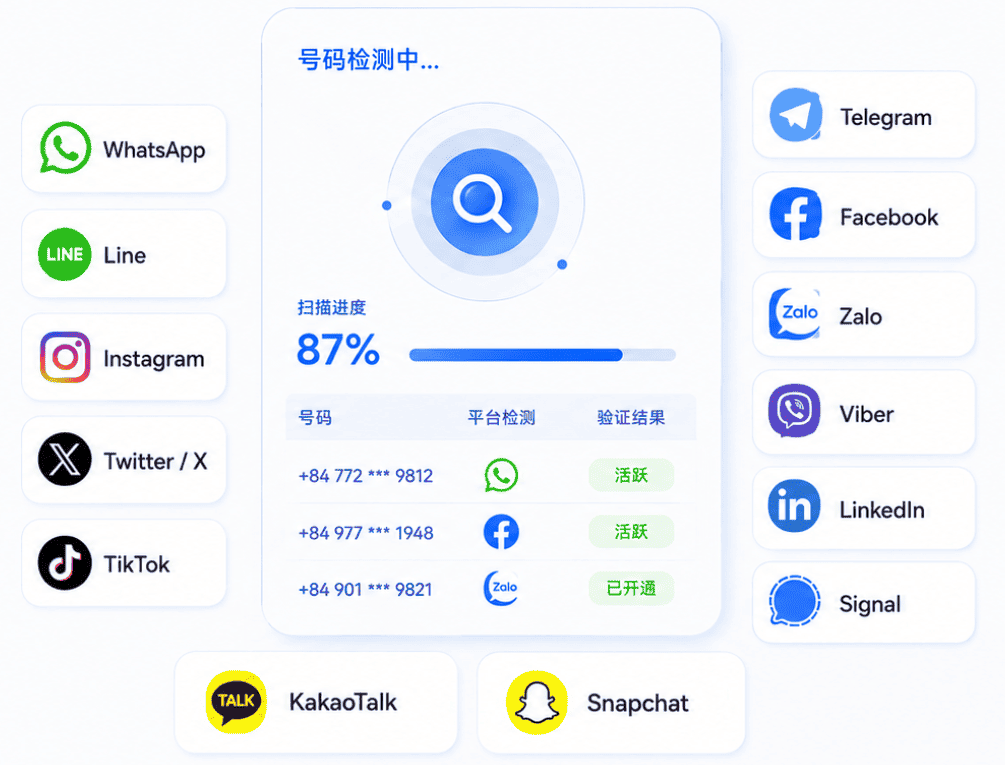
Through Amman, device type, account status and communication capabilities can be identified simultaneously during the detection process, and combined filtering is supported. In this way, a batch of data closer to the target user can be obtained in one round of processing without the need for step-by-step operations.
For teams that need to continuously optimize data structures, this method makes it easier to stabilize output.
The core of screening is not to add conditions but to reduce errors
The purpose of multi-dimensional screening is not to increase the number of conditions, but to make the results more certain. When the dimensions of device, account, and communication capabilities are used together, the data gradually changes from a chaotic state to a clearly structured part. In high-conversion scenarios, this certainty is more important than simply expanding the data range.
Amman is the world's leading number screening platform, providing global customers with batch number screening and testing services covering 236 countries. The platform currently supports more than 40 mainstream social networking and applications, including WhatsApp, Line, Twitter, Facebook, Instagram, LinkedIn, Viber, Zalo, Binance, Signal, etc., adapting to the needs of multiple scenarios.
The main core functions cover multi-dimensional precise screening such as activation, activity, interaction, gender, avatar, age, online, accuracy, empty account, mobile phone device, etc., and can flexibly meet the needs of different users. Its core advantage is to integrate global mainstream social and application resources to provide users with one-stop, real-time and efficient number precision screening services, helping customers achieve global digital layout.
It is a common choice for all professional teams to complete rational screening before actually reaching users.
Editor abcheck has a lot of experience, welcome to communicate with me, click to contact @Tg8189