
Among social platforms, Snap’s user structure is relatively unique. It does not rely on public content distribution like traditional platforms, but puts more emphasis on acquaintance relationships, instant interaction and light content communication. This characteristic determines that when acquiring customers on Snap, you cannot simply use the "add people + send in groups" method, but need to establish a clearer direction from the screening stage.
If the front-end screening is not done well, no matter how you optimize the reach and conversion paths later, it will be difficult to make up for the gap caused by user quality. On the other hand, once the screening direction is correct, relatively stable feedback can be obtained even if the touching action is not complicated.
Therefore, in the Snap system, screening is not an independent action, but the starting point of the entire customer acquisition process.
Why Snap is more suitable for young users to acquire customers
Snap's core user group is relatively young, especially between the ages of 18 and 30. This type of user is highly receptive to new things, but they are also more sensitive and are obviously repelled by information with a strong "marketing sense".
From the perspective of usage habits, these users prefer:
- High-frequency short interactions rather than long reading
- Prioritize visual content over purely textual expression
- Respond immediately rather than delay communication
These characteristics mean that if the selected users themselves do not meet the characteristics of this group, even if the account actually exists, it will be difficult to form effective interaction.
In other words, screening accounts on Snap is not just about “whether they are active”, but also about “whether they fit in with the mainstream user profile of the platform.”
Step 1: Make it clear that you are not looking for users, but what type of users you want
In actual operation, many problems arise in the first step: the goal is not clear. As long as they are Snap users, they will be included in the scope. The people screened out in this way will inevitably be mixed, making it difficult to operate in a unified manner in the future.
A more reasonable way is to define the user type before filtering, including but not limited to the following dimensions:
- Age group: Is it consistent with your product or service positioning?
- Interest direction: whether it has any intersection with the target content
- Regional distribution: whether it belongs to the target market
- Consumption power: Do you have the foundation for conversion?
When these conditions are clear, screening is no longer about “casting a wide net” but directional filtering.
This step seems simple, but it often determines 80% of the subsequent results.
Step 2: What are the key filtering conditions for Snap filters?
In the Snap environment, judging user quality cannot rely solely on a single indicator, but requires comprehensive judgment from both behavioral and structural levels.
Common valid filters include:
- Activity frequency: whether there is continuous login and usage behavior
- Content interaction: whether there is a record of sending or receiving Snap
- Friend relationship: Do you have a certain number of friend networks?
- Usage habits: Does it conform to the common usage rhythm of the platform?
Compared with some open platforms, Snap has less public information, which is one of the reasons why screening is more difficult. Therefore, in actual operations, many people will use screening software to conduct batch screening, and then further refine based on the results.
It should be noted that the tool itself can only provide basic screening capabilities. What really determines the quality of screening is whether the setting of screening conditions is reasonable.
Step 3: After screening, how to quickly establish a reach path
After the screening is complete, the real challenge begins. Snap users have a low tolerance for unfamiliar contacts. If the first step of communication is inappropriate, they can easily be ignored.
In the design of access paths, it is necessary to consider "reduce the sense of interruption" and "increase acceptance".
You can start from the following directions:
- Establish a basic connection first instead of outputting information directly
- Guide the other party to respond through light interaction
- Control touch frequency to avoid repeated operations in a short period of time
It’s often easier to get feedback in a more natural way than by pushing content directly.
Step 4: From interaction to trust, how to increase conversion probability
On Snap, conversions tend not to happen all at once, but are built over time through multiple interactions.
From the first contact to the generation of trust, users will generally go through several stages: attention, interest, interaction, and recognition. Each stage requires different content and communication methods to promote.
For example, in the initial stage, it is more suitable for lightweight content or simple communication to give users a basic impression; as interactions increase, more valuable information can be gradually introduced to strengthen trust; when users show clear interest, then enter the conversion stage.
If you push too hard in the early stages, it can easily interrupt the process and lead to user loss.
Several key variables that affect Snap’s customer acquisition effectiveness
During actual execution, several variables continue to affect the results.
The first is the quality of the account itself. If the account is abnormal or unstable, no matter how accurate the screening is, it will be difficult to continue to use it.
The second is the screening accuracy. If the screened users deviate greatly from the target group, all subsequent actions will be affected.
The other is the execution rhythm, including contact frequency, interaction methods, etc. These details will directly affect the user experience.
These factors interact to determine the final result.
Why do some people succeed while others fail using the same method?
On the same platform and similar operating methods, the results obtained by different people are often very different. This is usually not a "method issue" but a difference in "implementation details".
Some people established clear standards in the screening stage, and subsequent implementation was relatively smooth; others made constant corrections during use, but the front-end screening was always unstable, resulting in large fluctuations in overall efficiency.
There is another type of situation where the depth of understanding of the platform is different. Some people will constantly adjust their strategies based on user behavior, while others will stay on fixed methods, which will gradually widen the gap.
In the long term, stable results often come from a set of continuously optimized processes rather than a single point of skill.
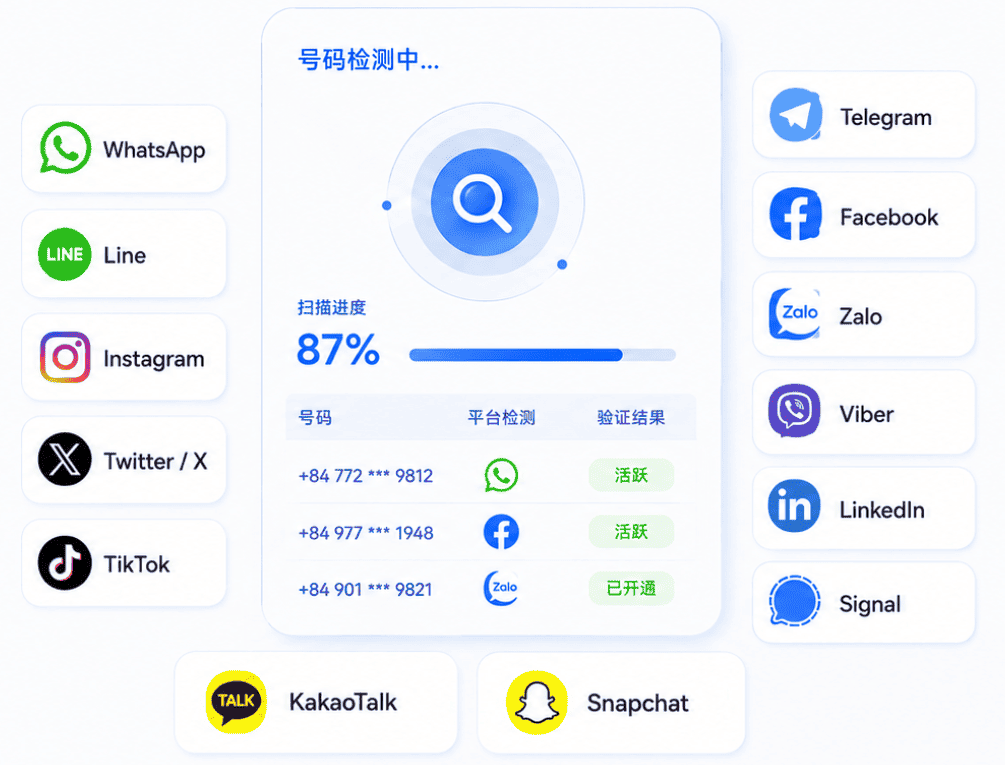
Amman is the world's leading number screening platform, providing global customers with batch number screening and testing services covering 236 countries. The platform currently supports more than 40 mainstream social networking and applications, including WhatsApp, Line, Twitter, Facebook, Instagram, LinkedIn, Viber, Zalo, Binance, Signal, etc., adapting to the needs of multiple scenarios.
The main core functions cover multi-dimensional precise screening such as activation, activity, interaction, gender, avatar, age, online, accuracy, empty account, mobile phone device, etc., and can flexibly meet the needs of different users. Its core advantage is to integrate global mainstream social and application resources to provide users with one-stop, real-time and efficient number precision screening services, helping customers achieve global digital layout.
It is a common choice for all professional teams to complete rational screening before actually reaching users.
Editor abcheck has a lot of experience, welcome to communicate with me, click to contact @Tg8189