
The South American e-commerce market has grown rapidly in the past few years, but many teams will encounter a practical problem when working in the private domain: traffic can be generated, but leads are unstable and the source of customers is single. Once a certain channel fluctuates, the overall growth will be affected. To stabilize the private domain of WhatsApp, the key is not to amplify a certain channel, but to separate the sources of clues, obtain them through combinations, and then cooperate with screening to form a continuously available data pool.
A clue is not a source but a structure
Many teams will rely on a single channel, such as only advertising, or only data collection. But in the South American market, this approach is difficult to be stable in the long term.
A more effective way is to establish three types of clue sources at the same time:
- advertising leads
- content clues
- data clues
These three types of clues have different functions, and only when used in combination can stable growth be achieved.
Advertising leads: large amount but need to be screened
Advertising is still the fastest way to get WhatsApp leads, especially in markets like Brazil, Mexico, and Colombia.
Common paths include:
- Facebook or Instagram form ads
- Click to jump to WhatsApp traffic ads
The characteristics of this type of clues are:
- Fast acquisition speed
- Large amount of data
- But the quality fluctuates significantly
In one case, a clothing e-commerce team ran Click to WhatsApp ads in Brazil and could get thousands of leads a day, but less than 30% of the users could actually communicate continuously. The reason is not that the advertising is not good, but that the data is not filtered.
If these clues are used directly, they will consume a lot of customer service resources.
Content clues: high quality but limited scale
Compared with advertising, content brings more accurate clues.
Common ways include:
- The comment area guides users to send private messages
- Social media account guidance plus WhatsApp
- Short video or live broadcast to attract traffic
The characteristics of this type of clues are:
- Users take active actions
- Stronger willingness to convert
- But the growth rate is slower
For example, a team that makes beauty products continuously outputs content through Instagram short videos, and guides users to send private messages and then transfer them to WhatsApp. The response rate of these users is significantly higher than advertising leads, but the number cannot support scale growth.
Therefore, it is more suitable for high-quality supplements.
Data clues: controllable but must be filtered
The third category is to directly obtain number data, including:
- local data provider
- Historical customer data
- Recruit users through other channels
The advantages of this type of clues are:
- Available in batches
- sustainable use
- Can be filtered according to needs
But the problem is also obvious. If no filtering is done, the quality of the data will be uneven.
In an actual case, a team that makes electronic products obtained South American numbers through data channels, and then filtered them through Shi'anman, retaining only users who had opened WhatsApp and had active behaviors. The response rate after final contact was significantly higher than the unscreened data.
The key to these types of leads is not to obtain them, but to filter them.
How to use the three types of clues in combination
It is difficult to achieve stable growth by using any kind of clue alone. A more reasonable way is to combine it.
It can be allocated like this:
- Advertising Lead Responsibility Scale
- Content leads are responsible for quality
- Data threads are responsible for supplementing and extending
On this basis, only through unified filtering can the data structure be stabilized.
All leads must be screened
No matter what type of source it is, the same problem will occur when using it directly: the data is unstable.
A more reasonable process is:
- All clues enter the unified pool
- Check the activation status first
- Filter active users
- Do simple layering again
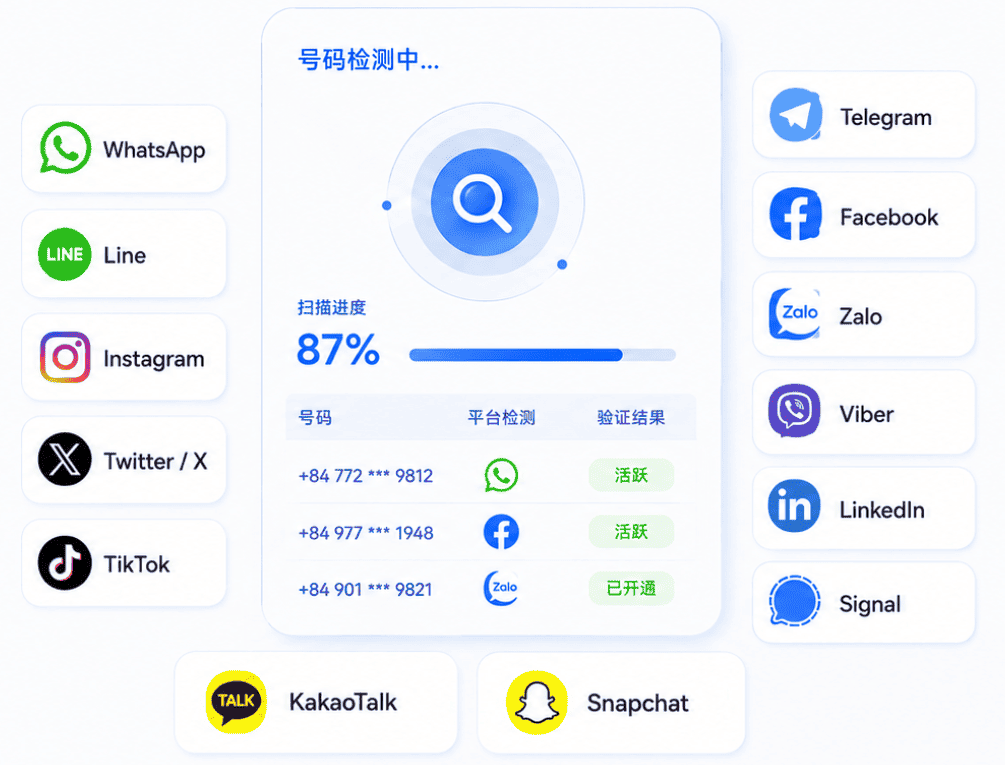
Through Amman, these screenings can be completed in one round of processing, and the three types of clues such as advertising, content, and data can be processed in a unified manner instead of operating separately.
This ensures that users who enter the private domain have basic conditions for use and are not in a mixed state.
The role of Amman in multi-source data
When there are more sources of leads, the biggest problem is not acquisition, but management.
Amman can help with several key things:
- Check WhatsApp activation status in batches
- Identify activity levels and filter out active users
- Output labels to facilitate subsequent layering
- Support API access and automatically process new data
In this way, whether it is advertising clues, content clues or data clues, they can be processed with the same set of standards to avoid data confusion.
The key to private sector growth is not channels, but structure
Many teams attribute growth problems to insufficient channels, but in the South American market, the more core issue is whether the lead structure is reasonable.
When the three types of clues are used in combination and Amman completes unified screening, the data will change from scattered to centralized, and the private domain will change from unstable to sustainable.
Instead of constantly changing channels, it is better to straighten out the source of leads and the logic of screening. Only after this step is completed, the growth will truly start to stabilize.