
When reaching Telegram users, many teams are accustomed to using a batch of data directly, without distinguishing user status, and sending or importing it into the community at once. It may seem efficient in the short term, but you will soon encounter problems: unstable responses, large differences in interactions, and difficulty in improving conversions.
The problem is not the way of reaching them, but that the users are not stratified. Users with different levels of activity are in completely different states. If they are handled in the same way, the results will be difficult to stabilize.
Why user stratification is more effective than unified reach
In actual data, the difference in user activity is very obvious. In the same list, some people use Telegram every day, some are online occasionally during the week, and some are silent for a long time.
If no distinction is made, several typical problems will arise:
- Active users are diluted by low-quality data, and overall feedback declines
- The reach rhythm is uncontrollable. Some users are over-reached, and some have almost no chance.
- Test results are confusing and it’s hard to tell whether the strategy is working
The meaning of layering is to allow users in different states to enter different rhythms, rather than to handle them uniformly.
How to use it for highly active users
Highly active users are the group of people closest to conversion. This type of user has obvious usage behavior and responds to messages more promptly.
When using it, you can focus on:
- Prioritize reaching and put core resources on this group of users
- Used to test new words or strategies, with faster feedback
- Undertake the main transformation tasks and improve overall efficiency
This type of user does not need repeated stimulation. The key is to have a steady rhythm and avoid over-exposure.
How to use medium active users
Medium active users are in a transitional state, with usage behavior but unstable. If this group of people is handled properly, they can be gradually transformed into highly active users.
A more appropriate way is:
- Reach out in batches to avoid centralized operations
- Test reactions with different content
- Gradually increase the frequency of interactions
The key for this type of users is not rapid conversion, but gradual activation.
How to deal with silent users
Silent users are usually people who have been inactive for a long time or use very infrequently. If this group of users directly participates in reaching out, it will easily lower the overall effect.
Solutions that may be considered include:
- Reduce contact frequency and avoid resource waste
- Do an activation test alone to see if recovery is possible
- Users who have been unresponsive for a long time will be directly eliminated.
In many cases, reducing this part of data is more effective than continuing to invest.
Changes brought about by layering
When users are stratified, the data moves from confusion to clarity. The usage methods for different groups of people are clear, and the overall rhythm is easier to control.
Common changes include:
- Response rate is more stable
- Test results are clearer
- Conversion paths are easier to optimize
Compared with a single processing method, layered data is easier to use continuously.
Using Amman to achieve active stratification is more straightforward
In actual operation, if you rely on manual judgment, it is difficult to distinguish user status stably. A more efficient way is to complete the stratification directly in the screening stage.
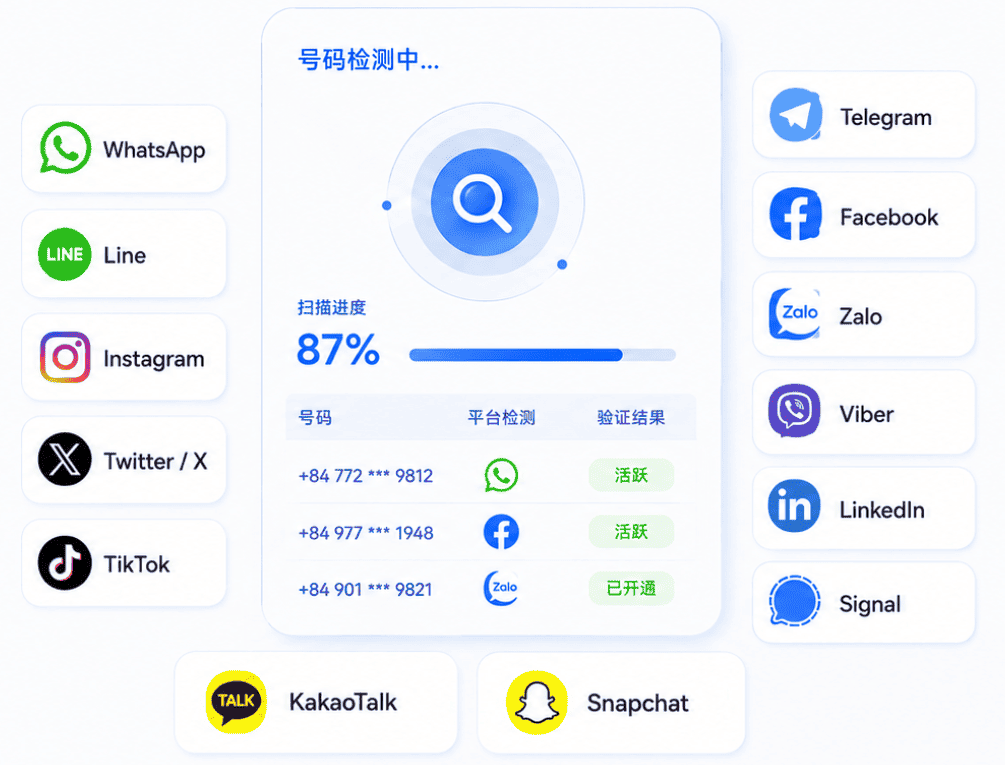
Through Amman, you can conduct batch detection of numbers, identify the activity of Telegram accounts, and classify them according to different statuses. In this way, the data has been stratified before entering the usage process, instead of being split later.
This method can reduce repeated operations and make it easier to form a stable process.
Layering is not a complex operation, but a basic action
Many teams will feel that layering increases operational complexity, but the reality is that not layering will cause more problems. Unified contact may seem simple, but it will continue to amplify errors in the future.
When highly active, medium active, and silent users are used separately, every step of the operation will be clearer. Instead of constantly adjusting your words, it is better to straighten out the user structure first. This step is often more direct.
Amman is the world's leading number screening platform, providing global customers with batch number screening and testing services covering 236 countries. The platform currently supports more than 40 mainstream social networking and applications, including WhatsApp, Line, Twitter, Facebook, Instagram, LinkedIn, Viber, Zalo, Binance, Signal, etc., adapting to the needs of multiple scenarios.
The main core functions cover multi-dimensional precise screening such as activation, activity, interaction, gender, avatar, age, online, accuracy, empty account, mobile phone device, etc., and can flexibly meet the needs of different users. Its core advantage is to integrate global mainstream social and application resources to provide users with one-stop, real-time and efficient number precision screening services, helping customers achieve global digital layout.
It is a common choice for all professional teams to complete rational screening before actually reaching users.
Editor abcheck has a lot of experience, welcome to communicate with me, click to contact @Tg8189