
In the Telegram ecosystem, "there are many users but no conversion" is not an exception, but a quite common phenomenon. On the surface, the group size is growing, the number of contacts is increasing, and they are even being reached every day, but the number of users who can ultimately produce actual results is always limited. The problem is not the size of the traffic, but the structure of the traffic.
TG itself is an extremely open platform, with low account acquisition costs and strong user mobility. This makes it easy to accumulate "quantity" but difficult to guarantee "quality". If clear standards are not established in the screening step, then all subsequent marketing actions will actually be repeated consumption on inefficient groups.
Screen number is not an auxiliary link in the TG marketing system, but the core step that determines the upper limit of efficiency.
The essence of TG marketing’s problem is that “the proportion of invalid users is too high”
When there is no obvious feedback from users, many people’s first reaction is to adjust the words and optimize the content. However, if the basic users themselves are not willing to interact, no matter how good the content is, it will be difficult to produce results.
TG users have an obvious characteristic: a very high proportion of silent users. Although a large number of accounts exist, they have not spoken or participated in interactions for a long time, or even only passively exist in the group. This type of user looks "valid" in the data, but has little value in actual use.
If you do not screen and directly reach this type of users, two problems will arise: first, the response rate is extremely low, and second, it is easily recognized by the system as harassing behavior, thus affecting the stability of the account itself.
Therefore, the first meaning of screening is to filter out these "invalid users" in advance and focus on people who are likely to generate feedback.
TG user stratification is the basic logic of screening numbers
Before screening, one premise needs to be clarified: TG users are not a unified group, but can be clearly stratified.
From the perspective of activity level, it can be roughly divided into three categories:
The first category is silent users. These people hardly participate in any interaction and only exist in groups or address books. This group of users has the largest number but the lowest value.
The second category is active users, who speak regularly, participate in discussions, and have a certain ability to feedback information. These people are the main targets.
The third category is high-value users, who are not only active, but also have clear needs or resources, and often show stronger participation in specific topics. These users are not large in number, but have the highest conversion potential.
The essence of screening is to identify as many of the latter two categories as possible among these three types of people, and reduce the proportion of the first category.
From "general traffic" to "precise crowds", the screening dimensions must be three-dimensional
In the TG environment, if you only rely on a single indicator for screening, bias will easily occur. Truly effective screening usually requires a combination of multiple dimensions.
Common valid dimensions include:
- Online status: Is there continuous online behavior, rather than occasional occurrences?
- Frequency of speaking: Have you ever spoken in the group?
- Depth of participation: Does the speech have content, rather than simple expressions or meaningless replies?
- Group distribution: Whether to join multiple related groups to reflect the concentration of interest
- Traces of account usage: whether there is basic information such as avatar, nickname, history, etc.
After these dimensions are superimposed, it can be closer to the real user status instead of being misled by superficial data.
In actual operation, the cost of manually screening this information is very high, so many people will use screening software to conduct preliminary screening and then make secondary judgments. But no matter which method is used, the filtering rules themselves are the key to determining the results.
Why do screened users still not convert?
Even if the screening is completed, it does not mean that there will be ideal results. There are still several problems that are easily overlooked.
The first is that the screening criteria do not match the business goals. If the filter is for "active users" but what is actually needed is "users with clear needs", then even if the user is active, conversion may not occur.
Secondly, the filtering dimensions are too superficial. For example, only looking at whether to speak and ignoring the quality of the content of the speech will lead to screening out a large number of "surface active but worthless" users.
Another key issue is the time factor. The active status of TG users changes dynamically. If older data is used, even if they were active users at the time, they may be silent now.
These factors will lead to a result: there is no problem with the screening itself, but the screened population does not match the current target, thus affecting the final effect.
The real key to TG marketing lies in the combination of “screening + operation”
Screening solves the problem of "finding the right person", but "making people take action" still relies on subsequent operations.
In a TG environment, users are more sensitive to unfamiliar information. If the contact method is too direct, it can easily be ignored or even blocked. Therefore, the communication rhythm needs to be more natural rather than forced at a single point.
A more effective way is usually to gradually build trust through multiple points of contact. For example, first establish a sense of presence through group interaction, and then communicate through private messages. This conversion path is relatively smoother.
At the same time, the content itself also needs to match the user status. For new users, the information is more basic; for users who are already interested, you can gradually delve into specific solutions or operations.
Screening is just the entrance, what really determines conversion is the execution details of each subsequent step.
How to build a reusable TG screening marketing process
When screening is no longer a temporary action but forms a process, the overall efficiency will be significantly improved. A relatively complete process usually includes three stages.
The first stage is preliminary screening, which uses basic conditions to quickly filter out obviously invalid users and narrow the scope. The second stage is fine screening, which uses behavioral data to further judge user quality and screen out high-potential groups. The third stage is the usage stage, where different reach strategies are developed based on user stratification, and screening criteria are continuously adjusted based on feedback.
These three stages do not exist independently, but are a cyclical process. The screening results will affect the operation strategy, and the operation feedback will in turn optimize the screening rules.
When this mechanism gradually stabilizes, user quality and conversion efficiency will enter a more controllable state, instead of relying on constant trial and error to find answers.
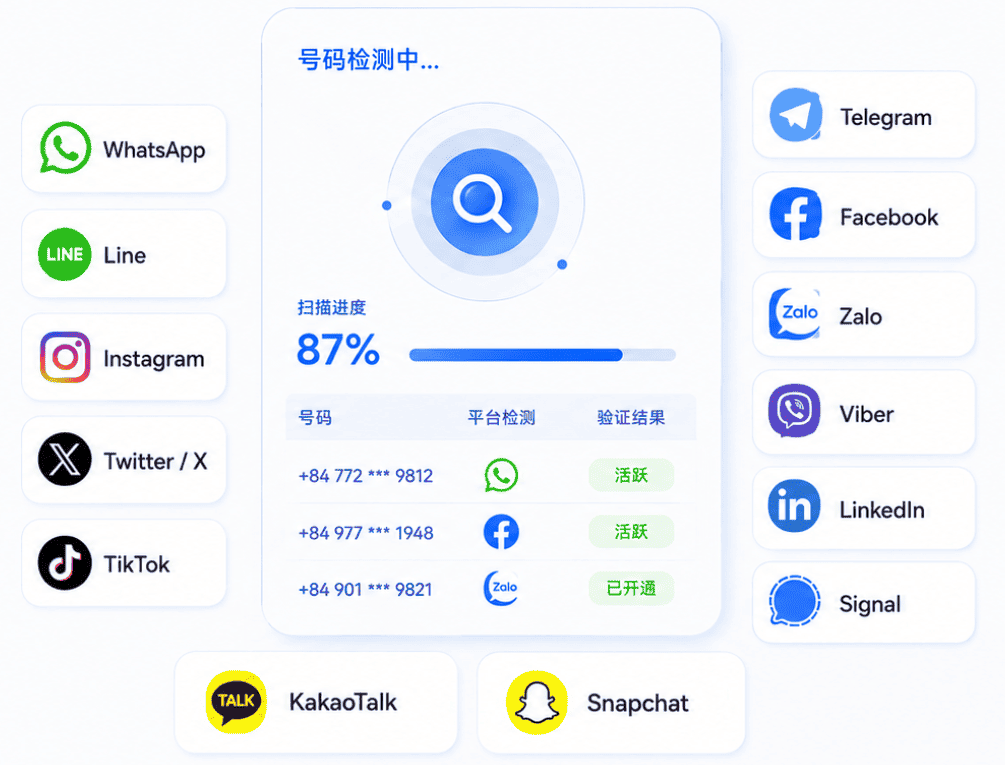
Amman is the world's leading number screening platform, providing global customers with batch number screening and testing services covering 236 countries. The platform currently supports more than 40 mainstream social networking and applications, including WhatsApp, Line, Twitter, Facebook, Instagram, LinkedIn, Viber, Zalo, Binance, Signal, etc., adapting to the needs of multiple scenarios.
The main core functions cover multi-dimensional precise screening such as activation, activity, interaction, gender, avatar, age, online, accuracy, empty account, mobile phone device, etc., and can flexibly meet the needs of different users. Its core advantage is to integrate global mainstream social and application resources to provide users with one-stop, real-time and efficient number precision screening services, helping customers achieve global digital layout.
It is a common choice for all professional teams to complete rational screening before actually reaching users.
Editor abcheck has a lot of experience, welcome to communicate with me, click to contact @Tg8189