
In the acquisition of e-commerce user data, many teams will directly use the data obtained by crawling or channels, but they will soon discover a problem: the amount of data seems to be a lot, but not much is actually usable. The problem is often not the source of the data but the lack of filtering.
Platform users such as Amazon, Temu, and Wish are essentially just “accounts that exist on the platform” and are not equivalent to reachable users. To make this batch of data truly useful, a round of status testing and screening needs to be done first.
Why can’t e-commerce platform user data be used directly?
E-commerce platform data usually contains multiple types of users:
- Users who are only browsing but have no active activity
- Accounts that have been registered but have not been used for a long time
- Account with incomplete information or abnormal status
- Users who are actually using it and have the possibility to interact
If there is no filtering, these users will be mixed together, making it difficult to judge the effect when using it, and there may even be a large number of invalid contacts.
The data characteristics of different platforms are different
Although Amazon, Temu, and Wish are all e-commerce platforms, they have different user structures and usage habits.
Amazon users tend to be more mature markets and have higher account stability.
Temu users are growing rapidly, but data is updated frequently
Wish users are widely distributed, but their activity levels vary significantly.
If these characteristics are not distinguished and processed uniformly, it can easily lead to unstable screening results.
The place of user status detection in filtering
In the number screening process, user status detection is a key link in the middle, which is used to determine whether the account truly exists and whether it is of value.
A clearer order of processing could be:
- Basic data organization
- User status detection
- Activity filter
Through this sequence, the data can be filtered layer by layer and transformed from "platform account" to "available users".
How to turn e-commerce users into reachable data
The e-commerce platform itself is not a communication tool, and user data needs to be further processed before it can be converted into accessible resources.
Common ways include:
- Extract or match user contact details
- Determine social platform registration status by number
- Then do active screening to ensure that users can be reached
The key to this step is to convert the data within the platform into data available across platforms, rather than just staying within the e-commerce platform.
Batch filtering can reduce a large amount of invalid data
When the amount of data is large, manual filtering is not only inefficient, but also difficult to ensure uniform standards.
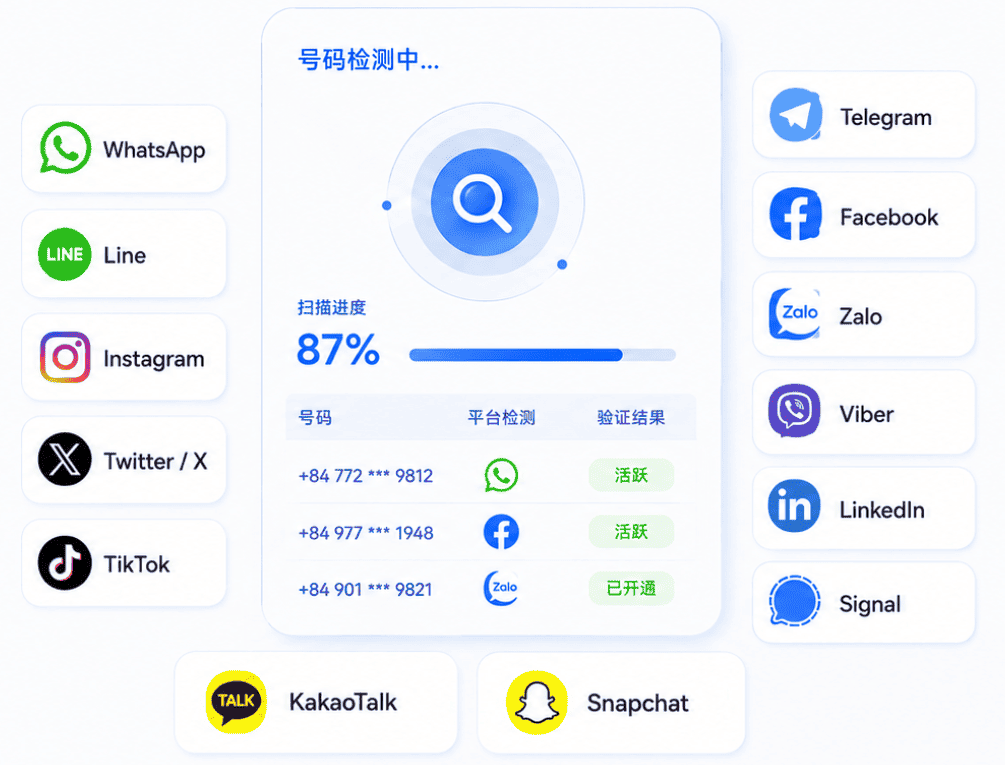
Through Shianman, the numbers corresponding to e-commerce users can be tested in batches, the status of social platform accounts can be identified, and filtering can be performed based on activity levels. Data is processed in the same process, no staged operations are required.
After the screening is completed, a batch of data closer to real users can be obtained directly instead of the original mixed data.
The key to converting data from platform users to usable users
The data on the e-commerce platform is only the starting point, the real value is the users who can be reached.
Through status detection and filtering, data can be gradually transformed from "existence of accounts" to "available resources". When this step is stable, subsequent reach and conversion will be more basic.
Amman is the world's leading number screening platform, providing global customers with batch number screening and testing services covering 236 countries. The platform currently supports more than 40 mainstream social networking and applications, including WhatsApp, Line, Twitter, Facebook, Instagram, LinkedIn, Viber, Zalo, Binance, Signal, etc., adapting to the needs of multiple scenarios.
The main core functions cover multi-dimensional precise screening such as activation, activity, interaction, gender, avatar, age, online, accuracy, empty account, mobile phone device, etc., and can flexibly meet the needs of different users. Its core advantage is to integrate global mainstream social and application resources to provide users with one-stop, real-time and efficient number precision screening services, helping customers achieve global digital layout.
It is a common choice for all professional teams to complete rational screening before actually reaching users.
Editor abcheck has a lot of experience, welcome to communicate with me, click to contact @Tg8189