
The more detailed the Crypto business becomes, the simple user label of the currency circle is often not enough.
When doing Web3 communities, activities or customer accumulation in the early days, a lot of data would simply be recorded as Crypto users and Web3 users. When later business gradually involves different countries, different trading platforms, Telegram communities or other channels, you will find that the original classification is too broad.
For example, among the same Crypto-related users, some are from Southeast Asia and some are from Europe; some are related to Binance, and some are related to Bybit, HTX, Kraken and other platforms; and some have only participated in Web3 activities and have no clear platform label.
At this time, the Crypto screen number will be used.
To put it simply, Crypto screening is to continue to filter the existing Web3 and currency-related mobile phone numbers in terms of numbers, countries, regions, platform status, etc., so that the data that originally only had the big label of Crypto users can continue to be subdivided.
Crypto screening is not about judging who has how much assets
If we explain this concept clearly first, it will be easier to understand the subsequent screening logic.
Crypto sifting mainly solves the problem of number and platform data classification.
For example, which country the number belongs to, which trading platform it is related to, whether it is related to social platforms such as Telegram, and whether there is any obvious abnormality in the number.
These are all information that can be further detected and sorted out.
However, it is not possible to directly determine the number of assets in a user's account based only on the mobile phone number or platform registration status, nor can it explain the transaction amount, transaction frequency or investment willingness.
Therefore, for truly practical Crypto user screening, the focus should be on data that can be confirmed.
Country and region are the most basic level of classification
The currency users themselves are global.
If Web3 users in Southeast Asia, the Middle East, Europe, Latin America and other markets are all mixed in the same database, it will be more troublesome to identify specific countries later.
For example, if the current business focus is Thailand, you can continue to screen Crypto-related users from the Thai number range.
If you are planning to do business in the UAE market, switch to the corresponding country.
If the subsequent focus shifts to Germany, France or other European countries, they can also be managed separately.
In this way, the Crypto number database will not only have one global currency circle user label, but will gradually form a data range for different countries and regions.
For people who have been working in overseas markets for a long time, this layer is usually the easiest to use first.
The relevant status of the trading platform is an important direction for Crypto screening.
After the countries are separated, you can continue to look at the specific trading platforms.
They are all Web3 users, some may be related to Binance, and some may be related to Bybit, HTX, Kraken, KuCoin and other platforms.
If the platform information is not differentiated, every time a user related to an exchange is needed, the entire Crypto database will have to be reprocessed.
Therefore, you can continue to perform corresponding platform registration or platform-related status detection based on the current business.
For example, now we mainly focus on Binance, so we will deal with Binance-related users first.
Bybit is needed in the next stage, and Bybit-related screening will continue to be added.
This method is more flexible and easier to manage than testing all platforms at the beginning.
A Crypto user may be involved with multiple platforms at the same time
Platform classification is not a single-choice question.
It is very common for users in the currency circle to contact multiple trading platforms at the same time.
A user may be associated with Binance, but also with Bybit, Kraken or other platforms.
Therefore, after the Crypto number screening, there is no need to forcefully stipulate that a number can only belong to one trading platform.
The multi-platform attribute is useful information in its own right.
If you need Binance-related users in the future, check the Binance scope; if you need Kraken-related users, switch to the corresponding platform; if your current business focuses on multi-platform users, you can also continue to combine existing conditions.
In this way, the same Crypto database can adapt to different platform requirements.
Telegram sources can also be retained
Many Web3 users themselves came from the Telegram community.
Project groups, industry groups, activity groups, and historical customer groups may all generate a large amount of Crypto-related data.
Therefore, after performing Crypto number screening, there is no need to discard the original Telegram source.
Platform status and the source itself are two different pieces of information.
For example, if a user comes from the Telegram community and is related to a trading platform, these two layers of information together will have more reference value than a single user tag in the currency circle.
In the future, if you only need Crypto users from Telegram sources, you can continue to narrow the scope around the original sources.
The underlying status of the number itself is also worth checking
Crypto screening numbers are not just platform classifications.
If the number data has been accumulated for a long time, it may also contain duplicate numbers, numbers with abnormal formats, long-term invalid data, or historical mobile phone numbers that have not been updated for many years.
If these problems are not dealt with, every subsequent trading platform test may bring the same old data repeatedly.
Therefore, before reusing historical Crypto numbers, you can first check the basic quality of the numbers.
Especially for data merged from multiple activities, communities, and CRM files, number deduplication and basic status detection will be more practical.
Clean up the number library itself first, and then classify the specific platforms. The subsequent data will be easier to maintain.
Shianman can conduct corresponding testing according to Crypto business needs.
When the number of Crypto users is small, manual classification can still be handled.
However, after the number of Web3 numbers reaches tens of thousands or hundreds of thousands, the country, trading platform, Telegram and the basic status of the number will all be sorted manually, and the efficiency will drop significantly.
Shianman covers global numbers and a variety of social and business platform-related detection scenarios, and you can choose the corresponding detection capabilities according to the current Crypto business needs.
For example, currently we mainly want to filter global numbers by country and region, which can be done around national markets.
If you need users related to Binance, Bybit, HTX, Kraken and other platforms, then choose the corresponding platform for testing.
If you still need Telegram-related data, number status or other number attributes, you can continue to filter based on actual business.
The key point is to detect only the type of data that is needed, rather than stacking all detection items at once just to make user labels appear more.
New Crypto data and old data from a few years ago are best viewed separately.
The Web3 industry is changing rapidly, and user data is worth retaining.
The numbers obtained from recent activities and the historical Crypto users accumulated two or three years ago, even if the platform tags are the same, the degree of data freshness is different.
If the original database has activity time, customer entry time, and consultation records, you can continue to retain them.
In this way, when looking for recent Web3 users in the future, there is no need to retrieve all the data from long ago.
Old users can still save it, but it will be clearer to manage it separately from recently added data.
Crypto screen numbers can constantly change according to current business
There is no need to design a fixed template for Crypto user categories at once.
Today the business focus may be on Telegram users in Southeast Asia, tomorrow it may need Kraken-related users, and next month it will be on the Bybit market in the Middle East.
If you only build a large and comprehensive list of currency users at the beginning, you will have to reorganize it every time you change the business direction.
A more trouble-free way is to gradually supplement the basic information about the country, platform, source and number.
Shiamman can help handle these actual needed detections, while the original sources such as Web3 activities, Telegram communities, and historical customers continue to be retained.
In this way, the same Crypto database does not need to be rebuilt over and over again.
Whichever country the business transfers to, switch the country scope; whichever trading platform you follow, add corresponding platform conditions; you need relevant Telegram users, and then combine it with the original social sources.
The real practicality of Crypto screening is that it allows an originally broad user base in the currency circle to be continuously reorganized according to the needs of different markets and different platforms.
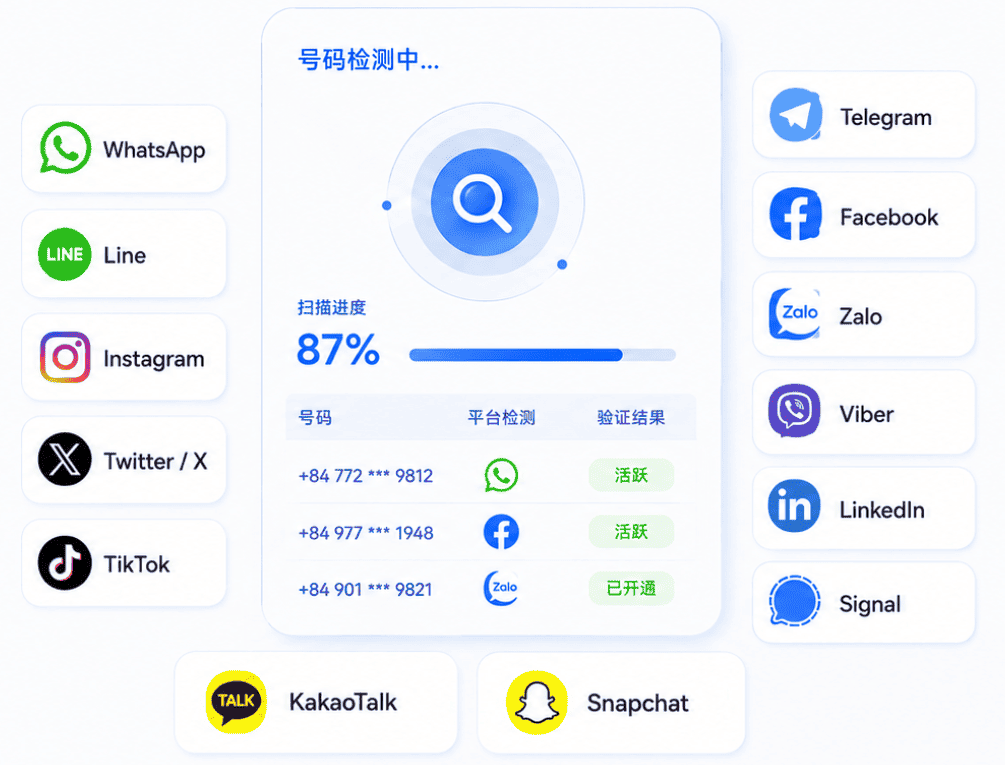
Amman is the world's leading number screening platform, providing global customers with batch number screening and testing services covering 236 countries. The platform currently supports more than 40 mainstream social networking and applications, including WhatsApp, Line, Twitter, Facebook, Instagram, LinkedIn, Viber, Zalo, Binance, Signal, etc., adapting to the needs of multiple scenarios.
The main core functions cover multi-dimensional precise screening such as activation, activity, interaction, gender, avatar, age, online, accuracy, empty account, mobile phone device, etc., and can flexibly meet the needs of different users. Its core advantage is to integrate global mainstream social and application resources, provide users with one-stop, real-time and efficient number precision screening services, and help customers achieve global digital layout.
It is a common choice for all professional teams to complete rational screening before actually reaching users.
Editor abcheck has a lot of experience, welcome to communicate with me, click to contact@Tg8189