
In WhatsApp marketing, mass sending itself is not complicated. What really makes the difference is the data processing before sending. If the numbers are not filtered and directly imported into the group, the effect will be mediocre in the short term. In the long term, a series of chain problems will occur, and these problems are often not noticed at the first time.
Once the data is in a mixed state, subsequent sending, replying, and conversion will be hindered.
Delivery looks normal, but reach isn’t real
Unfiltered numbers are usually mixed with users in a variety of different statuses, including unactivated, empty accounts, low-active accounts, etc. These numbers may appear successful when sent, but that does not mean the user will see the message.
Common situations are:
- Unregistered user, message has no actual recipient
- If the account is not used for a long time, the messages cannot be viewed in time.
- Low active users, unresponsive to reach
The result is that the sending volume is very high, but the actual reach ratio is very low. The data seems to have action, but actually has no effect.
The account environment is easily dragged down
When a large number of invalid numbers participate in mass sending, a problem will arise: the sending behavior does not match the user behavior.
The specific performance is:
- Send volume increased, but interaction was minimal
- There is almost no feedback from the user side
- Abnormal behavior data
In this case, the overall usage environment of the account will be affected, making subsequent operations difficult to stabilize. It's not a problem with a single delivery, but the cumulative impact of continued operations.
The response rate cannot be used as a reference indicator
In unfiltered data, the response rate itself has no reference value.
The reason is:
- Different user statuses are mixed together
- It is impossible to distinguish whether it is a user problem or a language problem
- The performance of each batch of data fluctuates greatly
This will lead to a result where the team constantly adjusts the content but can never find a stable direction.
Human resources are occupied by invalid data
The problem becomes more obvious when customer service is involved.
Common situations are:
- A large number of low-quality users enter the communication process
- Customer service time is wasted on unresponsive or worthless conversations
- Valuable users do not receive enough follow-up
In this case, even if more manpower is added, it will be difficult to improve efficiency because the problem lies with data rather than manpower.
Why are so many people unaware of the problem?
Problems caused by not filtering numbers usually amplify gradually rather than bursting out all at once.
Common misjudgments include:
- I think my speaking skills are not good enough
- I think the sending time is wrong
- It is thought that the market itself has low conversion
These judgments are not completely wrong, but they ignore a premise: whether the data itself is available.
If the data is not filtered, these optimizations will be difficult to produce significant results.
The correct way to handle it is to put filtering first
A more stable approach is to complete data filtering before sending, rather than remediating it after sending.
It can be processed in this order:
- First perform empty number filtering to remove obviously invalid data.
- Then do a WhatsApp activation test to confirm that users can be reached
- Then filter the activity and target the people who are currently using it.
Through these three steps, the data entering the mass sending process can be of basic quality rather than in a mixed state.
The actual role of using time Amman before mass distribution
In practice, Amman can complete batch screening before sending, rather than relying on human judgment.
It can be done:
- Does the batch inspection number actually exist?
- Determine whether WhatsApp is activated
- Identify user activity
- Output filtered available data
In this way, the users who enter the group sending process are part of the filtered data, not the original data.
Under the same sending scale, filtered data can often bring more stable replies rather than simply increasing the number of sendings.
If data is not filtered, problems will continue to amplify
Mass messaging itself will not automatically bring results, data quality is the foundation.
If the numbers are not filtered, sending will only amplify the problem; if the data is filtered, sending will only become meaningful. The effectiveness of each message does not depend on how many are sent, but on who is sent.
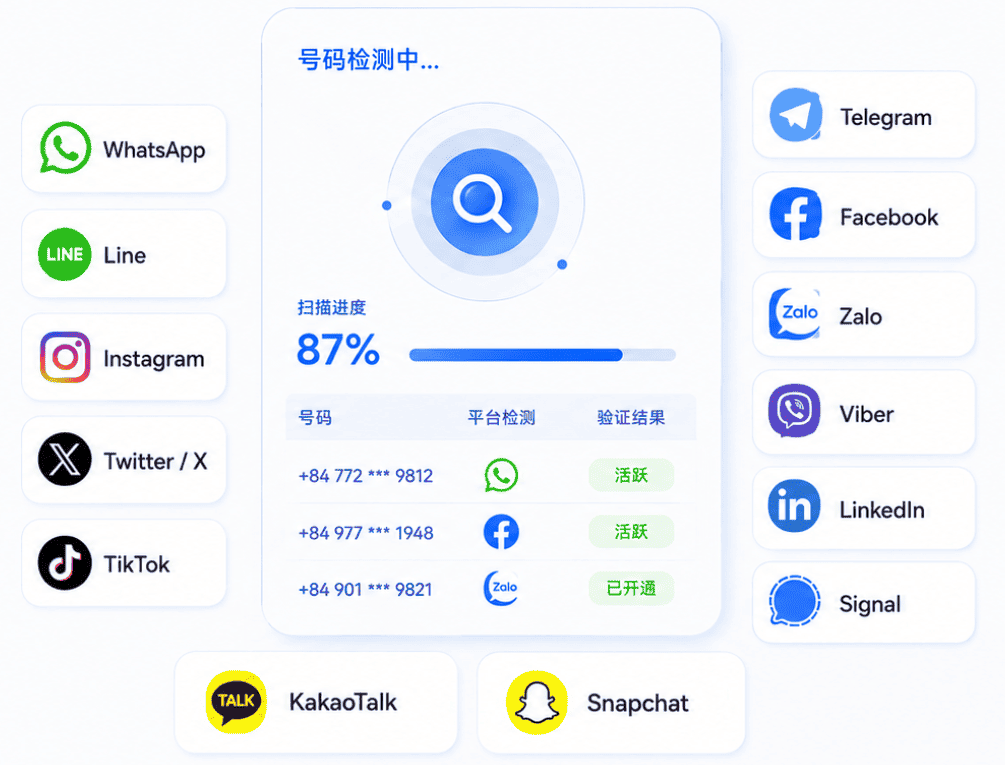
Amman is the world's leading number screening platform, providing global customers with batch number screening and testing services covering 236 countries. The platform currently supports more than 40 mainstream social networking and applications, including WhatsApp, Line, Twitter, Facebook, Instagram, LinkedIn, Viber, Zalo, Binance, Signal, etc., adapting to the needs of multiple scenarios.
The main core functions cover multi-dimensional precise screening such as activation, activity, interaction, gender, avatar, age, online, accuracy, empty account, mobile phone device, etc., and can flexibly meet the needs of different users. Its core advantage is to integrate global mainstream social and application resources to provide users with one-stop, real-time and efficient number precision screening services, helping customers achieve global digital layout.
It is a common choice for all professional teams to complete rational screening before actually reaching users.
Editor abcheck has a lot of experience, welcome to communicate with me, click to contact @Tg8189