
When screening WhatsApp users, many teams are no longer satisfied with simple classification by gender or age. Especially among mature female users, just knowing who they are is no longer enough to support conversion judgment. What is more important is whether they have "current consumption intention."
Among the same mature female users, some are in the stage of clear needs, some are just browsing, and some will hardly convert. If no distinction is made and everyone reaches it in the same way, the results will be difficult to stabilize.
Why traditional crowd labels are no longer enough
Early screening logic mostly stayed on basic attributes, such as gender, age, and region. These tags can help narrow the scope, but they cannot determine the user's current status.
The actual problem is:
- Under the same label, user needs vary greatly
- Unable to tell who is closer to conversion
- There is a lack of basis for contact sequence and resource allocation
When the data scale expands, this rough segmentation method will cause resources to be used scatteredly, making it difficult to achieve effective transformation.
The core logic of consumption intention stratification
The key to stratifying consumption intentions is not to put more labels on users, but to judge the stage of the user through behavior.
It can be simply understood as three categories:
- Users with clear needs have higher conversion potential
- Potential demand users need to be guided and cultivated
- Low-intent users are difficult to generate feedback in the short term
The value of this layered approach lies in allowing different users to enter different rhythms, rather than handling them uniformly.
Key stratification dimensions for female mature users
In actual screening, such users can be judged through several dimensions instead of relying on a single label.
- Activity: Whether there is continuous use behavior
- Response rhythm: whether there is feedback on the touch
- Stability of use: Whether the account exists for a long time and is used normally
After combining these dimensions, we can get closer to judging the user's current status instead of staying at the basic attributes.
How should people with different intentions use it?
After layering, the key is how to use different groups of people.
For high-intent users, we can prioritize reaching them and concentrate resources on conversion.
Targeted users can be reached in batches and guided step by step through content.
For low-intent users, investment can be reduced to avoid wasting resources.
This layered use method allows each batch of data to play a more specific role.
How to implement intent stratification through data filtering
In actual operation, consumption intention is not directly visible, but needs to be gradually approached through screening.
You can follow this logic:
- First, screen the WhatsApp activation status to confirm that it is reachable.
- Then filter active users and filter out low-usage accounts.
- Combined with the use of stability for further differentiation
Through layer-by-layer filtering, the original data can be compressed into a part that is closer to the target users.
Use Amman to achieve more efficient multi-dimensional screening
When the amount of data is large, manual layering is not only inefficient, but also difficult to maintain consistent standards. A more practical way is to directly complete multi-dimensional screening at the screening stage.
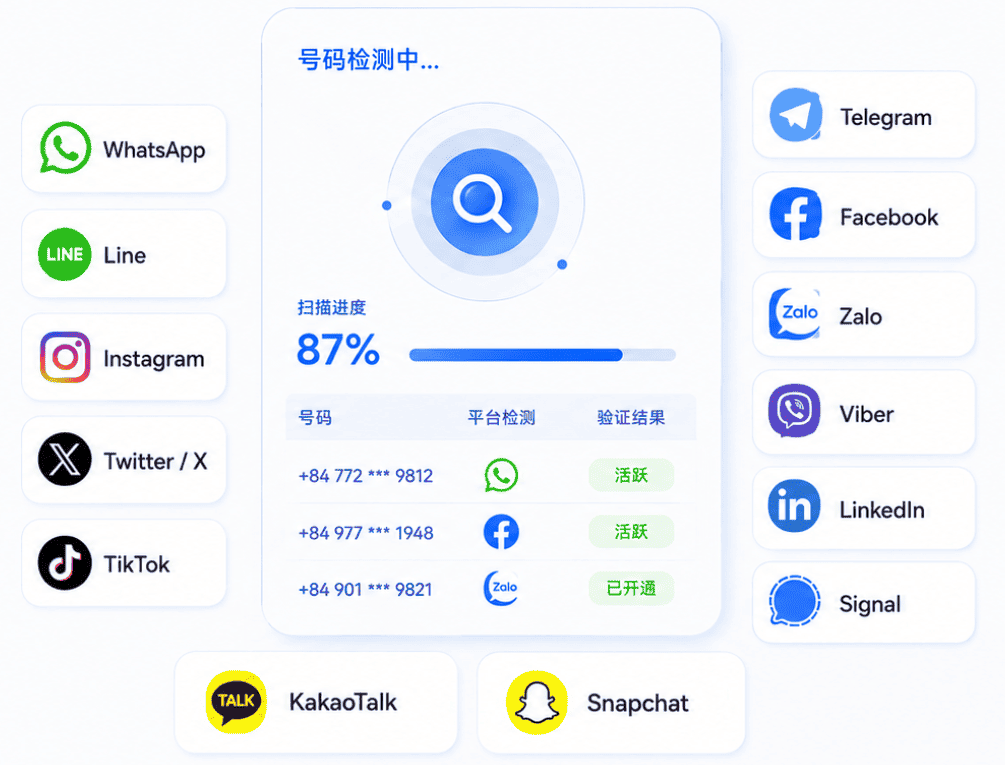
Through Amman, you can perform batch detection on numbers, identify WhatsApp activation status, and filter based on activity and account status. In this way, the data can be initially divided into different levels in one round of processing, providing a basis for subsequent intention stratification.
This method can reduce repeated operations and allow the data to be structured before being used.
From “Who is it?” to “Do you want to buy it now?”
The reason why female mature users are valued is not only because of their spending power, but also because with proper screening, it is easier to find people with clear needs.
When the filtering logic shifts from basic tags to consumption intent, the data will change from scattered to centralized. Compared with simply expanding the user scope, this method is easier to improve the overall conversion efficiency.
Amman is the world's leading number screening platform, providing global customers with batch number screening and testing services covering 236 countries. The platform currently supports more than 40 mainstream social networking and applications, including WhatsApp, Line, Twitter, Facebook, Instagram, LinkedIn, Viber, Zalo, Binance, Signal, etc., adapting to the needs of multiple scenarios.
The main core functions cover multi-dimensional precise screening such as activation, activity, interaction, gender, avatar, age, online, accuracy, empty account, mobile phone device, etc., and can flexibly meet the needs of different users. Its core advantage is to integrate global mainstream social and application resources to provide users with one-stop, real-time and efficient number precision screening services, helping customers achieve global digital layout.
It is a common choice for all professional teams to complete rational screening before actually reaching users.
Editor abcheck has a lot of experience, welcome to communicate with me, click to contact @Tg8189