
When actually using WhatsApp for contact, a situation often occurs: the same batch of numbers, the sending method does not change, but the feedback is very different. Some batches have obvious responses, while others have almost no response. The problem is usually not sending the action, but whether the user itself is active.
If no distinction is made, the data will be mixed together and the results will be unstable. By screening out active users and reaching them first, the overall effect will be clearer.
Why are the results of the same batch of data very different?
The number itself is just a portal and does not mean that the user will see the information. Although many accounts have registered for WhatsApp, they use it very rarely or even do not log in for a long time.
When the proportion of such low-active users increases, even if the sending volume is large, not much information is actually seen, and ultimately the response rate decreases.
Therefore, data differences are essentially activity differences.
What characteristics do active users usually have?
During the screening process, some basic features can be used to determine whether the user is using it.
For example, if the account information is complete, has an avatar, and has a normal nickname, it usually means that the user has used it before. For another example, if the account status is normal and there are no abnormalities or long-term deactivation, this type of user is closer to the actual status of use.
Although these characteristics cannot be completely equated with activity, they can be used as effective references in actual screening.
How to prioritize active users when screening accounts
In terms of process, active screening can be placed at a key position instead of being supplemented at the end.
A more stable way is:
Do number detection first and filter out unavailable data
Screen the registration status again to ensure that the account exists
Finally, filter activity and only retain users with usage behavior
Through this sequence, the data will be shrunk layer by layer, eventually leaving a part that is more likely to produce a reply.
Data layered use is more effective than mixed use
After filtering is complete, the data can be simply stratified rather than used all at once.
For example:
Prioritize highly active users
Moderately active user batch testing
Low active users reduce investment
This method can make the performance of each batch of data clearer and make it easier to judge the effect.
Reducing invalid contacts is the key to improving efficiency
Many times, the problem is not not enough contact, but too much ineffective contact.
If a large amount of resources are consumed by low-active users, the overall efficiency will be reduced. By screening in advance, this part of the consumption can be reduced, allowing the reach to be more concentrated on effective users.
It is more direct to use Amman to filter active users.
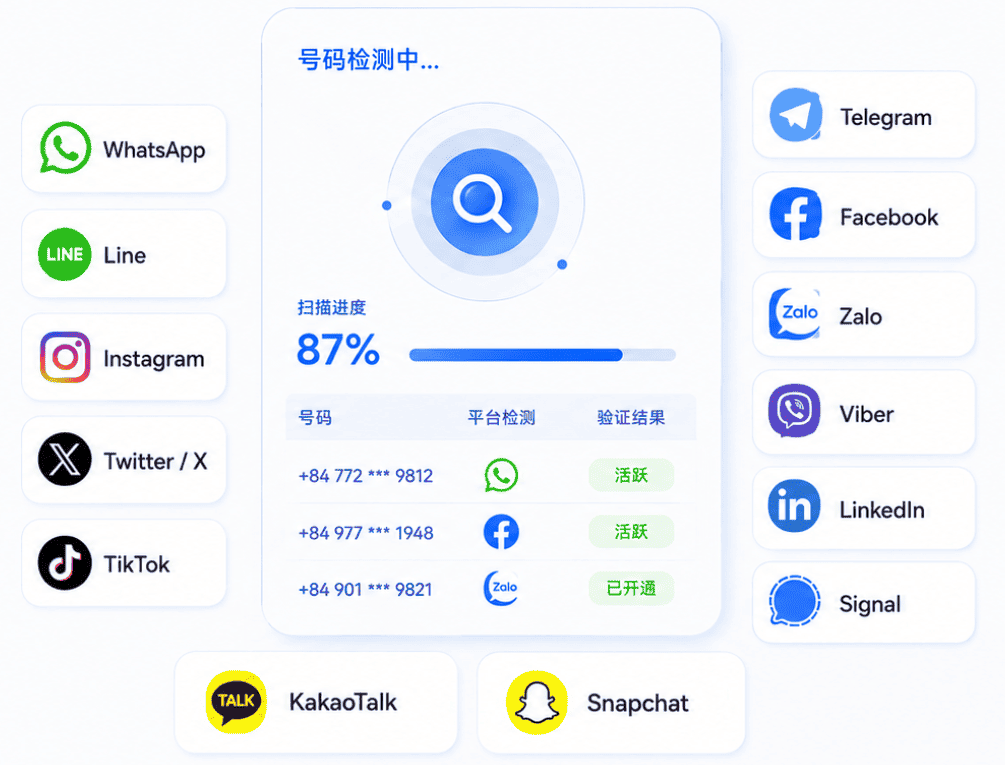
In actual operation, Usage Amman can directly identify account activity during the screening stage and filter out low-active users. With batch testing, screening can be completed in one round of processing, eliminating the need for additional step-by-step operations.
It also supports multi-platform account status identification and can be used in combination with other conditions during the filtering process to make the data closer to the target users.
Reaching the right people first is more important than reaching too many people
In scenarios like WhatsApp, reaching people is not difficult. What is difficult is reaching people who can reply.
When active users are prioritized and screened out, every contact will be more targeted. The data changes from a mixed state to a clearly structured part, making it more stable to use.
Amman is the world's leading number screening platform, providing global customers with batch number screening and testing services covering 236 countries. The platform currently supports more than 40 mainstream social networking and applications, including WhatsApp, Line, Twitter, Facebook, Instagram, LinkedIn, Viber, Zalo, Binance, Signal, etc., adapting to the needs of multiple scenarios.
The main core functions cover multi-dimensional precise screening such as activation, activity, interaction, gender, avatar, age, online, accuracy, empty account, mobile phone device, etc., and can flexibly meet the needs of different users. Its core advantage is to integrate global mainstream social and application resources to provide users with one-stop, real-time and efficient number precision screening services, helping customers achieve global digital layout.
It is a common choice for all professional teams to complete rational screening before actually reaching users.
Editor abcheck has a lot of experience, welcome to communicate with me, click to contact @Tg8189