
When doing foreign trade, SaaS overseas or B2B customer acquisition, email is still the most stable way to reach customers. Compared with private chat on social media, email is more suitable for long-term communication, content undertaking and conversion precipitation. However, in actual implementation, many teams get a batch of email data and send it directly to the group. As a result, it either ends up in the trash or there is almost no reply.
The problem is not the mailbox channel, but whether the data itself is processed. Emails, like numbers, are essentially "reachable tools" and can only have marketing value if the data quality is high enough.
Common sources of US mailbox data
The channels for obtaining email data are relatively mature, and different sources correspond to different quality structures.
- LinkedIn and corporate information collection
Reverse email inference based on position and company information, suitable for B2B scenarios, highly accurate but requires verification
- Historical customer accumulation
From website registration, inquiries, past cooperative customers, the best quality but limited scale
- Data platform or data vendor
It has wide coverage and fast acquisition speed, but needs to focus on cleaning and screening.
- Website scraping and public data
Including corporate official websites, directory websites, and industry directories, suitable for supplementing data
There are no absolute advantages or disadvantages to these sources. The key lies in whether subsequent validity testing and stratification processing are done.
Why does mailbox data need to be tested?
An email address is not like a mobile phone number. Just because the format is correct does not mean it can be used. Uninstrumented data often contains a large number of problems.
Common situations include:
- The email address does not exist or is spelled incorrectly
- The mailbox server cannot receive mail
- Email that has not been used for a long time
- High-risk mailbox (easy to enter the trash)
If you send it directly without testing, it will bring several results:
Low delivery rate affects overall reputation
The bounce rate is high, which affects subsequent sending capabilities.
The response rate is unstable and it is difficult to judge the value of the data
Therefore, mailbox detection must be placed before sending, rather than remediating after sending.
A standard set of mailbox detection procedures
In actual operation, mailbox processing can be broken down into several fixed steps.
- Format check
Filter mailboxes with obvious errors, such as missing @ or abnormal domain names
- Existence detection
Determine whether the mailbox really exists and whether it can receive emails
- Server detection
Determine whether the email server responds normally
- Risk identification
Flag high-risk mailboxes that may affect delivery
Through these steps, the invalid parts in the original data can be eliminated in advance.
Activity and quality judgment are equally important
Email detection is not just about “whether it can be sent”, but also about “whether it’s worth sending”.
Basic judgments can be made from several dimensions:
- Whether it is a corporate email (such as a company domain name)
- Whether it is a commonly used email service (Gmail, Outlook, etc.)
- Whether it matches the target industry
For example, in B2B scenarios, the value of corporate email is usually higher than that of free email because it is closer to real business needs.
It is more stable to use data after stratification
Like numbers, email data also needs to be layered rather than sent uniformly.
It can be simply divided into:
- High quality email
Corporate email + detection passed + matching target industry, priority access
- Medium quality email
The free email or some information is incomplete and is used for testing.
- Low quality email
Risky or unstable mailbox, reduce use
This layered approach allows for a clearer sending strategy rather than blindly mass sending.
Email sending strategy needs to match data quality
The data quality is different, and the sending method also needs to be adjusted.
- high quality data
You can directly send the core content and match it with a personalized opening to improve conversions.
- medium data
Use lighter touch methods, such as resource sharing or industry information
- low quality data
Control sending frequency to avoid affecting overall email reputation
If all data uses the same strategy, it is easy to have unstable effects.
The Importance of Batch Processing and Systematization
When the data scale increases, manual processing of mailboxes is no longer feasible. A more reasonable approach is to establish automated processes.
Can be achieved:
- Data import automatic detection
- Automatically mark valid and invalid mailboxes
- Hierarchical output by tag
- Send in conjunction with email system
In this way, each batch of data has been processed before entering the sending process, instead of being screened later.
How to determine whether mailbox data is available
After filtering, data quality can be judged through several indicators.
- Has the bounce rate dropped significantly?
- Is the email open rate stable?
- Are responses concentrated in high-quality data?
If these indicators gradually stabilize, it means that the data structure is healthy and can be used continuously.
The difference between email data and number data
Compared with WhatsApp or Telegram, email has an obvious feature: feedback is slower but more stable.
Suitable scenarios include:
- B2B sales
- SaaS product promotion
- Long-term transformation projects
Therefore, email data emphasizes “quality + continuous reach” rather than short-term bursts.
Data processing determines the upper limit of email marketing
In email marketing, many teams will continue to optimize titles, content, and sending time, but if the data itself is not processed well, these optimizations will be difficult to produce significant results.
After the mailbox data is inspected and stratified, several changes will occur:
Improved delivery rate
The proportion of garbage bins decreased
Replies are more stable
At this time, optimizing the content has practical significance.
It’s not that email is difficult to create, it’s just that the data is not processed well
In the US market, email is still a very effective way to acquire customers. The key lies in whether the data is used correctly.
When the data changes from "original list" to "structured user pool", sending, follow-up, and conversion will become more controllable. Compared with constantly looking for new data, it is often easier to get stable results by processing existing data well.
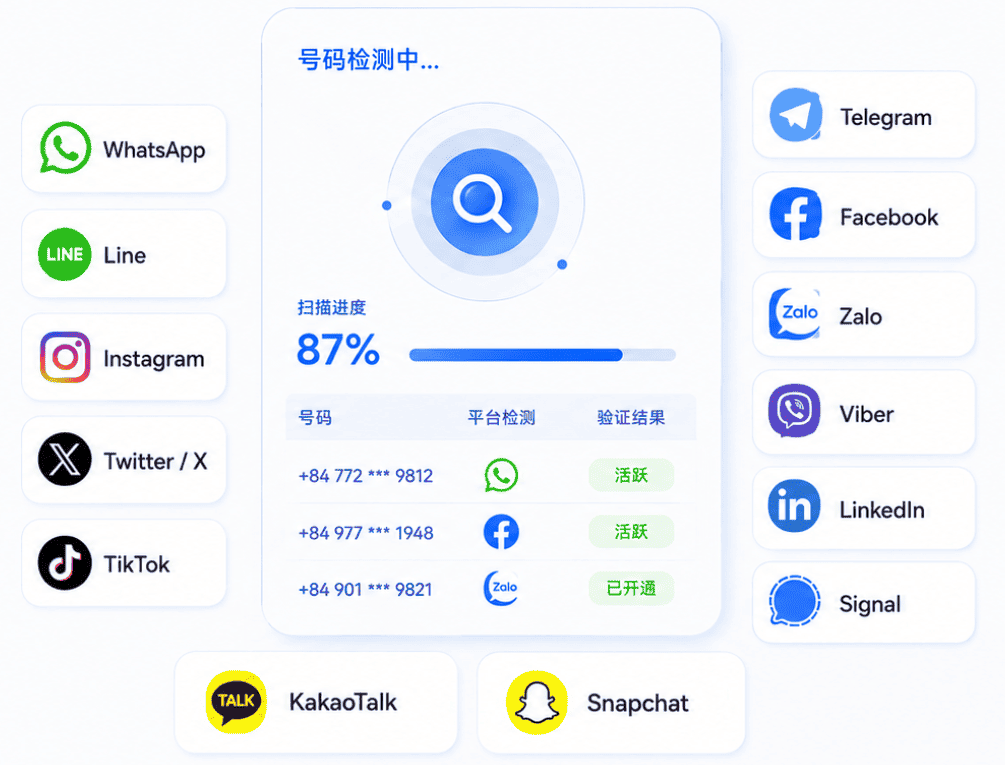
Amman is the world's leading number screening platform, providing global customers with batch number screening and testing services covering 236 countries. The platform currently supports more than 40 mainstream social networking and applications, including WhatsApp, Line, Twitter, Facebook, Instagram, LinkedIn, Viber, Zalo, Binance, Signal, etc., adapting to the needs of multiple scenarios.
The main core functions cover multi-dimensional precise screening such as activation, activity, interaction, gender, avatar, age, online, accuracy, empty account, mobile phone device, etc., and can flexibly meet the needs of different users. Its core advantage is to integrate global mainstream social and application resources to provide users with one-stop, real-time and efficient number precision screening services, helping customers achieve global digital layout.
It is a common choice for all professional teams to complete rational screening before actually reaching users.
Editor abcheck has a lot of experience, welcome to communicate with me, click to contact @Tg8189